
As pet parents, we often leave the television on when we head out to work, hoping the background noise and moving pictures will keep our companion animals entertained. While this trick works beautifully for many dogs and cats, leaving the TV on for a highly sensitive, intelligent bird is an entirely different story.
If you own a parrot—whether it is a tiny Budgie, a cocky Cockatiel, or a brilliant African Grey—you have probably noticed them staring intensely at the screen, tilting their heads, or whistling at the characters.
This begs the fascinating question: Can parrots actually watch TV? How do their advanced avian eyes perceive our television screens, and is it a healthy form of visual stimulation? Let’s dive into the science behind parrots and television.
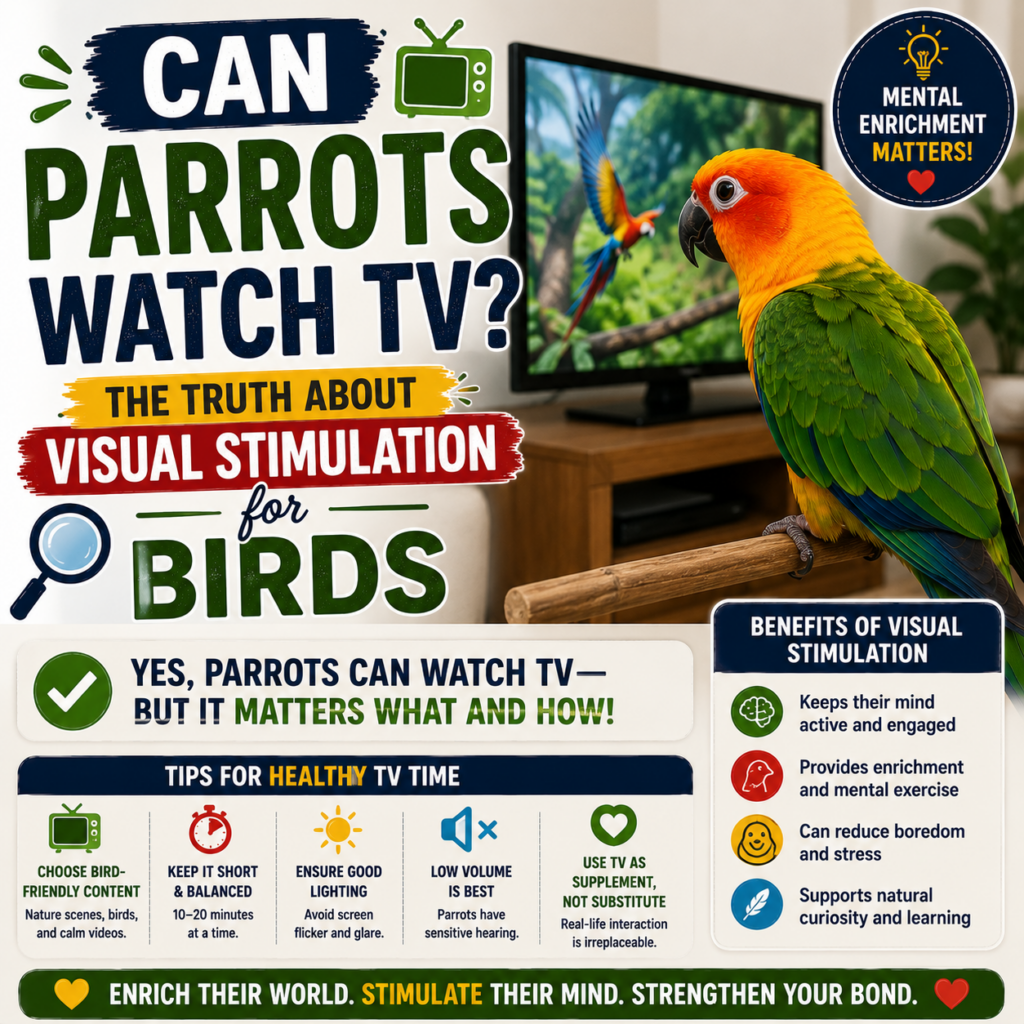
1. The Science of Avian Vision: The “Flicker Fusion Frequency”
To understand what a parrot sees when they look at a modern television screen, we have to look at the physics of avian biology. Humans and birds process visual frames at completely different speeds.
- Human Vision: The human eye has a Flicker Fusion Frequency (FFF) of roughly $60\text{ Hz}$. This means that if a screen displays 60 moving pictures per second, our brains fuse those separate frames together into a smooth, seamless video stream.
- Parrot Vision: Parrots possess some of the most advanced eyes on the planet, with a Flicker Fusion Frequency reaching up to $100\text{ Hz}$ or even $150\text{ Hz}$. Because their eyes process visual data almost twice as fast as ours, a standard television screen does not look smooth to them.
What the TV Looks Like to a Parrot: To your bird, a standard television screen looks like a high-speed, continuous strobe light effect. Instead of a movie, they see a jarring, flickering sequence of flashing images. While some modern $120\text{ Hz}$ or $240\text{ Hz}$ 4K television screens can look smoother to a bird, the rapid frame rate changes and flashing lights can still be highly disorienting.
2. Parrots Can See Invisible Colors on the Screen
Not only do parrots see faster than humans, but they also see an entirely extra dimension of color. Humans possess trichromatic vision (red, green, and blue receptors). Parrots possess tetrachromatic vision, meaning they have a fourth receptor dedicated exclusively to processing Ultraviolet (UV) light.
Because modern televisions are engineered strictly for human eyes, they utilize RGB (Red, Green, Blue) color balancing. When a parrot looks at the screen, the colors can look incredibly unnatural, distorted, or strangely intense compared to the natural outdoor environment they are evolutionarily hardwired to navigate.
3. The Psychological Risks: Fear and Separation Overload
While the physical flashing of a television can be annoying, the actual content broadcasted on the screen presents a real psychological danger for a companion bird.
The Predator Reflex
Parrots are prey animals. In the wild, their survival relies on reacting instantly to shadows moving above them. If you leave a television channel playing a wildlife documentary or a show featuring large flying creatures—such as hawks, eagles, or even drones—your parrot’s hunting-alarm system will trigger. A sudden camera zoom on a flying animal can send your bird into a panic attack, causing them to crash into their cage bars or pluck their feathers out of chronic stress.
The Misleading “Human Flock” Voice
Parrots are highly social flock animals that form intense bonds with voices. Leaving a talk show or a news broadcast running for 8 hours while you are at work can confuse your parrot. They hear human voices speaking continuously, but when they call out to join the conversation, the television characters never reply. This lack of active social engagement can fuel immense frustration, screaming habits, and separation anxiety.
Quick Summary: Is TV Good or Bad for Your Parrot?
| Aspect of Television | What It Feels Like to a Parrot | The Verdict / Action |
| Standard $60\text{ Hz}$ Screen | A stressful, continuous strobe light. | Bad. Upgrade to a high-refresh rate screen or keep them away. |
| Wildlife Shows (Hawks/Predators) | Immediate existential threat. | Dangerous. Avoid leaving predatory imagery running. |
| Children’s Cartoons | High-contrast, bright colors and playful music. | Acceptable in small doses ($1\text{ to }2\text{ hours}$ max). |
| Classical Music Channels | Soothing auditory backdrop without flashing frames. | Excellent. The best choice for leaving a lonely bird at home. |
Better Alternatives for Safe Visual Stimulation
If you want to keep your brilliant parrot mentally occupied while you are busy, ditch the television and try these healthier, avian-approved visual and auditory stimulation alternatives:
- Set Up a Window Perch: Place your parrot’s cage or stand near a window (ensuring it is safely screened and out of direct, harsh sunlight). Watching real trees rustle, wild songbirds fly past, and cars drive by provides natural, real-time $3D$ visual stimulation that matches their advanced brain processing speeds.
- Play Specialized Radio or Music: Instead of leaving the TV running, play a streaming playlist of soft classical music, jazz, acoustic guitar tracks, or natural rainforest sounds. This satisfies their acoustic needs without overloading their sensitive retinas with flashing lights.
- Deploy Foraging Enrichment: The ultimate boredom-buster is physical manipulation, not passive viewing. Provide puzzle toys, wrap their favorite treats in brown paper bags to shred, or hide pellets inside cardboard rolls. Foraging expends massive amounts of mental energy, keeping their minds sharp and peaceful.
Conclusion
Can parrots watch TV? While they can perceive the colors and shapes moving across the screen, the truth is that our televisions are biologically incompatible with their hyper-fast, ultraviolet avian vision. To a parrot, television is often a flickering, confusing strobe experience rather than true entertainment. Keep the TV viewing to an absolute minimum, replace it with soothing classical music playlists, and invest in plenty of physical foraging toys to ensure your intelligent bird stays truly happy, healthy, and mentally balanced!