
If you live with a parrot, you’ve likely had that eerie feeling that your bird knows exactly how you’re feeling. You come home after a bad day, and instead of their usual boisterous chatter, your parrot sits quietly on their perch, softly preening your hair or leaning their head against your cheek.
It begs the question: Can parrots understand human emotions? Are they truly empathetic, or are they simply reacting to the changes in our body language?
Science suggests that parrots possess a level of emotional complexity that rivals many mammals. Here is the truth behind avian emotional intelligence.
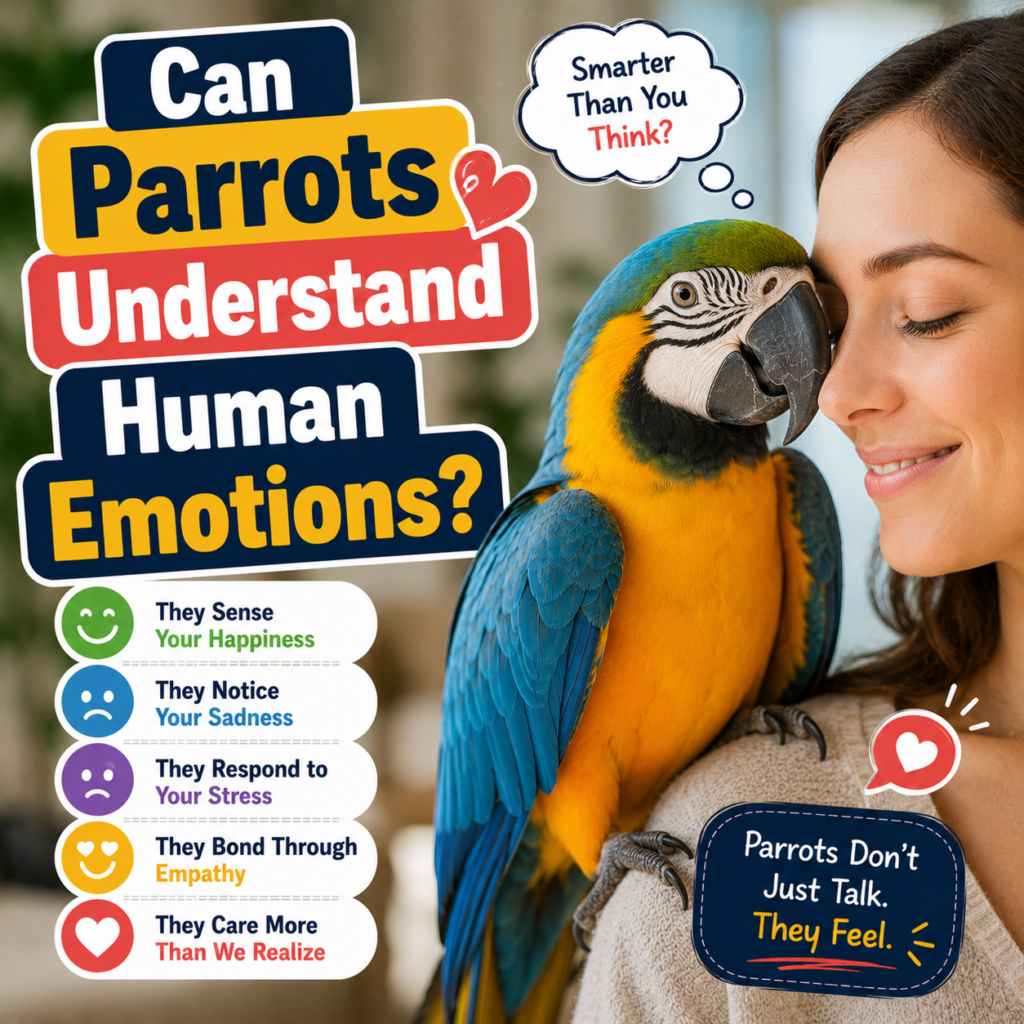
The Science of Avian Empathy
For a long time, the scientific community dismissed avian intelligence as purely instinctual. However, recent studies in cognitive ethology have proven that parrots, especially species like African Greys, Cockatoos, and Macaws, possess highly developed emotional brains.
Parrots are social, flock-oriented animals. In the wild, their survival depends on their ability to read the emotional states of their flock mates. If one bird is fearful, the whole flock needs to be on high alert. This survival instinct has translated into an incredible ability to read human emotional cues, including facial expressions, vocal tones, and even shifting energy levels.
How Parrots Perceive Your Emotions
Parrots don’t just “see” you; they observe you with a level of focus that is often unnerving. They process your feelings through three primary channels:
1. Vocal Cues
Parrots are masters of sound. They don’t just mimic your words; they mimic your inflection. If you speak to them in a high-pitched, excited tone, they get excited. If your voice is low, slow, and somber, they often mirror that energy by becoming quiet. They are listening for the emotional “subtext” of your speech.
2. Body Language and Micro-Expressions
Parrots are highly visual creatures. They are incredibly sensitive to changes in your posture, the way you walk, and your facial expressions. If your shoulders are slumped or you are moving with the tension of stress, your bird notices it immediately.
3. Energy and “State of Mind”
Many parrot owners report that their birds seem to “know” when they are sad, anxious, or angry. Because birds are prey animals in nature, they are hypersensitive to the energy of their environment. When you are feeling agitated, your parrot senses the “vibe” of the room changing, and they often react by becoming agitated themselves.
Signs Your Parrot Is Responding to Your Emotions
| Emotional State | Typical Parrot Response |
| Sadness | They may become unusually calm, sit quietly near you, or offer gentle grooming (preening). |
| Anxiety/Stress | They may become vocal, pace on their perch, or exhibit “flighty” body language. |
| Anger/Agitation | They may pin their eyes (rapidly dilating/constricting pupils) or become more reactive to movements. |
| Happiness | They may dance, whistle, bob their heads, or make happy “chattering” noises. |
Are They Empathic or Just Reactive?
There is a debate in the scientific community: Is it true empathy, or is it emotional contagion?
- Emotional Contagion: This is when a parrot “catches” your emotion. If you are stressed, they feel stressed and act out.
- True Empathy: This is the ability to perceive your state and act in a way to help you.
Many parrot owners believe it is the latter. When a bird gently nips at a tear-streaked cheek or leans into a person who is crying, they are engaging in a pro-social, comforting behavior that serves no other purpose than to soothe the human they are bonded with.
⚠️ The Risk of “Emotional Mirroring”
Because parrots are so good at understanding our emotions, they are also prone to mirroring our negative states. If you are living through a high-stress period, your parrot will likely pick up on that energy, which can lead to stress-induced health issues like feather plucking, screaming, or aggression.
If you are feeling overwhelmed, remember to take a few minutes of “calm” time before interacting with your bird to protect their emotional well-being.
How to Strengthen Your Emotional Bond
If you want to cultivate a deeper, more positive emotional connection with your parrot, try these tips:
- Be Mindful of Your Mood: If you are feeling angry or frustrated, take a moment to breathe before approaching your bird. They will appreciate your calm energy.
- Talk to Them Like a Friend: Narrate your day in a calm, soothing voice. Even if they don’t understand the words, they will understand the emotion behind your tone.
- Positive Reinforcement: When you are happy and playing, reward your bird. They will associate your positive emotional state with good things happening for them, creating a cycle of mutual joy.
The Bottom Line
Yes, parrots can absolutely understand human emotions. They are sophisticated, emotional beings that form profound, lifelong bonds with their humans. They don’t just live in our homes; they live in our emotional worlds, acting as mirrors to our inner lives. When you love a parrot, you aren’t just taking care of a pet—you are forming a partnership with a highly intelligent friend who truly cares how you feel.