
We all want our homes to be places of unburdened joy, laughter, and relaxation. But for a nervous dog, an anxious rescue cat, or a hyper-vigilant exotic bird, a standard household can sometimes feel like a sensory minefield. A sudden knock at the front door, the roar of a thunderstorm, a passing vehicle, or even the rearranging of furniture can cause their nervous system to spin into an immediate fight-or-flight response.
When your animal companion panics, it can leave you feeling completely helpless. How do you help a nervous pet feel safe under your roof?
In companion animal psychology, soothing a fearful animal requires moving past human intuition. We cannot simply look them in the eye and explain that they are secure. Instead, we have to rewrite their environment using their specific sensory dialects. Let’s look at the expert-approved steps to transforming your living space into a low-stress sanctuary.
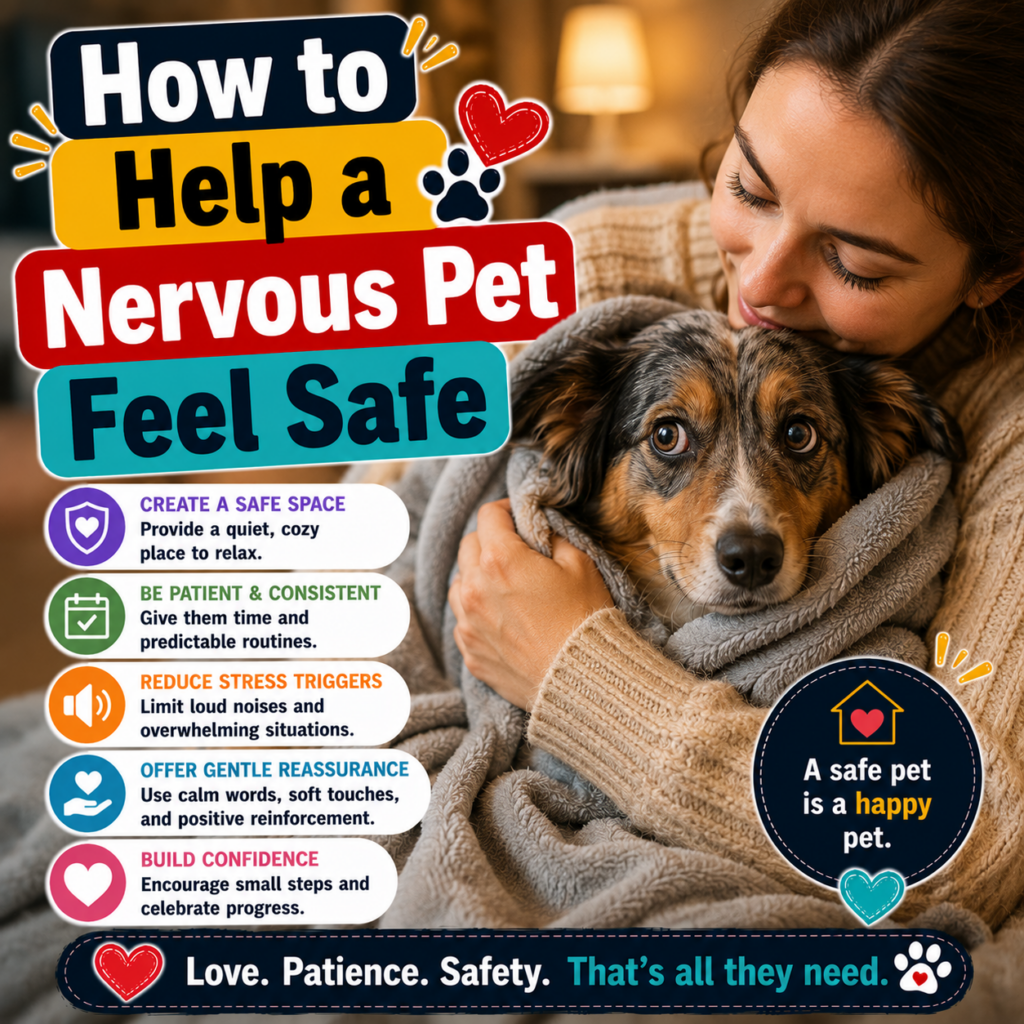
1. Establish Structural Boundaries: The Power of the “Micro-Sanctuary”
When an animal experiences acute fear, their baseline cortisol (the stress hormone) spikes, and their primitive brain craves an immediate escape route. If your home features wide-open spaces with nowhere to hide, a nervous pet’s anxiety will skyrocket because they feel entirely exposed to potential predators.
Your very first step is to provide a dedicated, unviolated hiding zone.
- For Dogs: A sturdy plastic or wire crate covered with a dark, breathable blanket is the ultimate canine den. It eliminates 360-degree environmental exposure, allowing them to monitor the room from a single, safe vantage point.
- For Cats: Set up a cozy cardboard box, a covered igloo bed, or a designated shelf in a quiet wardrobe. Cats map safety through vertical control and enclosed boundaries.
- For Birds (Parrots): Position their enclosure against a solid wall rather than in the center of a room or directly in front of an open window, where passing shadows can trigger their high-alert prey instincts.
The Golden Sanctuary Rule: Never, ever reach your hand into your pet’s designated safe zone to drag them out for a hug, medication, or grooming. If their ultimate hiding spot is violated by a human, their biological anchor erases, leading to severe chronic anxiety.
2. Leverage Scent Anchors: Activating the Biochemical Brake
Animals do not experience a room primarily through its design aesthetic; they experience it through their superpowered noses. A dog’s sense of smell is up to 100,000 times more sensitive than ours, and cats rely heavily on chemical profiles to identify safe territory.
You can easily exploit this sensory trait to lower their baseline duress.
Take an old, unwashed cotton t-shirt or a sweatshirt that you wore over a busy weekend—something heavily saturated with your natural skin cells, oils, and pheromones—and place it directly inside their bed or crate. Your unique scent profile acts like a powerful biochemical security blanket. When your pet curls up against your clothing, it activates the reward centers of their brain, triggering an immediate release of oxytocin (the bonding and comfort hormone) that naturally lowers their heart rate.
At a Glance: Decoding Anxiety Signals Across Species
Before you can effectively comfort your pet, you must accurately read their silent cries for help. Animals broadcast stress long before they resort to vocalizing or hiding.
| Pet Type | Subtle Micro-Anxiety Signals | Major Distress Cues | Best Sensory Intervention |
| Dogs | Yawning when resting, lip-licking, showing the whites of their eyes (whale eye). | Pacing frantically, whining, panting while cool, or trembling. | The Weighted Hug: Introduce a snug-fitting anxiety vest or place a heavily scented human t-shirt in their den. |
| Cats | Pinned-back ears (airplane ears), a low and rhythmically thumping tail, dilated pupils. | Vanishing into dark corners for days, refusing premium wet food, or scratching furniture excessively. | The Safe Room Lock: Limit their real estate to a single, small room with pheromone diffusers. |
| Birds (Parrots) | Heavy panting, wide eyes, pacing along the perch, holding wings slightly away from the body. | Constant screaming, wing-thrashing, or self-destructive feather plucking. | The Canopy Cover: Cover three sides of their enclosure with a breathable cloth; leave a dim nightlight on. |
3. Implement the “Passive Presence” Strategy
When human parents see a pet trembling with fear, our natural evolutionary reflex is to run over, scoop them up, and shower them with high-pitched verbal reassurances like, “It’s okay, it’s okay!”
In animal psychology, this can accidentally make their anxiety significantly worse.
To a nervous dog or cat, a human running directly toward them with wide eyes and intense vocalizations mimics a predatory threat pattern. Furthermore, if you lavish them with frantic attention only when they are panicking, you can accidentally reinforce their hyper-vigilant state.
Instead, use passive presence. Sit quietly on the floor a few feet away from their hiding spot. Do not stare at them. Read a book, scroll on your phone, or speak in a low, monotone, conversational voice. By remaining completely calm, predictable, and physically grounded, you function as a stable emotional buffer, teaching their brain that the surrounding environment is entirely safe.
💡 The Audio Shield: Sound-Masking Therapy
Nervous pets often have highly sensitive auditory processing systems. Sudden ambient noises from outside can cause minor trauma loops in their brain. To combat this, introduce continuous white noise, a running box fan, or classical music designed specifically for animals. Studies demonstrate that slow, rhythmic classical melodies played at a low volume effectively mask outside acoustic spikes, stabilizing the heart rates of anxious shelter animals.
4. The Path of Desensitization: Reward Small Victories
Once your pet has learned that their micro-sanctuary is safe, you can slowly expand their confidence using systematic desensitization and positive reinforcement.
If your pet is terrified of a specific trigger—such as the sound of the vacuum cleaner or the sight of a pet carrier—never force them to confront it head-on. Introduce the object at a massive distance where they can see it but do not panic. The exact second they look at the object without running away, hand them an elite, high-value treat (like a lickable cat puree, a piece of boiled chicken, or a fresh walnut for a parrot).
Over weeks of patient repetition, their brain gently rewrites its neural pathways, replacing their ancient fear reflex with a happy expectation of a premium reward!
The Bottom Line
Helping a nervous pet feel safe isn’t a transformation that happens overnight. It is a patient, deeply rewarding marathon built on a foundation of mutual trust and environmental predictability. By respecting their structural boundaries, leveraging your personal scent anchors, modeling calm parental behavior, and moving at their specific emotional pace, you can easily guide your companion animal out of survival mode. Soon enough, their anxious walls will melt away, leaving you with a beautifully calm, confident, and secure family member under your roof.


