If you have ever placed a small toy mirror inside a birdcage or let your companion parrot wander onto your bathroom counter, you know how spectacular their reaction can be. An African Grey might stretch their neck and stare intensely. A Macaw or Cockatoo might puff their feathers, bob their head rapidly, hiss, or even try to feed the “other” bird trapped behind the glass.
These vibrant, emotional interactions leave many pet parents asking a profound cognitive question: Can parrots recognize themselves in mirrors?
Do they actually look at the reflection and understand their own personal identity like a human child does, or do they truly believe a completely new flock member has suddenly entered their territory? Let’s look into the cutting-edge neuroscience and breakthrough mirror experiments to find out.
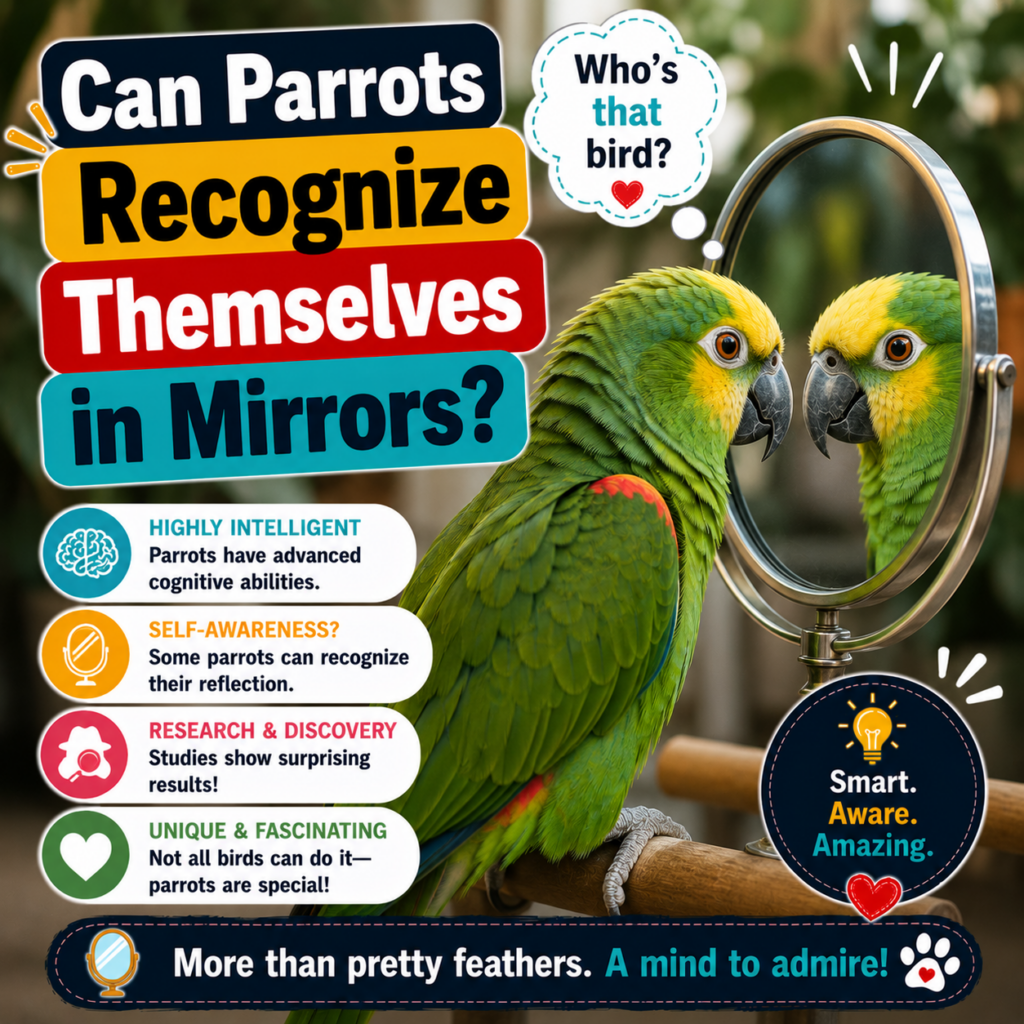
1. The Ultimate Benchmark: The Mirror Self-Recognition (MSR) Test
To determine if an animal possesses an abstract concept of self, cognitive psychologists utilize the Mirror Self-Recognition (MSR) test, originally designed by Gordon Gallup Jr. in 1970.
In this clinical test, a harmless, odorless, brightly colored dot or sticker is placed onto a part of the animal’s body that they can only see by looking into a mirror.
- Failing the Test: If the animal attacks the mirror, courts the reflection, or completely ignores the mark, they treat the reflection as a stranger.
- Passing the Test: If the animal looks in the mirror and immediately uses their own limbs or beak to scratch, touch, or investigate the mark on their own body, it proves they possess true self-awareness.
2. The Avian Champion: The Famous Magpie Study
For decades, scientists confidently asserted that passing the visual mirror test was a luxury exclusive to large-brained mammals like chimpanzees, dolphins, and Asian elephants. Because birds lack a mammalian neocortex, it was assumed they lacked the neural hardware for abstract self-awareness.
That assumption was completely shattered by a landmark study published in PLOS Biology.
Researchers tested Eurasian Magpies (members of the corvid family) by placing bright yellow and pink stickers on their throats. When placed in front of a mirror, the magpies spent significantly more time scratching at the stickers on their own feathers while looking at the glass. This marked the first time a non-mammalian creature successfully passed the mirror test, proving that advanced bird brains can develop a complex sense of self.
At a Glance: How Different Pets Process Mirror Reflections
Not all companion animals decode reflections using the same sensory or cognitive networks.
| Pet Type | Primary Sensory Driver | Do They Pass the Visual Mirror Test? | How They View Their Reflection |
| Parrots | Visual & Auditory | Inconclusive / Species-Specific. Most pass individual behavioral milestones but fail the strict sticker test. | The Social Extension: They frequently treat the reflection as a companion flock mate or a rival. |
| Magpies / Crows | High Visual Logic | Yes. Confirmed to possess true visual self-recognition capabilities. | The Self-Image: They immediately realize the reflection mirrors their own physical body. |
| Dogs & Cats | Olfactory (Smell) | No. Because a mirror carries zero pheromone or scent signatures, it holds no biological meaning. | Environmental Static: They may bark or hiss initially, then completely ignore it as a ghost entity. |
3. The Parrot Paradox: Why Do They Court the Glass?
If magpies can pass the mirror test, what about our highly intelligent companion parrots?
Despite their incredible problem-solving skills, ability to learn human language, and high emotional baseline, most parrot species fail to pass the official, strict Gallup mark test. Instead of using the mirror to groom hidden parts of their body, parrots almost always default to social, flock-oriented behaviors.
The Flock Instinct Takeover
Parrots are intensely social, monogamous prey animals that are genetically hardwired to never be alone in the wild. Isolation triggers massive stress hormones in their brain.
When a parrot looks into a mirror, they see an incredibly vivid, high-definition bird that moves perfectly in sync with them. To an African Grey or Cockatiel, the evolutionary desire for a flock mate completely overrides abstract logic. They choose to treat the reflection as a real, living companion. They will preen the glass, chat with it, dance, and even attempt to regurgitate food to bond with the “mirror bird.”
⚠️ The Hidden Danger of Cage Mirrors
While it looks cute to watch a budgie or lovebird play with a small mirror, avian behaviorists warn that permanent mirrors can cause severe psychological distress. Because the mirror bird mirrors every action but can never touch them, groom them, or talk back, the parrot can become dangerously obsessed. This unrequited social loop often leads to severe behavior issues, including hormonal aggression, territorial cage-guarding, and self-destructive feather plucking.
4. Exceptional Minds: Alex the African Grey
While parrots as a whole group sit in a scientific gray area, individual exceptional birds have shown brilliant flashes of mirror understanding.
The famous Alex the African Grey, trained by Dr. Irene Pepperberg, utilized mirrors to expand his own cognitive mapping. Alex learned to look into a mirror to see parts of his body that were physically invisible to him, such as his under-tail coverts.
In fact, the very first time Alex ever asked the abstract question, “What color?” was while he was looking directly at his own reflection in a mirror. Upon being told his feathers were “gray,” he memorized the word and applied it correctly from that day forward—proving that even if they fail standard human-designed testing, their internal self-concept is beautifully complex.
The Bottom Line
Can parrots recognize themselves in mirrors? Biologically, the consensus remains a fascinating “almost.” While their corvid cousins can pass the official mark test, most parrots intentionally choose to view their reflection through the lens of deep flock genetics. They don’t look at the glass to admire their own self-image; they look at it to find a friend, a companion, and a social anchor in a big, confusing human world. By understanding this sensory preference, you can protect their mental health, limit mirror access, and ensure you remain their ultimate, real-life flock leader!