
If you have ever spent five minutes scrolling through TikTok, Instagram, or Reddit’s massive r/OneOrangeBraincell community, you already know the internet’s ultimate pet consensus: orange cats operate on a completely different psychological wavelength.
We have all witnessed the spectacular, unhinged antics of the ginger feline. One minute, an orange cat is sweet-talking you for head-scratches, and the next, they are trying to bite a running vacuum cleaner, scaling your kitchen window curtains like a rock climber, or sitting inside an empty soup pot staring into a blank wall.
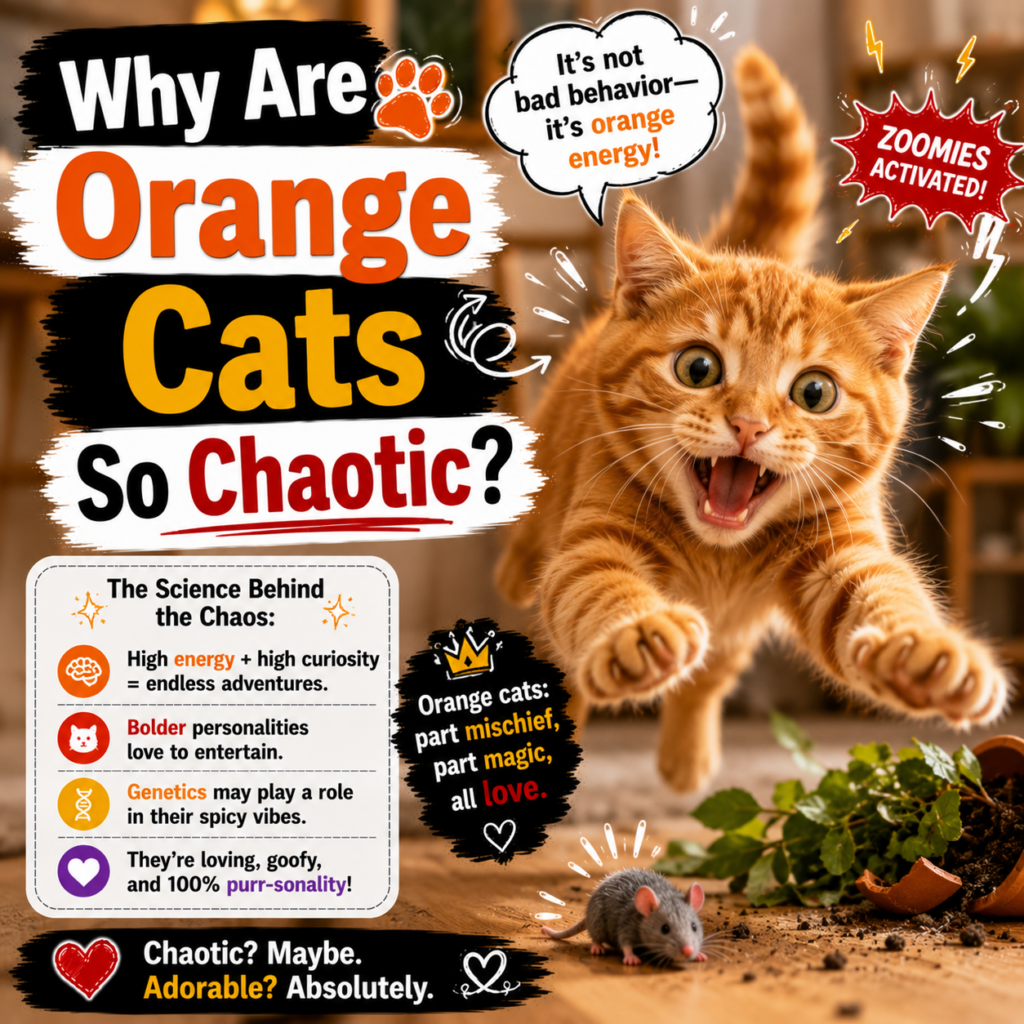
This viral reputation has left millions of cat parents asking a classic behavioral question: Why are orange cats so chaotic?
Is there a genuine genetic link between ginger fur and absolute behavioral madness, or is the famous “orange cat energy” just a massive internet myth driven by human confirmation bias? Let’s look into the cutting-edge science of feline genetics, neurochemistry, and evolutionary history to unlock the truth.
1. The X-Chromosome Equation: The Gender Imbalance of Orange Felines
To decode why orange cats behave like tiny, unpredictable chaos agents, we first have to look at the fascinating genetics of feline coat pigmentation.
The specific genetic code responsible for producing an orange coat is known as the O gene, which dictates the production of pheomelanin (red/orange pigment) over eumelanin (black/brown pigment). This specific modifier sits exclusively on the X chromosome.
Because of this genetic layout, roughly 80% of all orange tabby cats are male.
In mammalian behavioral psychology, male cats naturally display higher baseline frequencies of bold exploration, high-risk curiosity, territorial boundary patrols, and attention-seeking play loops compared to female felines. Therefore, when people claim that orange cats are incredibly chaotic, what they are often tracking is simply high-octane male cat energy amplified across an entire population!
2. The Melanin-Melanocyte Link: fur Color vs. Brain Neurochemistry
Is it possible that the physical chemical pathway that turns a cat’s fur orange also rewires their internal brain chemistry? Feline neurobiologists are currently looking at a fascinating concept known as the Melanocyte Hypothesis.
In embryonic development, both a cat’s skin pigment cells (melanocytes) and their primary central nervous system tracks develop from the exact same cellular blueprint: the neural crest.
Because skin pigments and brain neurons share this foundational evolutionary link, variations in pigmentation genes can directly spill over into a mammal’s behavior.
In wild animal species, mutations that cause lighter or redder coats are frequently linked to distinct alterations in the adrenal gland development, leading to a natural rise in boldness, a lower tolerance for sensory overstimulation, and a massive curiosity index. Your ginger shadow isn’t trying to ruin your home decor on purpose; their primitive neural crest programming simply wired them to be fearless, high-speed explorers!
At a Glance: Decoding the Orange Cat “Chaos” Profiles
While their antics look completely random, orange cat behavior can be cataloged into distinct, recognizable sensory and territorial patterns.
| The Chaotic Manifestation | What It Looks Like | The Root Science / Catalyst | What Your Orange Cat Is Secretly Saying |
| The 3:00 AM Wall Sprint | Launching off your head, tearing down halls, chasing invisible entities. | Crepuscular Energy Release: High-octane hunting drives firing at peak ancestral hours. | “The room range is electric! I must test the mechanical boundaries of this wall right now!” |
| The Fearless Appliance Audit | Stepping directly onto open dishwashers, inspecting running vacuums, climbing inside bags. | Low Neophobia Baseline: An evolutionary lack of fear toward novel environmental changes. | “This spinning object looks highly suspicious. Let me swat it to verify its threat level.” |
| The Demanding Lap Takeover | Violently head-butting your laptop, screaming for food, knocking over items. | Operant Conditioning Mastery: High social intelligence mapping human reaction loops. | “You are ignoring my facial pheromone flags. I will now knock over this ceramic cup to adjust your focus!” |
3. The Psychology of the Internet Meme: Human Confirmation Bias
While genetics and embryology confirm that orange cats lean heavily male and display high boldness metrics, behavioral psychologists note that a major component of the “orange chaos” theory comes down to human pattern-recognition software.
Once the internet collectively crowned orange cats as the “lovable dummies who share a single braincell,” our human brains developed an intense confirmation bias:
- When a black or grey cat knocks a glass off a kitchen table, you pass it off as normal feline behavior.
- When an orange cat knocks a glass off a kitchen table, your brain immediately screams, “Aha! Classic orange cat chaos! The braincell has departed!”
This cultural loop has turned orange felines into the undisputed comic actors of the domestic animal kingdom. Because humans expect ginger cats to be quirky and outgoing, we actively encourage their eccentric routines with positive reinforcement—laughing at their zoomies, recording their clumsy leaps, and rewarding their bold attention-seeking loops with high-value treats.
💡 The Emotional Paradox: The Friendliest Chaos Agents
Despite their chaotic, unhinged reputation, veterinary lifestyle surveys frequently document a beautiful paradox: orange tabby cats are systematically rated by owners and clinicians as the most affectionate, friendly, and attached felines. Their high boldness doesn’t just manifest as destructive zoomies; it also translates into an absolute lack of fear when bonding with humans. An orange cat is significantly more likely to approach a new guest, climb straight onto a stranger’s chest for a heavy purr session, and demand intense, full-body allorubbing than more reserved coat profiles.
The Bottom Line
Are orange cats truly more chaotic than their black, white, or calico housemates? Science says yes—but with a brilliant, logical twist. Driven by an 80% male gender imbalance that favors high-energy play, an evolutionary embryonic link that twins fur pigmentation with a bold nervous system, and a delightful loop of human positive reinforcement that celebrates their eccentricities, ginger felines are beautifully engineered to keep life unpredictable. Treat their wild, unhinged antics with the profound love, safety rugs, and complex mental enrichment they deserve—after all, a little bit of orange chaos is a very small price to pay for a bond that fills your home range with endless laughter, absolute trust, and pure joy!