
If you share your home with a highly intelligent exotic pet bird like an African Grey, an Amazon, a Macaw, or a Cockatoo, you know they are anything but low-maintenance apartment decorations. They dance to music, mimic your laughter, and call your actual name when you step away.
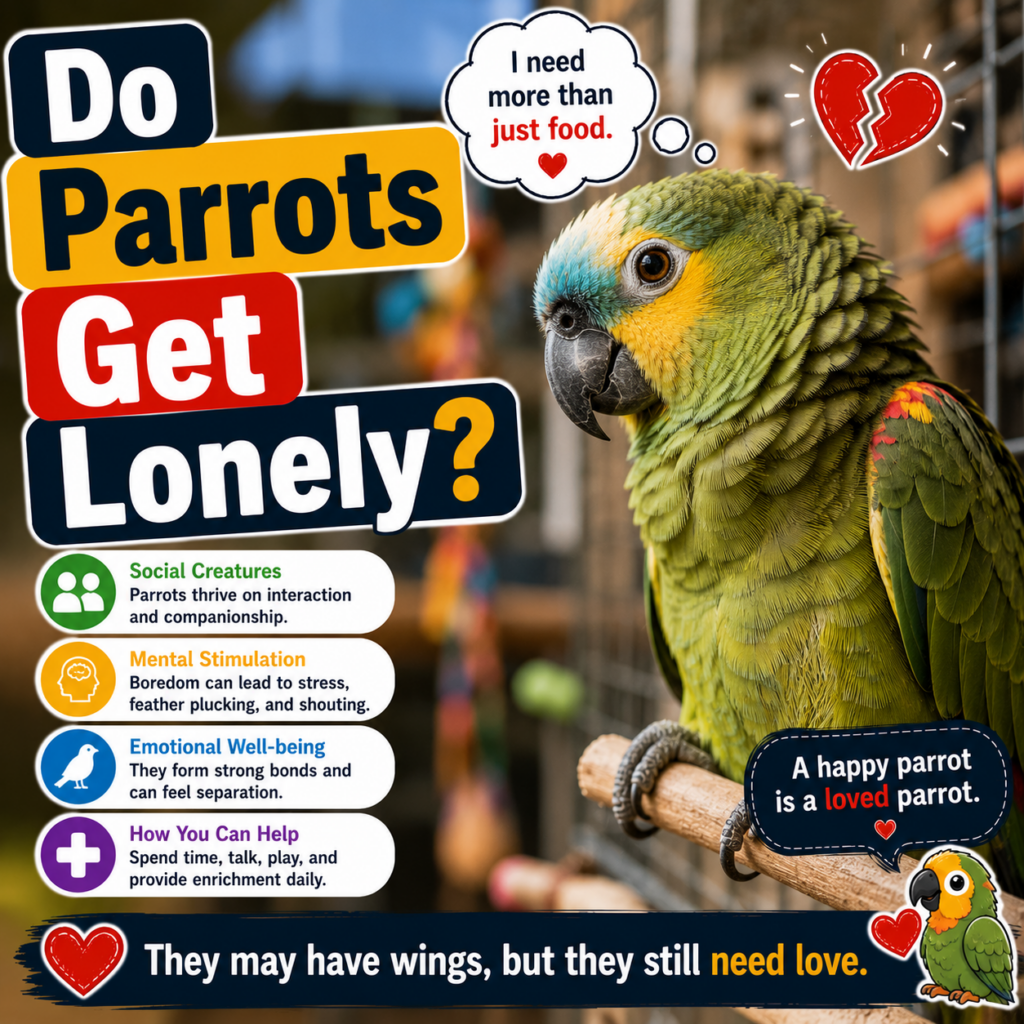
But when the house goes completely quiet, you head off to your 9-to-5 job, or you get caught up in a busy week, an important question often looms over any bird owner’s head: Do parrots get lonely?
Do they simply take a peaceful nap while you are gone, or do their highly evolved brains suffer when left in isolation? Let’s dive into the fascinating world of evolutionary biology and avian psychology to discover the truth about parrot loneliness and how to protect their mental health.
1. The Evolutionary Blueprint: Born to Be in a Flock
To understand a parrot’s emotional baseline, we have to look at how they are hardwired to survive in the wild. Unlike domestic dogs and cats, which have undergone thousands of years of genetic modification to adapt to human households, parrots are biologically wild animals.
In their natural jungle or savannah habitats, a parrot is never truly alone.
They live in complex, hyper-social flocks that can number from dozens to hundreds of birds. They forage for fresh fruits together, preen each other’s hard-to-reach feathers to bond (allopreening), and use unique vocal signatures to map out coordinates. For a parrot, isolation in nature means one of two things: they have been abandoned by the flock, or a predator is nearby. Therefore, loneliness isn’t just a sad feeling for a parrot—it triggers a primal survival panic.
2. The Cognitive Burden of High Intelligence
Parrots possess an extraordinary ratio of brain-to-body mass that rivals that of chimpanzees, dolphins, and even human toddlers. They are capable of advanced logic, emotional processing, and long-term memory tracking.
However, high intelligence is a double-edged sword.
When a creature with a toddler-like intellect is placed inside a cage for 8 to 10 hours a day with nothing to look at but empty walls, their brain doesn’t just rest; it actively deconstructs. Chronic boredom combined with social loneliness causes their cortisol (stress hormone) levels to skyrocket. Without an outlet for this mental energy, they will begin to direct that stress inward.
At a Glance: Behavioral Signs of a Lonely Parrot
When an exotic bird feels isolated and lonely, they broadcast their emotional distress through distinct behavioral warning signs.
| Behavioral Symptom | What It Looks Like | The Root Psychological Trigger |
| Feather Plucking & Self-Harm | Chewing on, pulling out, or stripping feathers from their chest, back, or wings. | Chronic anxiety, boredom, and a lack of tactile grooming stimulation. |
| Chronic Screaming / Shreiking | Piercing, non-stop vocal outbursts that last for hours, especially when you leave. | An amplified, desperate flock call trying to force you back into their sight. |
| Stereotypic Pacing | Repetitively swaying side-to-side or flipping their head in a continuous loop on the perch. | Cognitive stagnation; their brain is desperate for real-time mental enrichment. |
| Aggressive Outbursts | Lunging, biting, screaming, or flaring their wings when you try to approach their cage. | Emotional frustration or a defense mechanism born from a lack of trust. |
💡 The Reality of Monogamous Attachment
Many large parrot species form strict, lifelong monogamous pairs. In a human home, your bird will often select one family member to be their chosen life partner. If that preferred human suddenly stops interacting with them or leaves for an extended vacation, the parrot doesn’t just feel lonely—they experience genuine psychological grief and mourning, which can cause them to reject food or pluck their feathers overnight.
How to Prevent and Cure Avian Loneliness
You don’t necessarily have to quit your job to keep a parrot happy. You can dramatically lower their stress levels and fulfill their social needs by restructuring their environment:
- Implement “Passive Companion” Environments: Never leave your parrot’s cage in an isolated back bedroom. Place their sanctuary corner in the heart of the home, like the living room or a busy home office. Even if you aren’t actively petting them, simply being in their line of sight while you work or watch TV satisfies their need for flock proximity.
- Upgrade to Mechanical and Digital Enrichment: When you leave the house, turn on a television showing animal documentaries, or play a playlist of soft music or ambient jungle sounds. This tricks their auditory system into believing the territory is safely occupied.
- Ditch the Food Bowls (Use Foraging Puzzles): In the wild, parrots spend 70% of their day hunting and working for food. Stop serving their meals easily in a plastic dish. Use cardboard boxes, wooden blocks, or puzzle feeders that force them to chew, shred, and solve problems to get their walnuts. This healthy burnout replicates wild energy consumption.
- The 15-Minute Rule of Dedicated Interaction: Dedicate a specific 15-minute block every evening—untouched by your phone or distractions—to direct bonding. Train a new trick, practice vocal mimicry, or offer gentle head scratches. This sequential predictability lets them know that their primary flock member will always return to them.
The Bottom Line
Yes, parrots get incredibly lonely. Their deep emotional capacity and ancient flock genetics mean that companionship is a basic biological requirement, not a luxury. By transforming your home into a stimulating, predictable sanctuary and recognizing their subtle body language cues, you can easily protect your feathered companion from the dangers of isolation. Give them the time, respect, and cognitive stimulation they deserve, and they will happily remain your most loyal, affectionate, and thriving lifelong flock mate!