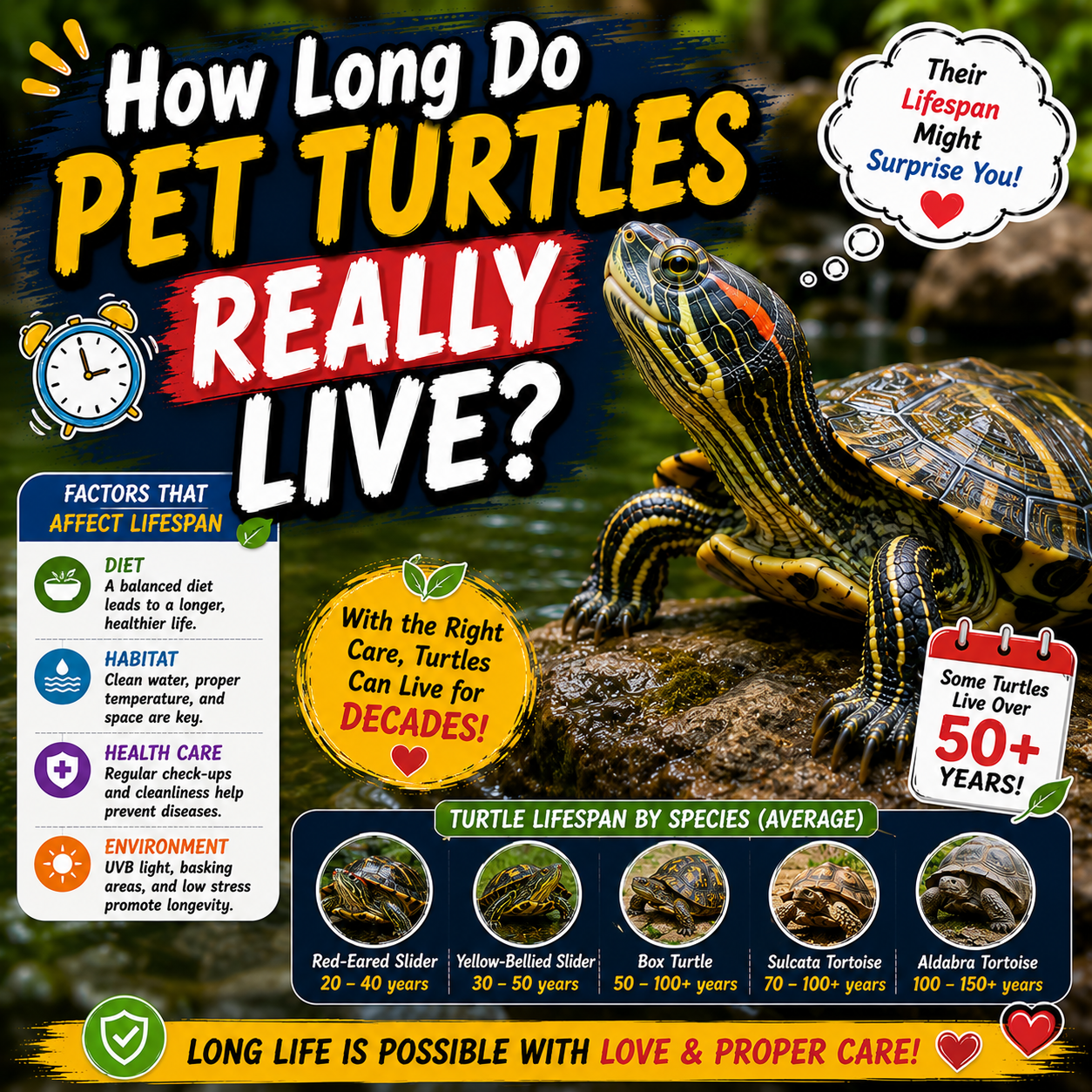
If you are thinking about bringing a pet turtle home, or if you’ve recently bought a tiny, coin-sized hatchling from a pet store, you are likely wondering: How long do pet turtles really live?
We’ve all heard legendary stories of ancient giant tortoises living for well over a century. While most common pet turtle species won’t outlive a giant tortoise, they still possess an extraordinary lifespan compared to other household pets like dogs, cats, or hamsters.
In fact, purchasing a pet turtle isn’t just taking on a temporary hobby—it is often a lifelong commitment. Let’s break down the realistic lifespan expectations by species, look at the biological reasons behind their longevity, and learn how to help your turtle reach its maximum golden years.
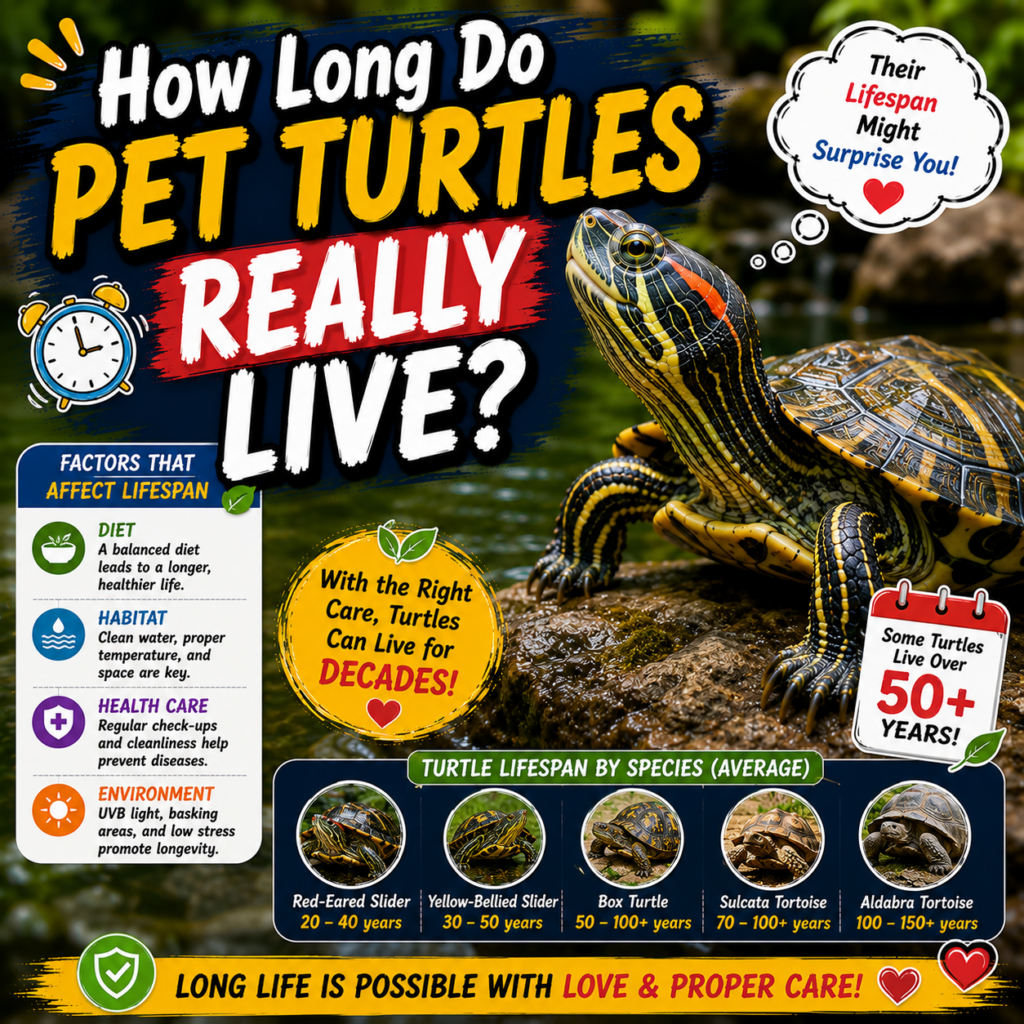
The General Lifespan Matrix by Popular Species
The word “turtle” covers a massive family of reptiles, each with its own distinct biological clock. On average, a properly cared-for aquatic or semi-aquatic pet turtle will live between 20 to 50 years.
Here is what you can realistically expect based on the most popular pet turtle species:
1. Red-Eared Sliders: 20 to 40 Years
The absolute most common aquatic pet turtle in the world. While many die prematurely due to poor beginner husbandry, a Red-Eared Slider kept in a large tank with proper filtration and UVB lighting will easily cruise past its 30th birthday.
2. Box Turtles: 30 to 50+ Years
Whether it’s an Eastern Box Turtle or a Three-Toed Box Turtle, these terrestrial companions are incredibly long-lived. In optimal outdoor setups that mimic their natural forest floors, it is not uncommon for a box turtle to live for 50 to 70 years, occasionally outliving their original owners.
3. Painted Turtles: 20 to 30 Years
Famous for their gorgeous, brightly colored under-shells, these aquatic turtles are slightly smaller than sliders but boast a highly robust immune system, comfortably living for two to three decades in a well-calibrated habitat.
4. Musk and Mud Turtles: 30 to 50 Years
If you prefer a smaller turtle species that maxes out around 4 to 5 inches, Musk or Mud turtles are fantastic options. Don’t let their small size fool you—their compact bodies are built to last up to half a century.
At-A-Glance Lifespan Comparison Table
| Turtle Species | Average Captive Lifespan | Adult Physical Size | Minimum Tank/Enclosure Volume |
| Red-Eared Slider | 20 – 40 Years | 8 – 12 Inches | 80 – 120 Gallons |
| Painted Turtle | 20 – 30 Years | 5 – 8 Inches | 50 – 80 Gallons |
| Box Turtle | 30 – 50+ Years | 5 – 7 Inches | Large outdoor pen / 4x2ft enclosure |
| Musk / Mud Turtle | 30 – 50 Years | 3 – 5 Inches | 30 – 50 Gallons |
Why Do Turtles Live So Exceptionally Long?
The secret behind a turtle’s extreme longevity lies deep within its evolutionary biology. Turtles possess a remarkably slow metabolic rate.
Unlike warm-blooded mammals that burn energy continuously to maintain a steady internal body temperature, cold-blooded turtles rely on the external environment. Because their organs, heart rate, and metabolic pathways run at a slow, highly efficient pace, their cellular aging process is drastically delayed.
Furthermore, their tough bone-and-cartilage shell acts as a brilliant evolutionary shield, protecting their vital internal organs from physical stress and environmental wear-and-tear over the decades.
4 Critical Factors That Direct Your Turtle’s Lifespan
In captivity, a turtle cannot choose its environment. If your turtle is going to reach its maximum age potential, you must perfectly manage these four environmental variables:
1. Unblocked UVB Lighting (The Calcium Key)
Without a high-quality reptile UVB bulb, a turtle cannot synthesize Vitamin D3, which is critical for absorbing calcium from its food. Missing or expired lighting leads to Metabolic Bone Disease (MBD), a painful and fatal condition that deforms their shell and shuts down internal organs early in life.
- Remember: Replace your UVB bulbs every 6 to 12 months, even if they are still shining visible light!
2. Powerful Water Filtration and Dilution
Turtles are messy animals that produce heavy organic waste loads. To prevent eye, skin, and shell infections (like shell rot), invest in an external canister filter rated for two to three times the actual volume of your aquarium. Additionally, adhere to a strict 25% partial water change every single week.
3. Balanced, Vitamin-Rich Nutrition
Do not feed your turtle exclusively commercial pellets. As they mature into adults, their diet must transition heavily into fresh greens. Ensure your adult turtle gets plenty of dandelion greens, romaine lettuce, and shredded carrots (for Vitamin A) to protect their respiratory system and keep their organs thriving.
4. Stress Reduction (Space to Swim and Roam)
Cramming a large adult turtle into a small 20-gallon tank induces chronic physical stress, which directly weakens their immune system. Always provide ample space using the standard metric:
$$\text{Required Water Volume} = 10\text{ Gallons per 1 Inch of Shell Length}$$
Conclusion: A Beautiful, Generational Bond
At the end of the day, a pet turtle isn’t a short-term commitment like a hamster or a goldfish. When you commit to a turtle, you are welcoming a companion that will accompany you through multiple life milestones—from college graduations to career changes, and potentially even retirement.
By setting up a spacious tank, checking your water parameters rigidly, maintaining an unblocked UVB lighting system, and expanding their vegetable menu, you will ensure your ancient, shelled friend lives a long, healthy, and breathtakingly vibrant life right by your side!