If you share your life with an exotic pet bird—whether it’s a tiny, spirited Budgie, a charming Cockatiel, an elite intellectual African Grey, or a magnificent, colorful Macaw—you know that avian behavior is a non-stop theatrical production. Birds are dynamic, expressive creatures that communicate using a complex, non-verbal dialect of feathers, eyes, and vocalizations.
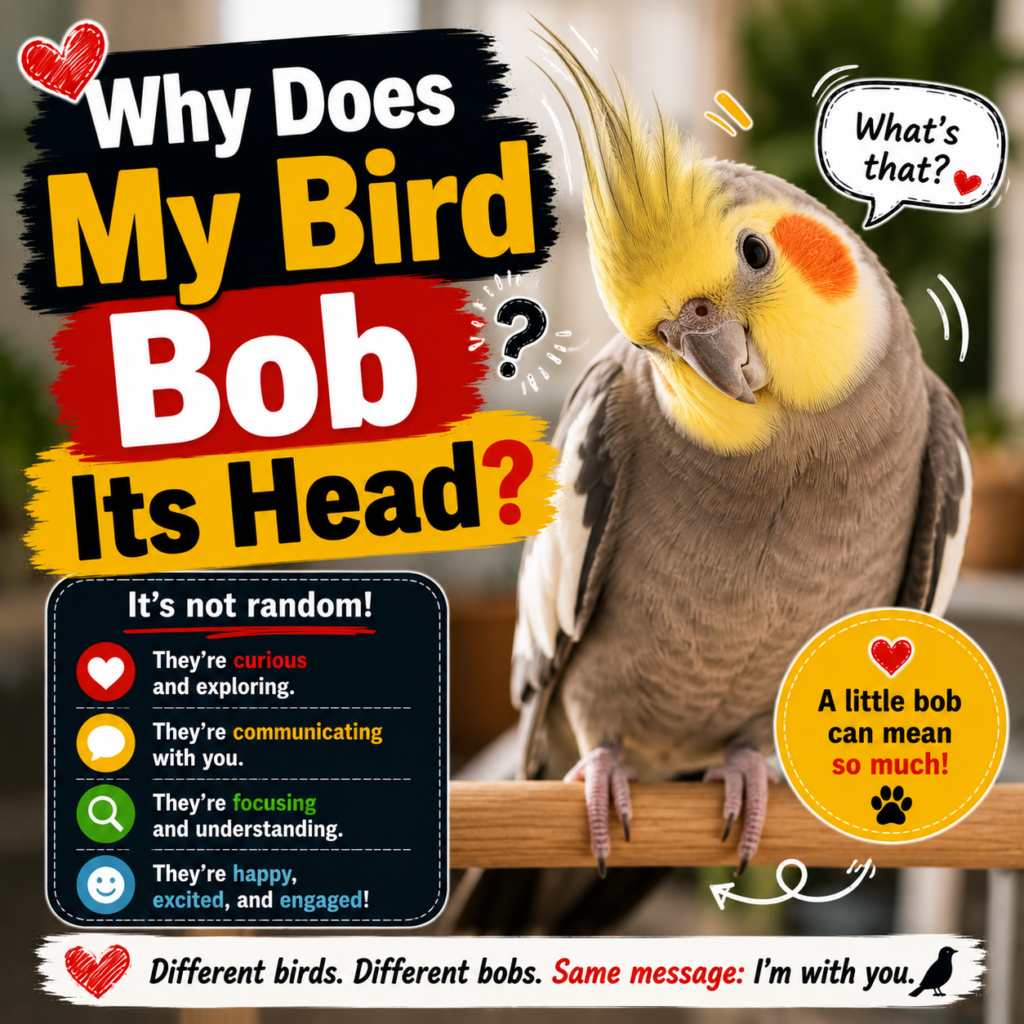
Among these behaviors, one of the most common, mesmerizing, and comically animated actions is head-bobbing. Your bird stands on their perch, locks their eyes on you, and starts moving their head rapidly up and down like a rock star at a concert.
It is an incredibly endearing sight that instantly makes you smile. But as you watch their rhythmic dancing, you might find yourself asking an important behavioral question: Why does my bird bob its head?
Is it a sign of pure joy, a physical tool for visual mapping, a demand for high-value treats, or a hormonal display? Let’s look into the cutting-edge science of avian neurobiology and behavior to decode the true meaning behind your bird’s favorite dance moves.
1. Depth Perception and Spatial Mapping: The Avian Visual Engine
To understand why a bird bobs their head, we first have to look past our human worldview and step directly into avian optical anatomy.
Humans have eyes positioned on the front of our faces, providing us with a large field of binocular vision and excellent native depth perception. Most birds, however, are prey animals with eyes positioned laterally on the sides of their skulls. This layout gives them a massive, life-saving 300-degree field of vision to scan the range for predators, but it leaves them with very poor depth perception when looking at a static object right in front of them.
When your bird bobs their head up and down or tilts it sharply to one side while inspecting a new toy, a fresh foraging puzzle box, or a new person entering the household range, they are performing an advanced spatial audit.
By changing the vertical and horizontal position of their eyes rapidly, their dense nidopallium brain structures can stitch together multiple visual frames to calculate the exact distance, size, and safety parameters of an object!
2. Pure Joy and Overwhelming Excitement (The Happy Dance)
Beyond the raw science of optics, head-bobbing is the ultimate, universal avian exclamation point for high-value emotional stimulation.
Parrots and corvids are intensely social, empathetic flock animals that experience an energetic baseline of emotions. When you walk into the room after a long work deadline, unwrap a premium slice of walnut, or play an upbeat, rhythmic song, your bird’s internal reward pathways light up, triggering a massive release of feel-good dopamine.
Because birds are highly kinetic creatures, they cannot easily hide their excitement. A rhythmic, bouncy head-bob combined with slightly lifted wings, a wagging tail, or joyful vocal chirping is a clear declaration of psychological safety and bliss. Your bird is proudly telling the entire family flock, “I love this moment, I feel safe, and I am completely happy under your protection!”
At a Glance: Translating Your Bird’s Head-Bobbing Habits
To accurately interpret what your feathered companion is trying to broadcast, you must look at the exact velocity of the bobbing and analyze the surrounding body language clues.
| Head-Bobbing Style | Accompanying Avian Body Language | The Underlying Catalyst | What It Means in Bird Language |
| The Rhythmic Dance | Dilated eyes, relaxed feathers, clicking beak, whistling, or mimicking catchphrases. | Pure Excitement & Social Bonding: Celebrating a reward or your presence. | “The ambient energy is amazing! I am mirroring your happy baseline, human flock mate.” |
| The Intensive Focus | Neck stretched far forward, eyes pinned (pupil pinning), body completely stationary. | Visual Depth Perception & Tracking: Mapping out a target coordinates before taking flight. | “I am calculating the physical distance to that landing zone or checking out this unfamiliar item.” |
| The Low-Body Pump | Croaking or whining vocalizations, drooping wings, clicking tongue, soliciting touch. | Hormonal / Courting Display: Viewing the human handler as a monogamous mate. | Requires a Boundary Adjustment: “I am choosing you as my exclusive nest partner.” |
| The Frantic Weave / Sway | Pacing back and forth along the cage bars, vocal screaming, feather plucking. | Stereotypic Stress / Cognitive Boredom: Trapped in a high-cortisol anxiety loop. | Requires Immediate Enrichment: “My brain is starving for stimulation. I am completely frustrated.” |
3. The Maternal Blueprint: Nestling Begging Cues
If you are caring for a hand-reared baby bird or a newly weaned juvenile chick, you will notice that their head-bobbing routine is incredibly frantic, low to the ground, and accompanied by persistent, high-pitched whines or clicking sounds.
In the wild architecture of avian husbandry, this specific movement is a hardwired survival trigger known as the begging reflex.
In the nest territory, baby birds rapidly pump their heads up and down whenever a parent bird arrives with fresh foraging resources. This mechanical movement aligns their beak correctly with the parent’s mouth and triggers an involuntary feeding reflex.
When a young companion bird bobs their head at you while keeping their body crouched, they are reverting to their infant memory banks. They view you as their primary parent protector and caretaker, using their ancestral dialect to scream, “You are my safety blanket! Please feed me high-value treats or comfort my nesting instincts right now.”
⚠️ When Head-Bobbing Signals Hormonal Aggression or Stress
While 90% of head-bobbing is completely healthy and joyful, avian behaviorists warn pet parents to watch out for the hormonal takeover. When a bird enters reproductive maturity, they can start using low, slow head-bobs paired with trailing wings and a fanned tail to court their human handler. Allowing this behavior to continue by petting your bird anywhere other than their head can cause intense territorial cage-guarding, chronic anxiety, and hormonal frustration. If the bobbing looks stiff and angry, step back—it means, “I am guarding this boundary, back off!”
How to Correctly Respond to Your Bird’s Dancing Energy
To fast-track your bond and keep your companion bird’s mental health completely balanced, adjust your social feedback loop using these science-backed animal psychology tips:
- Mirror Their Joyous Baseline: When your bird looks at you and starts bobbing rhythmically out of excitement, dance back! Bob your head gently, smile, use an enthusiastic, high-pitched vocal frequency, and offer a favorite treat. This cooperative interaction activates their social mirror neurons, hardwiring an unshakable sense of trust between you.
- Introduce Foraging Puzzles: If your bird’s head-bobbing shifts into frantic, repetitive swaying or side-to-side pacing, their brilliant brain is starving for cognitive stimulation. Break their boredom loop immediately by introducing shredded paper boxes, hidden seed puzzles, and fresh branches to chew on.
- Respect Their Optical Tracking Space: If you see your bird stretching their neck and bobbing slowly while analyzing a new object, do not move the item suddenly or force it into their personal cage space. Allow them the time they need to complete their 3D optical audit so they can conclude on their own that the environment is completely safe.
The Bottom Line
When your favorite feathered shadow starts bobbing their head like a joyful little pendulum, science shows you are witnessing a magnificent display of avian intelligence and emotion. Driven by an evolutionary need to calculate environmental physics with a lateral visual engine, a primal desire to connect with their family flock, and a neurochemical rush of pure dopamine, their dance is a beautiful monument to your bond. Treat their expressive communication with the profound patience and mental enrichment it deserves—it is just another wonderful daily reminder that you are the absolute center of their vibrant, intelligent world!