
It is a scenario every remote worker and student knows all too well: you are in the middle of typing an important email, finishing an assignment, or attending a virtual meeting, and suddenly, your cat walks across the room, steps over your hands, and plops themselves down directly onto your keyboard.
They look up at you with complete innocence, perhaps letting out a soft purr, completely unbothered by the fact that they just sent a string of random characters like “jjjjjjjhhhhh” to your boss.
It leaves many frustrated yet charmed pet parents wondering: Why does my cat sit on my laptop?
Are they intentionally trying to disrupt your workflow, or is there a deeper biological and psychological reason behind this workspace takeover? Let’s dive into the fascinating world of feline psychology to find out.
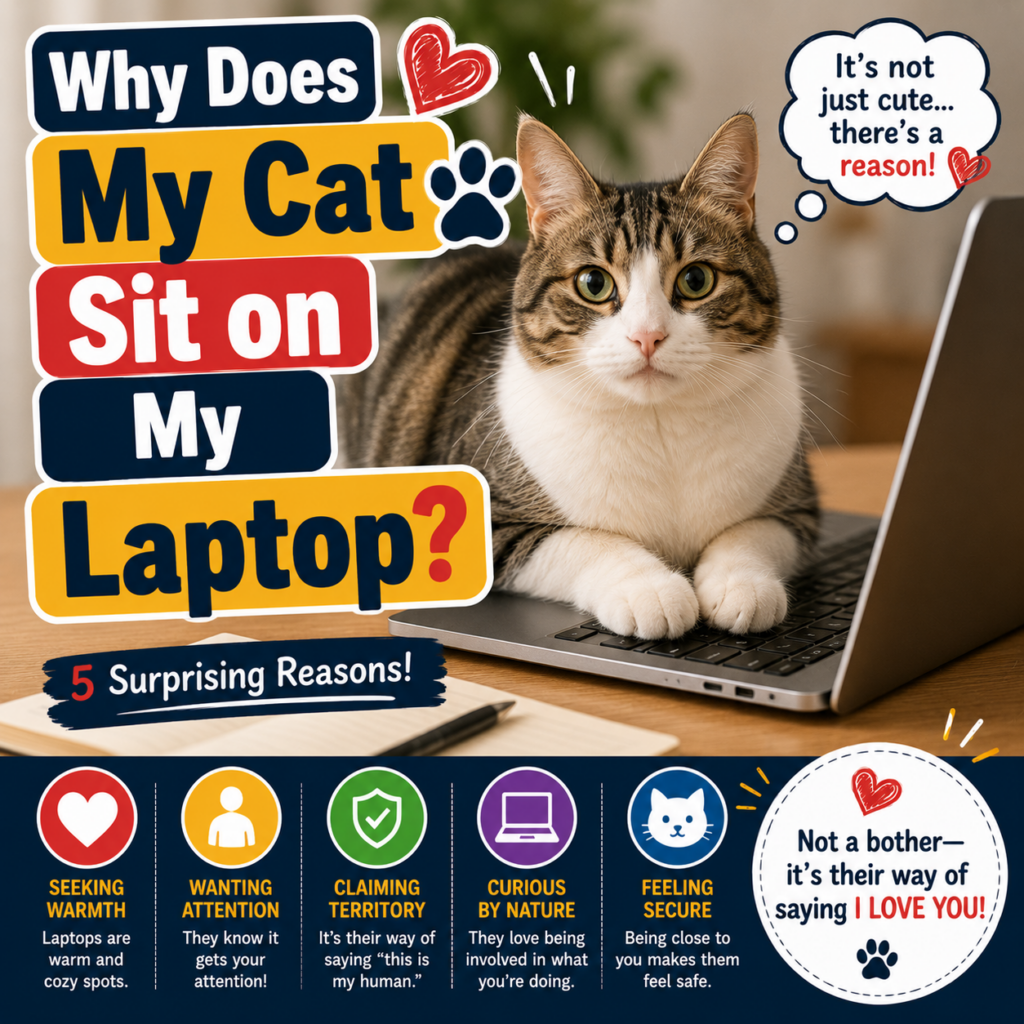
1. Seeking Maximum Warmth (The Heat-Seekers)
The simplest explanation for this behavior is rooted in basic feline biology. Cats are natural heat-seekers. A cat’s normal body temperature sits around 101°F to 102.5°F (38.3°C to 39.2°C), which is significantly higher than a human’s baseline temperature.
Because of this, cats require extra energy to maintain their internal body heat. Your laptop—especially when the internal fan is running and the battery is warming up—acts like a living, breathing heating pad. To your cat, your expensive computer is simply the coziest, warmest spot in the entire room to take a nap.
2. A Desperate Plea for Your Undivided Attention
Cats are master observers of human patterns. When you sit at your desk, your cat notices that you focus your undivided attention entirely on that glowing plastic square. You stare at it, you talk to it, and your hands actively tap away at it for hours.
Your cat quickly connects the dots: That object is stealing my human’s attention.
By physically placing their body directly over the keyboard, your cat is inserting themselves into your line of sight. It is a brilliant, tactical move that says, “Stop looking at that screen and look at me instead!” If you instantly stop typing to laugh, talk to them, or pet them to move them out of the way, you have successfully rewarded the behavior, ensuring they will do it again tomorrow.
Decoding Your Cat’s Workspace Takeover
How your cat behaves when they invade your desk can tell you exactly what they are looking for.
| Cat’s Workspace Action | What It Usually Means | What You Should Do |
| Loafing directly on the keys | They are soaking up the battery heat and blocking your view for attention. | Gently transition them to a nearby warm alternative. |
| Gazing at you and slow-blinking | They feel completely safe being close to you while you are stationary. | Slow-blink back to return the “cat kiss” affection. |
| Rubbing their cheeks on the screen | Scent-marking the laptop to claim it (and you) as their property. | Offer them a quick head scratch to satisfy their bonding need. |
| Swatting at your mouse cursor | Their natural hunting instincts are triggered by the moving icon. | Pause work for a 5-minute interactive toy session. |
3. Scent-Marking and Territorial Claiming
Cats are fiercely territorial animals that map out their world using smell. They have hidden scent glands concentrated around their cheeks, lips, chin, and the pads of their paws.
When you spend all day typing, your laptop becomes heavily saturated with your natural human scent. Because your cat views you as a core member of their pack, they want to merge their scent with yours.
When they step on the keyboard or rub their face against the corners of your laptop screen (a behavior known as “bunting”), they are depositing their pheromones. In cat language, this is their way of saying, “You belong to me, this machine belongs to me, and we are a happy family.”
4. Tactile Comfort and Curiosity
To a human, a keyboard is a tool for data entry. But to a cat, a keyboard is a highly textured, fascinating surface. The individual keys offer a unique tactile sensation under their paws, and the subtle clicking sounds your laptop makes when you type can trigger their curiosity.
Furthermore, cats naturally love enclosed or distinct boundaries. A laptop screen opened at an angle creates a cozy, semi-enclosed “micro-territory” that makes a cat feel psychologically secure and protected from the back while they rest.
💡 How to Reclaim Your Keyboard (Without Hurting Their Feelings)
If your cat’s constant typing intervention is ruining your productivity, you can gently train them to respect your workspace using the “Decoy Bed” method:
- Set Up a Nearby Alternative: Place a cozy cat bed, a folded fuzzy blanket, or an old laptop box directly on your desk, right next to your computer.
- Add Warmth and Scent: Put a self-warming mat or an unwashed t-shirt that smells like you inside the decoy bed.
- Reward the Boundary: Every time your cat chooses to sit in their designated bed instead of on your laptop, immediately reward them with a high-value treat. They will quickly learn that sitting next to you is much more profitable than sitting on you!
The Bottom Line
When your cat sits on your laptop, it is a beautiful cocktail of biological instinct, a search for physical comfort, and pure emotional attachment. They aren’t trying to sabotage your career; they simply see you sitting still, feel the warmth radiating from your device, and want to be as close to their favorite human as possible. Enjoy the cozy workspace company—it’s just a reminder of how deeply bonded your feline friend is to you!