If you have ever played an upbeat song near your pet bird, you have likely witnessed one of the most delightful spectacles in the pet world: your parrot bobbing their head, shuffling their feet from side to side, and swinging their body perfectly in time with the beat.
It looks incredibly human. But why does my parrot dance to music?
Are they genuinely enjoying the track, or are they simply mimicking your movements to get attention? As it turns out, neuroscientists and animal behaviorists have studied this exact phenomenon, and the answer is mind-blowing. Parrots are one of the very few creatures on Earth that share a unique biological trait with humans: true rhythmic entrainment.
Let’s dive into the fascinating science behind why your bird loves to groove.
1. Neurobiology: The Vocal Learning Connection
For a long time, scientists believed that rhythmic dancing was a uniquely human behavior. However, a famous landmark study focusing on an African Grey parrot named Alex and a YouTube-famous Cockatoo named Snowball changed everything.
Researchers discovered that parrots don’t just move randomly to sound; they change their speed to match accelerating or decelerating tempos.
This happens because of vocal mimicry paths in their brains. The brain circuitry required to hear a sound, process it, and mimic it vocally is closely linked to the motor centers that control physical movement. Because parrots are advanced vocal learners, their brains are naturally wired to connect complex auditory rhythms directly with physical actions.
The Evolutionary Fact: Aside from humans and elephants, elephants and parrots are among the incredibly rare animals that can synchronize their movements to an external musical beat. Notably, dogs and cats—despite their high intelligence—cannot naturally dance to a rhythm because their brains lack this specific vocal-motor bridge.
2. Pure Joy and a Dopamine Rush
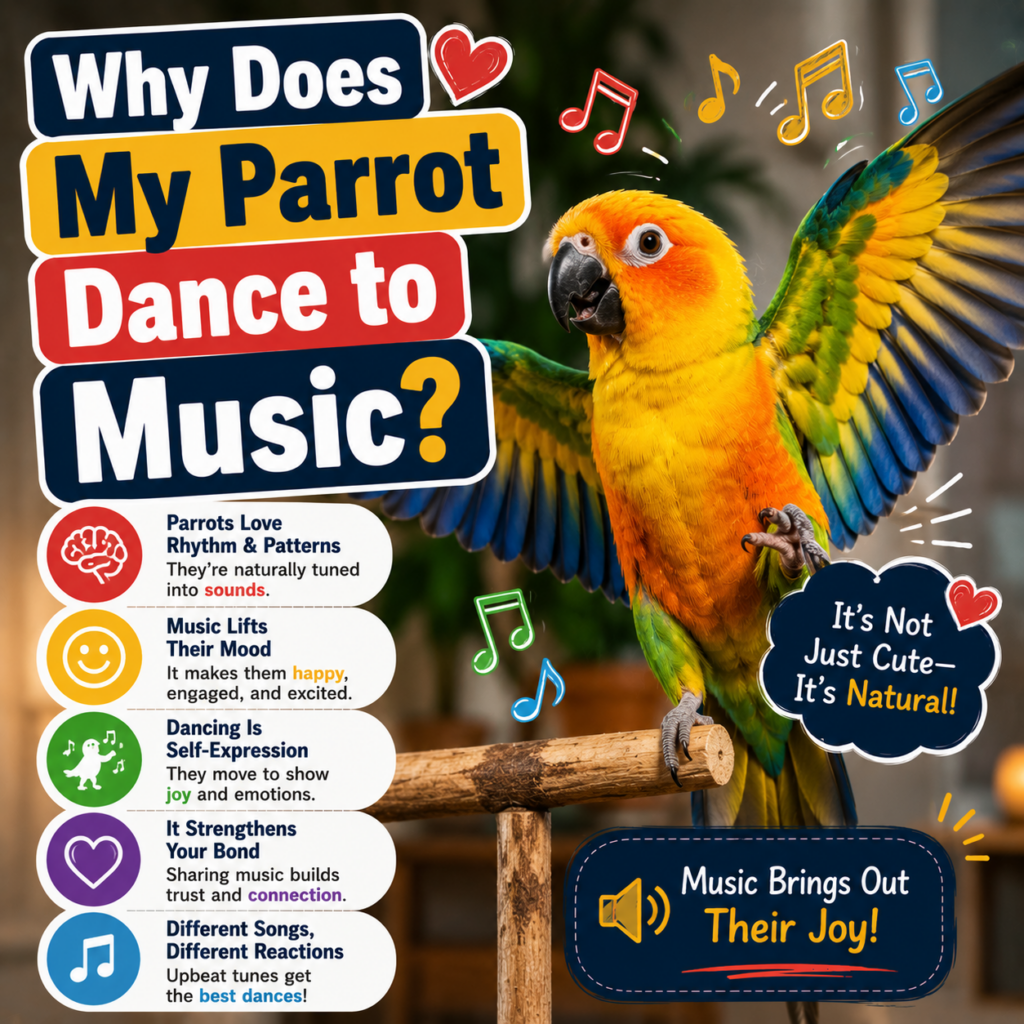
Do parrots actually like music? Absolutely. When a parrot dances, it isn’t a robotic reflex; it is a display of genuine happiness.
Listening to music they enjoy triggers a release of dopamine (the “feel-good” neurotransmitter) in an avian brain, very similar to how it affects humans. Dancing is a physical expression of that emotional high. If your parrot accompanies their dance with pinning eyes (rapidly dilating and constricting pupils), crest-raising, or happy chattering, they are experiencing pure auditory bliss.
At a Glance: What Is Your Parrot’s Musical Style?
Different parrot species exhibit unique dancing aesthetics and musical tastes based on their physical structures and personality traits:
| Parrot Species | Preferred Dance Moves | Favorite Genres |
| Cockatoos | High-energy head-banging, full-wing flares, and dramatic crest lifting. | Heavy beats, Pop, Rock, and Electronic dance music. |
| African Greys | Subtle rhythmic sways, side-to-side foot lifting, and synchronized whistling. | Ambient music, soft Classical, and structured Jazz. |
| Amazon Parrots | Full-body bobs, tail-flaring, and enthusiastic vocal accompaniment (singing along). | Upbeat Latin rhythms, Pop music, and theater tunes. |
3. The Power of “Flock Bonding”
Parrots are intensely social, flock-oriented exotic pets. In the wild, synchronous movements—such as flying together in tight formations or vocalizing in unison—are vital tools for building flock cohesion and safety.
When you turn on music and start dancing or clapping along, your parrot views this as a social flock ritual. By joining in on the dance, they are trying to match your energy, strengthen their secure attachment to you, and declare that you belong to the same happy flock.
How to Find Your Parrot’s Favorite Playlist
Want to host an ultimate dance party for your feathered friend? Follow these steps to decode their musical preferences:
- Experiment with Tempos: Start with medium-tempo pop tracks (around 100-120 BPM) and monitor if they sync up their head bobs.
- Watch Their Body Language: If a song makes your bird pace anxiously, scream aggressively, or retreat to the back of the cage, turn it off immediately. If they lift their foot or shake their tail, it’s a winner.
- Be Their Dance Partner: Parrots are performers. If you stand near their perch, bob your head, and clap your hands, your participation will instantly encourage them to unleash their best moves.
The Bottom Line
When your parrot dances to music, you aren’t just witnessing a cute trick—you are observing an extraordinary evolutionary phenomenon. Your bird’s rhythmic grooving is a beautiful cocktail of advanced neurological hardwiring, social bonding instincts, and pure emotional happiness.
So turn up the volume, grab a favorite treat, dance right along with them, and enjoy the incredible privilege of sharing a musical bond with your talented companion!