
Rabbits are often chosen as pet companions because people assume they are low-maintenance “starter pets” that are perfectly happy sitting in a small cage all day. However, this is one of the biggest misconceptions in the pet world.
In reality, rabbits have incredibly complex dietary, physical, and psychological needs. Because they are highly sensitive prey animals, even well-meaning owners can accidentally make mistakes that drastically impact their bunny’s health and lifespan.
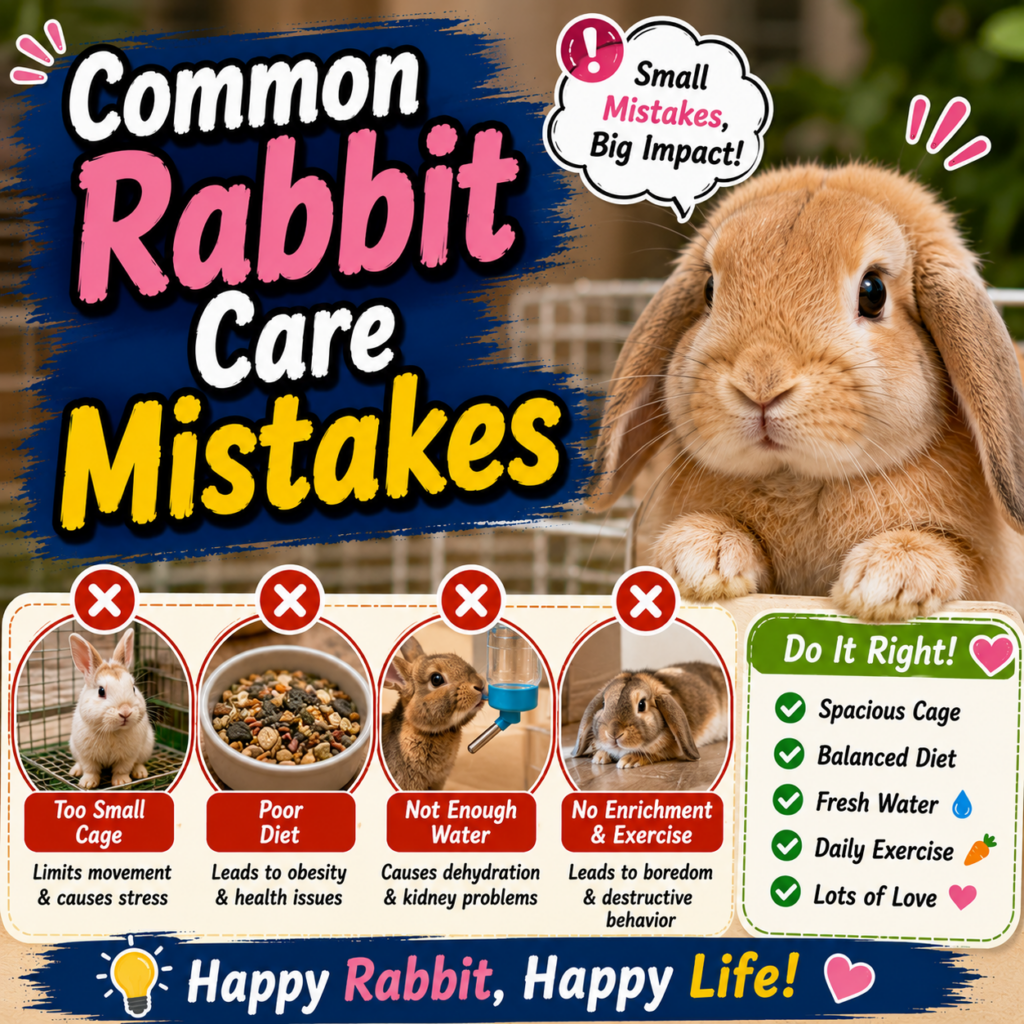
Whether you are a brand-new bunny parent or a seasoned keeper, avoiding these 7 common rabbit care mistakes will ensure your long-eared friend lives a long, joyful, and healthy life.
1. Underestimating the Importance of Hay (The Diet Matrix)
By far, the number one mistake rabbit owners make is feeding a diet too heavy in commercial pellets or fresh carrots, while neglecting fresh hay.
A rabbit’s digestive system is uniquely designed to process massive amounts of coarse fiber. Without continuous fiber, their cecum (the fermentation chamber in their gut) shuts down, leading to a fatal condition known as GI Stasis (Gastrointestinal Stasis). Furthermore, rabbits have open-rooted teeth that grow continuously; chewing coarse hay is the only natural way to grind them down.
- The Correct Balance: 80% to 85% of your rabbit’s total daily diet must be fresh Timothy hay or orchard grass. Pellets should be restricted to a small, measured daily portion, and carrots should only be treated as high-sugar candy.
2. Keeping Them Confined to a Small Cage
Rabbits are built to run, binky, jump, and stretch. Keeping a rabbit confined to a standard pet-store wire cage is the equivalent of forcing a human to live in a small walk-in closet for their entire life.
Lack of exercise causes severe health issues in rabbits, including muscle atrophy, obesity, painful hock sores, and deep psychological depression.
- The Modern Standard: Rabbits require a minimum of 4 to 5 hours of free-roam time outside their enclosure every single day. Many modern owners skip cages entirely and safely “free-roam” their rabbits in a puppy playpen or a fully rabbit-proofed bedroom.
3. Picking Them Up Aggressively (The Predator Grip)
It is completely natural to want to pick up and cuddle a fluffy bunny. However, most rabbits absolutely hate being held or lifted off the ground.
As prey animals, the only time a wild rabbit is lifted into the air is when a hawk or an owl catches them. Lifting them triggers a massive surge of adrenaline and fear. If they panic and kick out their powerful hind legs without proper support, they can easily fracture their own fragile spines.
- The Better Approach: Interact with your rabbit on their level. Lie flat on the rug and let them hop over to sniff you, climb on your back, or nudge your hand for head scratches. If you must lift them, always securely support their hindquarters.
4. Skipping the Spay or Neuter Surgery
Many owners assume that if they only have one rabbit, they don’t need to get them altered. This is a massive mistake for two major reasons:
- The Health Risk: Unspayed female rabbits have an astonishing 80% risk of developing fatal uterine cancer by the age of 4. Spaying your female rabbit is a literal lifesaver.
- Behavioral Issues: Around 4 to 6 months of age, hormonal surges trigger intense behaviors, including territorial spraying, aggressive biting, digging, and obsessive circling. Neutering or spaying removes these hormones, resulting in a much calmer, happier, and easily litter-trained pet.
5. Using the Wrong Litter Substrate
Rabbits can be easily litter-trained, but using the wrong material in their litter box can cause severe respiratory distress or liver failure.
❌ AVOID: Wood Shavings (Pine & Cedar) ──► Contain toxic phenols that cause liver damage.
❌ AVOID: Clay/Clumping Cat Litter    ──► Highly dangerous if ingested, causing internal blockages.

             🌟 USE: Paper-Based Pellets or Compressed Aspen Pellets 🌟
- The Safe Setup: Line a spacious cat litter box with safe, unscented paper-based pellets, then pile a giant mound of fresh Timothy hay right on top. Rabbits naturally love to eat hay while simultaneously doing their business!
6. Buying a Rabbit as an Unsupervised Toy for Children
Rabbits look like living stuffed animals, making them highly requested birthday gifts for young kids. However, rabbits are inherently fragile, easily startled, and do not enjoy loud noises or sudden grabby hand movements.
A child dropping a rabbit can instantly break its legs or back. Furthermore, rabbits have a lifespan of 10 to 12 years—long after a child’s initial interest has faded.
- The Reality: A rabbit should always be viewed as a family pet where a responsible adult handles 100% of the daily care, dietary tracking, and behavioral observation.
7. Bathing Your Rabbit in Water
When a rabbit gets dirty or experiences diarrhea (known as “poopy butt”), a beginner’s first instinct is to toss them into a sink or tub for a bath. Never submerge a rabbit in water.
Rabbits have dense fur that retains moisture for hours, making them highly susceptible to hypothermia. More importantly, being placed in water triggers extreme psychological panic, which can shock their delicate nervous system and cause sudden, fatal heart failure.
- The Safe Solution: If your bunny has a messy bottom, perform a localized “dry bath” by gently dusting cornstarch powder onto the soiled fur and brushing it out with a fine-tooth comb. For stubborn messes, use a warm, damp washcloth to spot-clean only the dirty skin layers.
Conclusion: A Well-Informed Owner Means a Thriving Bunny
Rabbits are wonderfully expressive, intelligent, and affectionate companions when given the proper care. By swapping out small cages for spacious playpens, prioritizing a high-fiber hay diet, and respecting their natural prey boundaries, you can easily avoid these common pitfalls.
Treat your bunny like a ground-dwelling companion rather than a caged rodent, and they will reward you with a decade of delightful mid-air binkies and sweet nose nudges!