
You are sitting quietly on the couch when you notice your cat jump onto the dining table. They walk over to a glass of water, a pen, or your car keys. They stop, look you dead in the eye, raise one paw, and slowly—deliberately—push the object over the edge.
Crash.
As you rush over to clean up the mess, your cat sits down calmly, completely unbothered by the chaos they just caused. It is a classic feline scenario that plays out in millions of households every single day.
But why does my cat knock things off tables? Are they just being mean, or is there a genuine biological reason behind this destructive habit? Let’s dive into the fascinating world of feline psychology to uncover the truth.
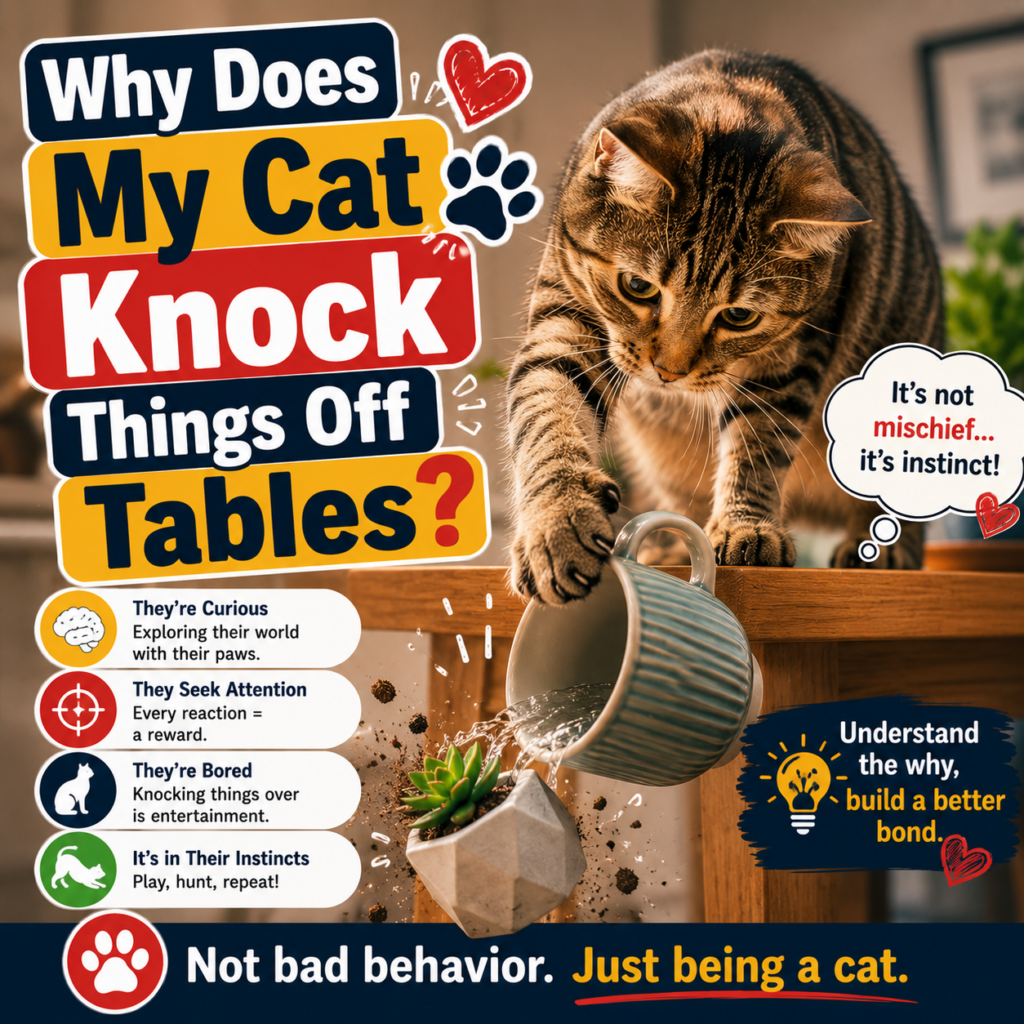
1. The Hunting Instinct: Testing for “Life”
Even though your domestic cat gets their meals served in a clean bowl every day, their ancestral hunting blueprints are still fully active. In the wild, felines are solitary predators that rely on stealth and tactile testing to catch their prey.
When a cat uses their paw to tap a pen, a coin, or a small bottle on your table, they are practicing predatory testing.
To a cat’s brain, that stationary object could be a mouse, an insect, or a small bird. By batting at it, they are checking to see if it will scurry, wiggle, or fight back. When the object falls off the edge and plunges to the floor, the sudden, fast motion satisfies their predatory curiosity. They have successfully “tested” the prey.
2. A Tactical Cry for Attention
Cats are incredibly smart pattern-recognizers, and they are master manipulators of human behavior. They know exactly which actions get a reaction out of you.
Think about what happens when your cat knocks a glass off the counter:
- You instantly stop scrolling on your phone.
- You get up from your chair and run into the room.
- You look directly at them and talk to them (even if you are sighing or scolding).
To a bored cat, even negative attention is better than no attention at all. Your cat quickly learns that knocking an object off a high surface acts like a magic butler bell—it instantly brings their human running to interact with them.
Decoding the Desk Takeover: What Is Your Cat Telling You?
How your cat acts while they are clearing off your tables can tell you exactly what resource they are looking for.
| Cat’s Table Behavior | The Root Motivation | The Best Solution |
| Staring directly at you while pushing a pen. | Attention Seeking: They are bored and want an immediate reaction. | Ignore the behavior if safe, or preemptively schedule structured play. |
| Batting an object repeatedly before dropping it. | Hunting Instinct: They are treating the object like moving prey. | Replace the item with interactive mouse toys or crinkle balls. |
| Knocking items off right next to an empty bowl. | Resource Demand: Their internal clock says it is dinner time. | Stick to a strict feeding routine so they don’t have to resort to alarms. |
3. Pure Play and Cognitive Boredom
Cats possess an abundance of mental and physical energy that needs a daily outlet. If a cat spends the entire day alone in a quiet house while you are at work, their environment becomes a boring background blur.
When they jump onto your table or desk, it becomes an interactive playground. Knocking items off shelves allows them to explore cause and effect, gravity, and sound. The satisfying click of a plastic lid hitting the hardwood floor provides a burst of tactile and auditory stimulation to an under-stimulated feline brain.
💡 The Psychology of the Laptop Leap
Similar to knocking things off tables, cats love to lay directly across your computer keyboard. They aren’t trying to erase your spreadsheets; they are attracted to the physical warmth radiating from the battery and want to insert themselves directly into your line of sight to claim your undivided attention!
4. Simple Curiosity and Sensory Processing
Cats explore their territories using their paws, which are packed with hyper-sensitive nerve endings. Tapping a smooth ceramic mug, a crinkly piece of paper, or a rolling pencil allows them to process the textures, weights, and boundaries of their home range. Sometimes, knocking an object over is just a passing experiment to see what that specific material sounds like when it meets the floor.
How to Stop Your Cat from Destructive Knocking
You don’t have to accept a life of broken glassware. You can gently redirect this behavior using a few expert adjustments:
- Ditch Passive Enrichment: If your cat’s toys are just sitting statically on the living room floor, they are boring. Switch to interactive wand toys, laser pointers, or motorized mice that mimic the erratic speed of real prey.
- Utilize Puzzle Feeders: Stop feeding your cat from a basic bowl. Use a foraging mat or a treat-dispensing puzzle toy. Forcing them to work and paw for their kibble burns up the exact predatory energy they would otherwise use on your car keys.
- Clear the Launchpads: Until the habit is broken, keep high-value, fragile items (like glasses, ceramics, or electronics) tucked away in closed drawers. If there is nothing interesting to push, the table loses its amusement park appeal.
The Bottom Line
When your cat clears off your counters, they aren’t trying to ruin your day or act maliciously. They are simply operating on beautifully ancient predatory instincts, looking for psychological simulation, or asking for a direct connection with their favorite human pack leader. Fill their environment with a little more interactive play and mental enrichment, and you’ll quickly find your tables staying perfectly organized—and your furbaby completely content!