We kiss our dogs on the head, let our cats curl up on our chests, and speak to our pet birds in soft, adoring tones. In return, they greet us with ecstatic full-body wiggles, gentle slow blinks, and affectionate vocal mimicking. To any pet parent, this exchange feels like pure, undeniable love.
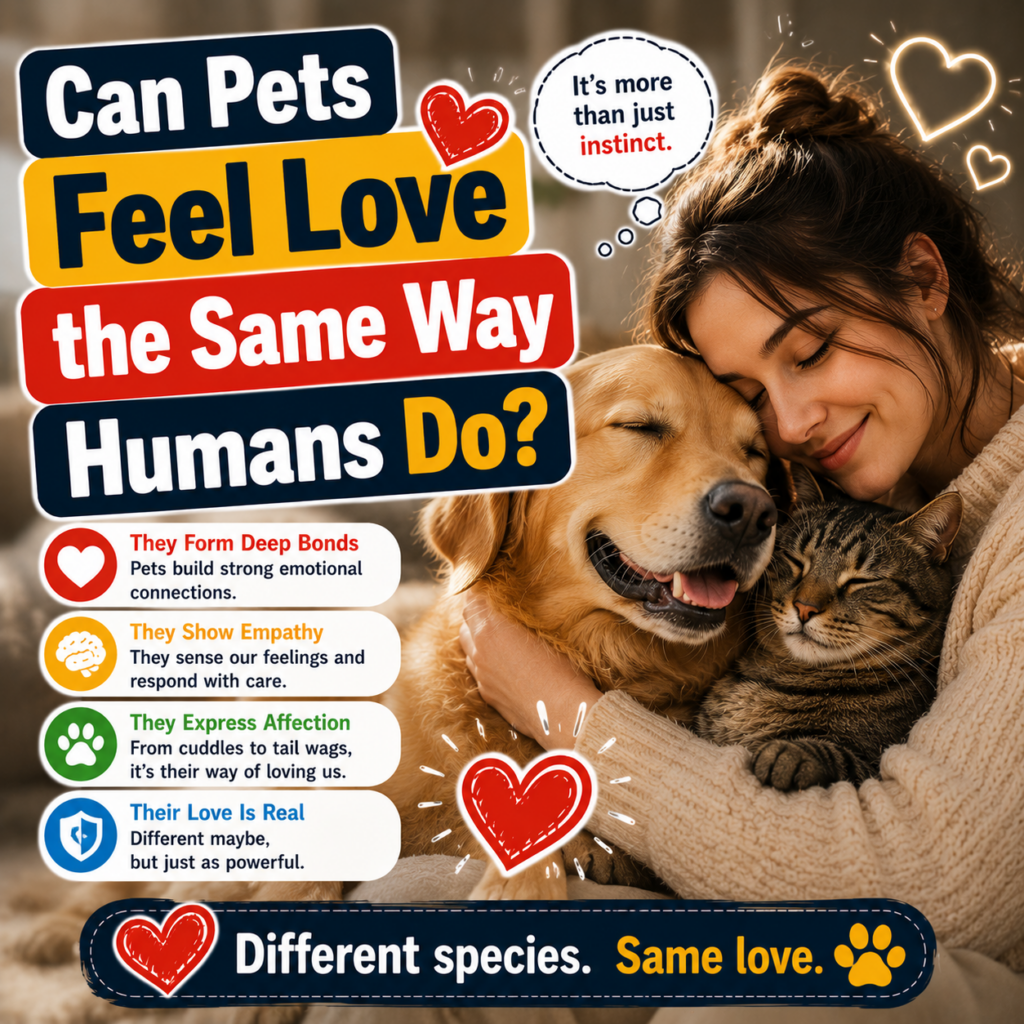
But it leaves a fascinating, deeply debated scientific question on the table: Can pets feel love the same way humans do?
Are we simply projecting our own complex human emotions onto our companion animals—a concept known as anthropomorphism—or do animals share the exact same biological capacity for deep, romantic, and platonic devotion?
Let’s dive into the evolutionary neurobiology and animal psychology to uncover how your pet experiences the chemical rush of love.
1. The Chemistry of Connection: The Oxytocin Overlap
If you want to know if an animal feels love, you have to look at their brain chemistry. The gold standard chemical marker for love, trust, and maternal bonding in humans is a powerful hormone and neurotransmitter called oxytocin.
Brain imaging and blood-sample studies have yielded mind-blowing results: when humans and domestic pets interact, both experience a massive surge in oxytocin.
The Landmark Study: Renowned neuroscientist Dr. Paul Zak conducted a study measuring oxytocin levels in dogs and cats before and after playing with their owners. The results showed that dogs experienced a 57% spike in oxytocin, while cats showed a 12% increase. This proves that the warm, fuzzy feeling of attachment isn’t exclusive to humans; your pet’s brain undergoes the exact same biochemical transformation when they are near you.
2. Emotional Processing: The Limbic System Match
For a long time, the rigid scientific community believed animals were merely biological robots driven entirely by survival instincts and associative learning. However, modern evolutionary biology has soundly debunked this theory.
All mammals (including dogs and cats) and birds share a highly developed brain structure known as the limbic system. This is the ancient, emotional command center of the brain responsible for processing fear, joy, grief, and attachment.
The Human vs. Pet Brain Difference
While our pets possess the same emotional hardware to feel core affection, where we differ is the neocortex—the part of the human brain responsible for complex language, abstract thought, and existential worry.
- Human Love: Can be complicated by abstract anxieties (“Do they love me back?” “What does the future hold?”).
- Pet Love: Is completely unburdened by language or complex ego. Because they live entirely in the present moment, their version of love is remarkably direct, honest, and pure.
At a Glance: How Different Pets Process and Return Love
Because different species possess distinct evolutionary backgrounds, their expressions of love are written in entirely unique behavioral dialects.
| Pet Type | Core Love Superpower | How It Compares to Human Love | Signature Love Cues |
| Dogs | The Pack Devotion | Miracles of empathy; they mirror your emotional stress and joy like a devoted partner. | Pressing their full weight against your legs (the canine lean), keeping soft eye contact, and sleeping belly-up. |
| Cats | The Secure Territory Attachment | Quiet, highly exclusive, and bound by a profound sense of psychological safety. | Bestowing the slow-blink “cat kiss,” kneading your lap (“making biscuits”), and head-bunting. |
| Birds (Parrots) | The Monogamous Lifelong Bond | Mirrors human romantic or soulmate devotion; they select one human for life. | Allopreening (grooming your hair), soft beak grinding as they fall asleep, and synchronized dancing. |
3. Parrots: The Elite Monogamous Soulmates
If you want to see a version of love that arguably rivals the intensity of human marriage, look no further than an exotic pet bird like a Macaw, Cockatoo, or African Grey.
In the wild, many large parrot species are strictly monogamous, pairing up with a single mate for their entire multi-decade lifespan. They travel together, defend territories together, and groom each other constantly to maintain their social bond.
When kept as household pets, a parrot will frequently direct this intense evolutionary blueprint toward their primary caretaker. They view you not just as a food provider, but as their chosen life partner. Their love is deeply passionate—they will protect you from other family members, experience genuine grief if you leave on vacation, and express absolute bliss simply sitting on your shoulder.
💡 The Scent of Security
A major indicator of pet love is how they interact with your scent. If your dog or cat constantly steals your unwashed laundry, curls up on your side of the bed when you leave, or rests their head on your shoes, they are engaging in a form of comfort-seeking. Your specific scent footprint activates the reward centers of their brain, making them feel completely secure even in your absence.
The Verdict: Do They Love Us?
So, do our pets feel love the same way we do? If your definition of love requires writing poetry, exchanging rings, or worrying about the future, then no.
But if love is defined as a profound biochemical bond, a biological choice to protect another creature, an immediate dropping of defensive barriers, and a deep sense of joy in another’s presence, then yes—pets absolutely feel love. In fact, because their affection is entirely untouched by hidden subtexts, judgment, or conditions, one could argue that our pets actually experience love in its most perfect, authentic, and beautiful form.