
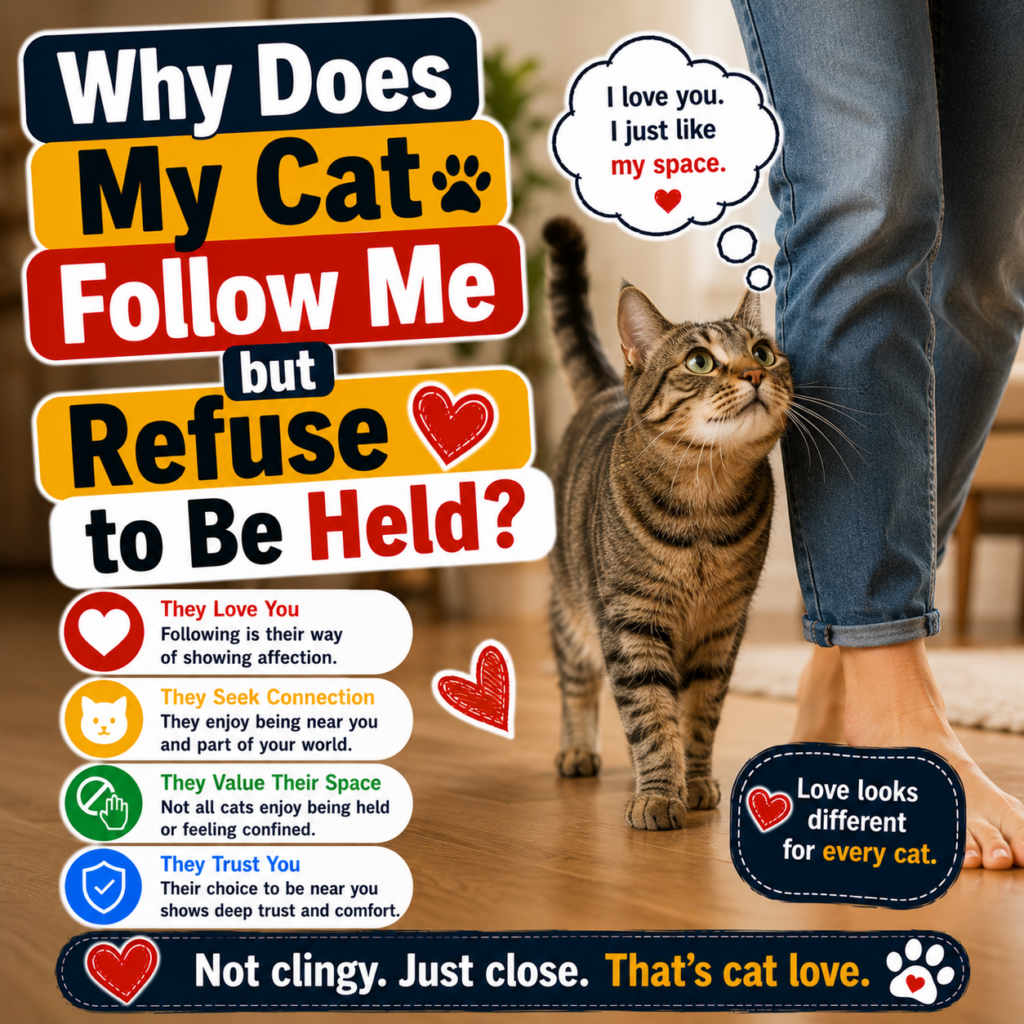
You stand up to walk into the kitchen, and your cat immediately trails behind you like a fluffy little shadow. They rub their cheeks against your ankles, look up at you with wide, adoring eyes, and softly chirp to get your attention. But the second you bend down, scoop them up into your arms for a hug, their entire body goes stiff. They squirm, push their paws against your chest, and desperately try to leap back down to the safety of the floor.
It can leave any devoted cat parent feeling deeply confused and slightly heartbroken. “If you love me enough to follow me everywhere, why do you hate it when I hold you?”
In the world of companion animal psychology, this is one of the most common paradoxes. The short answer? Your cat genuinely adores you, but they are communicating affection entirely on feline terms, not human ones. Let’s look into the fascinating science behind why cats crave your presence but guard their physical boundaries.
1. The Freedom Vector: Proximity vs. Physical Restraint
To understand this mixed signal, we have to look at what being held actually means to a feline brain. Cats are highly independent, solitary hunters. In their evolutionary history, their survival has depended entirely on their ability to move freely, sprint away from larger predators, and jump to safety at a split-second notice.
When you scoop your cat up into the air, you are accidentally removing their ultimate survival asset: control.
Even if they trust you completely, being wrapped tightly in human arms feels like a form of physical restraint. To their primal instincts, a lack of an immediate escape route triggers a minor flash of panic. When they follow you from room to room, they are exercising their free choice to share space with you. But when you lift them, that choice is temporarily taken away.
2. The Evolutionary Blueprint: Fear of Leaving the Ground
Unlike dogs, which are grounded pack animals, cats view the world through a three-dimensional vertical map. They love heights—but only when they get there using their own four paws.
When you pick a cat up, several disorienting things happen to their sensory system simultaneously:
- Loss of Ground Stability: Their paws are no longer making contact with a solid surface, leaving them feeling structurally insecure.
- Trauma Loops: For many rescue cats, the only times they have ever been forcibly picked up or put into a carrier were for stressful events like a trip to the veterinary clinic or a bath.
- Vulnerability of Vital Organs: Being held often exposes a cat’s soft underbelly to the room, which triggers an ancient defensive reflex to curl up or push away.
At a Glance: Decoding Affection vs. Setting Boundaries
It is essential to understand that following you around is a massive victory in cat communication. They are just drawing a clear boundary line around their physical bubble.
| Feline Behavior | What It Actually Means in Cat Language | How You Should Respond |
| Following you from room to room | “You are my safe companion range. I find your presence comforting.” | Acknowledge them with a soft, calm vocal tone or a slow-blink. |
| Rubbing their cheeks on your legs | Scent Marking: “I am writing my scent into you so everyone knows you belong to my family.” | Let them initiate the contact; do not use this as an invitation to pick them up. |
| Pushing paws against your chest | “I love being near you, but I feel trapped. Please put me back down.” | Release them immediately. Forcing the hold erases psychological trust. |
| Thumping or twitching their tail | Overstimulation: “My internal stress threshold has been crossed.” | Give them immediate space before their warning turns into a scratch or bite. |
3. The Power of Scent-Marking Over Physical Hugs
Humans are primates, which means our default biological method for showing intense affection is to hug, squeeze, and hold tightly. Cats, however, are chemical communicators. They show high-level attachment through scent-merging.
Cats possess specialized scent glands concentrated around their lips, cheeks, forehead, and the base of their tail.
When your cat follows you and wraps their tail around your calves, they are depositing facial pheromones onto your clothing. They are telling the world that you are a trusted, safe asset. To a cat, this quiet sharing of scent profiles is just as intimate and emotionally satisfying as a massive bear hug is to a human!
💡 How to Build “Handling Trust” on Their Terms
If you want to make your cat more comfortable with occasional handling, you can gently reshape their neural pathways using these patient adjustments:
- Practice the “Four-Paw Support”: When lifting your cat is necessary, never let their back legs dangle helplessly in the air. Always support their chest with one hand and cradle their hindquarters securely with your other arm so they feel balanced.
- The 3-Second Rule: Pick your cat up gently, count to three, and put them right back down before they start to squirm or panic. Reward them instantly with an elite treat. This teaches their brain that being held doesn’t mean being permanently trapped.
- Honor the Release: The absolute fastest way to get a cat to trust you is to let them go the exact microsecond they ask for it. When they realize that their boundaries are respected, their defensive anxiety disappears.
The Bottom Line
If your cat follows you everywhere but hates being held, do not take it personally. It isn’t a rejection of your love; it is simply a declaration of their species-specific boundaries. Your cat views you as an elite peer, a companion, and their ultimate provider. By respecting their need for physical freedom while celebrating their quiet, shadow-like devotion, you are establishing the ultimate high-trust sanctuary that every feline dreams of!