We have all been there. You are caught in the middle of a high-stress afternoon, staring at an overwhelming mountain of unread emails or endless chores. Your energy is low, and your mind is operating in a state of mental fatigue. To take a quick break, you open your phone and scroll through social media. Suddenly, a short video pops up: a golden retriever puppy gently tilting its head, an orange tabby cat sleeping in a tiny cardboard box, or a fluffy duckling riding on a mother dog’s back.
Instantly, the tension in your shoulders melts away. You let out an involuntary soft sigh, smile, and feel a sudden wave of calm wash over your entire body.
It is a delightful mental reset that plays out across millions of screens every single day. But why does looking at cute animals make us feel better? Is it just a temporary, shallow distraction, or is there a deep neurobiological and evolutionary trigger wired into our brains that responds to animal cuteness? Let’s dive into the fascinating science behind the psychological power of cute animals.
1. The Evolutionary Blueprint: Activating the “Baby Schema”
The primary reason our brains go soft when we look at cute animals is rooted in an ancient evolutionary survival mechanism called Kindchenschema (Baby Schema), first defined by renowned Austrian ethologist Konrad Lorenz in 1943.
Lorenz discovered that across almost all mammal species, infants possess a specific set of distinct physical traits:
- A relatively large head compared to the body size.
- Enormous, wide-set, circular eyes positioned low on the face.
- A soft, rounded forehead and chubby, contoured cheeks.
- Short, clumsy limbs and a waddling movement style.
When you look at a baby animal, your primitive brain cannot distinguish between a human infant and a baby animal. It drops all defensive walls and perceives that entity as a vulnerable, precious infant that needs immediate nurturing. Your brain rewards you for noticing this “infant” by instantly shifting your nervous system into a safe, calm baseline.
2. The Neurochemical Explosion: Rewriting Your Stress Levels
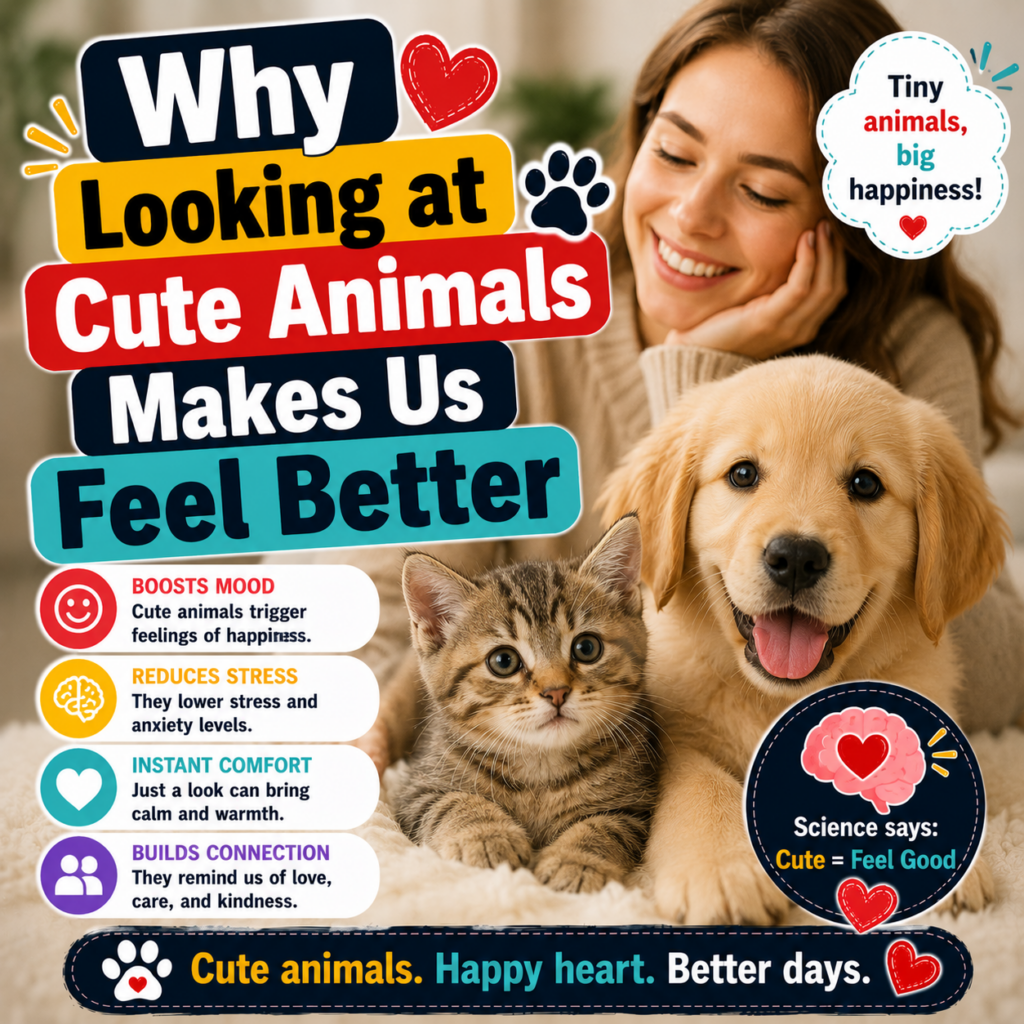
The feeling of relief you get from looking at cute animal photos isn’t just a psychological trick—it physically and measurably alters your brain chemistry.
When you struggle with an anxious day, your body releases the stress hormone cortisol, which keeps your nervous system trapped in a hyper-vigilant “fight-or-flight” mode.
Looking at a picture of a cute animal operates like an immediate biological brake system on your stress levels, triggering a massive, simultaneous release of three elite neurotransmitters:
The Neurochemical Cocktail:
- Oxytocin (The Bonding Hormone): Instantly lowers your heart rate, deepens your breathing, and cultivates a profound sense of psychological safety and social comfort.
- Dopamine (The Reward Molecule): Delivers a sharp spike of pure joy and satisfaction, effectively wiping out symptoms of mild environmental anxiety.
- Serotonin (The Mood Stabilizer): Restores emotional balance to your household baseline, making you feel grounded, safe, and happy under your own roof.
At a Glance: How Visualizing Cute Animals Reshapes Your Productivity
Looking at cute animals doesn’t just make you happy; it directly optimizes your cognitive performance.
| Type of Animal Media | The Primary Neurobiological Benefit | What It Does to Your Mindset | Best Used For |
| Fluffy Baby Animals (Puppies, Kittens) | Massive oxytocin and dopamine release. | Activates the caretaking reflex; shifts your focus outward. | Immediate relief from acute stress, low mood, or social isolation. |
| Funny / Quirky Pet Videos (Cats in boxes, Parrots dancing) | Sudden serotonin boost and laughter therapy. | Disrupts negative thought loops; inserts lighthearted humor into the day. | Overcoming creative blocks and erasing afternoon desk fatigue. |
| Animals Interacting with Other Species | Deep emotional buffering and validation. | Reinforces concepts of peace, harmonious social bonding, and safety. | Winding down before sleep or decompressing after a chaotic schedule. |
3. The Power of “Cute High” (The Hiroshima University Study)
Many critics used to claim that looking at cute animal photos at work or during study breaks was a form of lazy procrastination that ruined concentration. However, a famous, groundbreaking study conducted at Hiroshima University in Japan completely dismantled this myth.
Researchers wanted to test how the Japanese concept of Kawaii (cuteness) affected human motor skills and cognitive performance. They split participants into groups and had them complete high-focus tasks before and after looking at various images.
The Mind-Blowing Result:
The group that spent time looking at images of baby animals (puppies and kittens) showed a staggering 44% increase in accuracy and speed on subsequent detailed tasks. The groups that looked at adult animals or neutral foods showed zero performance boost.
The researchers concluded that viewing baby animals activates our protective, caretaking instincts. This behavioral shift automatically forces our brains to slow down, pay closer attention to detail, and operate with heightened systematic care—proving that looking at cute animals is actually a highly effective, science-backed productivity tool!
💡 The Paradox of “Cute Aggression”
Have you ever looked at a picture of an incredibly fluffy puppy or kitten and felt a sudden, bizarre urge to squeeze it, pinch its cheeks, or pretend to “bite” it? Don’t worry—you aren’t losing your mind. In animal and human cognitive psychology, this is a normal phenomenon known as Cute Aggression. When your brain is completely overwhelmed by a massive, uncontrolled flood of positive oxytocin and dopamine, it throws a brief flash of pseudo-aggression into the mix to balance your emotional scales, preventing your nervous system from short-circuiting from pure joy!
The Bottom Line
When you pause your busy lifestyle to smile at a picture of a golden retriever puppy or a quirky cat, science shows you are giving your brain essential psychological medicine. It isn’t an act of aimless scrolling; it is a beautifully designed evolutionary reflex that uses ancient baby schema genetics to lower your cortisol, trigger a flood of life-affirming oxytocin, and dramatically sharpen your cognitive focus. Go ahead and look at that cute animal video guilt-free—it is just another wonderful way to transform your daily routine into a much happier, balanced, and peaceful sanctuary!