
Every cat parent has experienced this deeply unsettling moment: It’s late at night, the house is completely quiet, and you notice your cat sitting frozen in the hallway. Their eyes are wide, their pupils are completely dilated, and they are staring intensely at a blank, empty patch of drywall. They don’t move a muscle. When you call their name, they completely ignore you, as if they are watching a hidden entity floating right in front of them.
It leaves many owners feeling slightly spooked, asking a classic question: Why does my cat stare at the wall?
Are they actually seeing ghosts, are they playing a strange feline game, or is there a fascinating neurological and sensory explanation behind this behavior? Let’s dive into the cutting-edge science of feline sensory biology to uncover the truth.
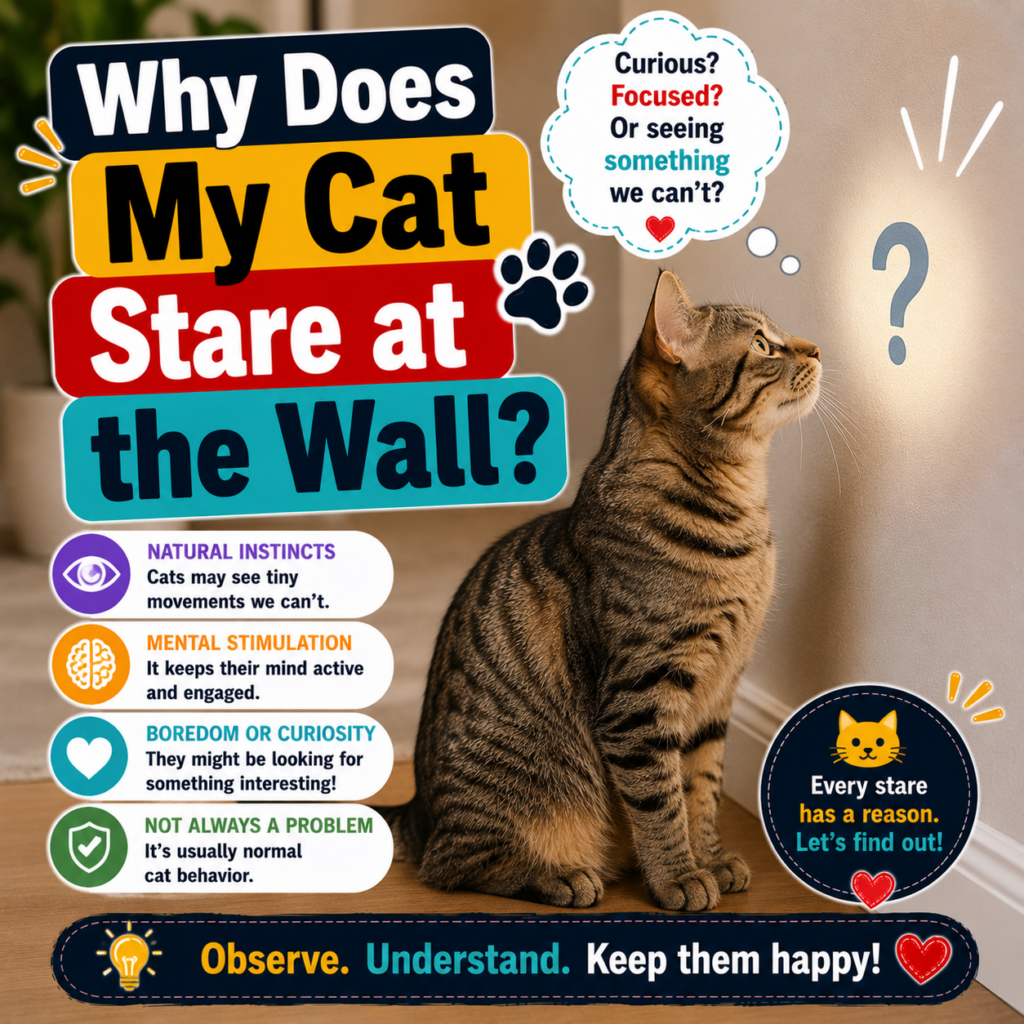
1. Superpowered Rodent Detection: Hearing Through the Drywall
The most common reason your cat is holding a stakeout by a blank wall isn’t supernatural—it’s acoustic.
Humans live in a visual-first world, but cats are highly specialized ambush predators that rely heavily on their spectacular hearing. A cat’s hearing range is absolutely magnificent, stretching up to 64,000 Hz, which is significantly higher than a human’s 20,000 Hz limit and even surpasses a dog’s acoustic range.
Your walls aren’t completely solid; they house electrical wiring, plumbing, and insulation channels. A tiny insect crawling behind the baseboards, a spider spinning a web near the ceiling, or a small mouse navigating the interior structure creates high-frequency micro-vibrations. Your cat isn’t staring at nothing; they are using their eyes to lock onto the exact coordinates of a sound you cannot even perceive!
2. Ultraviolet Vision: Seeing the Invisible World
When your cat stares at a seemingly empty wall during the day, they might actually be analyzing complex visual data that is completely invisible to human eyes.
A groundbreaking study published by researchers at City University London revealed that domestic cats and dogs can see light in the ultraviolet (UV) spectrum.
Humans possess a lens structure that blocks UV light from reaching the retina. Cats, however, have specialized transparent lenses that allow ultraviolet wavelengths to pass through effortlessly.
- The Flat Screen: To a human, a white wall is just a flat, uniform surface.
- The UV Matrix: To a cat, that same wall showcases complex maps of UV reflections, floating dust motes caught in sunbeams, tiny thermal drafts, or microscopic structural imperfections that glow under ambient light. They are simply captivated by a vibrant visual show we are biologically locked out of seeing.
At a Glance: Decoding Your Cat’s Wall-Staring Habits
Understanding your cat’s specific body language clues while they stare at the wall can tell you exactly what resource or sensory trigger has captured their attention.
| Feline Posture / Behavior | What Is Happening Sensorially | The True Feline Meaning |
| Body crouched, tail twitching, ears forward. | Predatory Tracking: They hear an insect or a rodent moving behind the drywall or under the floor. | “There is prey moving inside this structure. I am calculating my strike vector.” |
| Sitting calmly, blinking slowly, relaxed tail. | Visual Fascination: They are watching subtle shadows, dust motes, or UV light reflections. | “The light patterns on this surface are incredibly relaxing and interesting to map.” |
| Staring blankly, vocalizing loudly, appearing disoriented or distressed. | Cognitive / Medical Shift: Potential sign of Feline Cognitive Dysfunction or an internal neurological issue. | Requires a Vet Visit: Their internal processing center is experiencing a glitch. |
3. The Power of “Focal Seizures” and Hyperesthesia
While sensory superpowers explain 95% of wall-staring episodes, pet parents must also be aware of a unique medical condition known as Feline Hyperesthesia Syndrome (FHS) or localized focal seizures.
Unlike a grand mal seizure where an animal collapses, a focal seizure happens in a highly restricted zone of the brain. When a cat experiences a mild focal seizure, they can appear to completely “zone out” or lock their eyes onto a specific empty spot for several minutes.
⚠️ When to Consult a Veterinarian
If your cat’s wall-staring routine is accompanied by any of these sudden, involuntary behavioral markers, it may indicate an underlying medical issue like Feline Cognitive Dysfunction (feline dementia) or FHS:
- The cat suddenly bites or scratches at its own tail or lower back frantically right after staring.
- The skin along their spine ripples or twitches erratically.
- They display sudden, loud, distressed yowling while staring into space.
- They seem completely disoriented, dizzy, or fail to recognize your face when they snap out of the trance.
4. Pure Cognitive Play: Tracking Ambient Shadows
On a final, lighthearted level, cats are easily amused by subtle changes in their household range. Because their eyes are built to prioritize movement over fine detail, a tiny shift in ambient lighting can trigger their curiosity.
A car driving by outside casting a passing headlight shadow across the room, the reflection of your watch bouncing onto the plaster, or the subtle movement of a curtain thread blowing in the AC draft looks like a highly interactive game to your cat. They stare at the wall simply because their brain treats your interior architecture as a massive, rotating movie screen!
The Bottom Line
The next time you catch your favorite feline shadow conducting a silent stakeout by a blank wall, you don’t need to call a paranormal investigator. Science shows your cat is simply using their elite biological gifts. Driven by an advanced acoustic range that tracks hidden pests, a transparent lens system that decodes ultraviolet light, and an innate predatory drive to analyze moving shadows, they are completely plugged into a vibrant sensory universe. Enjoy their quirky devotion—it’s just another fascinating reminder of how beautifully complex our domestic companion animals truly are!