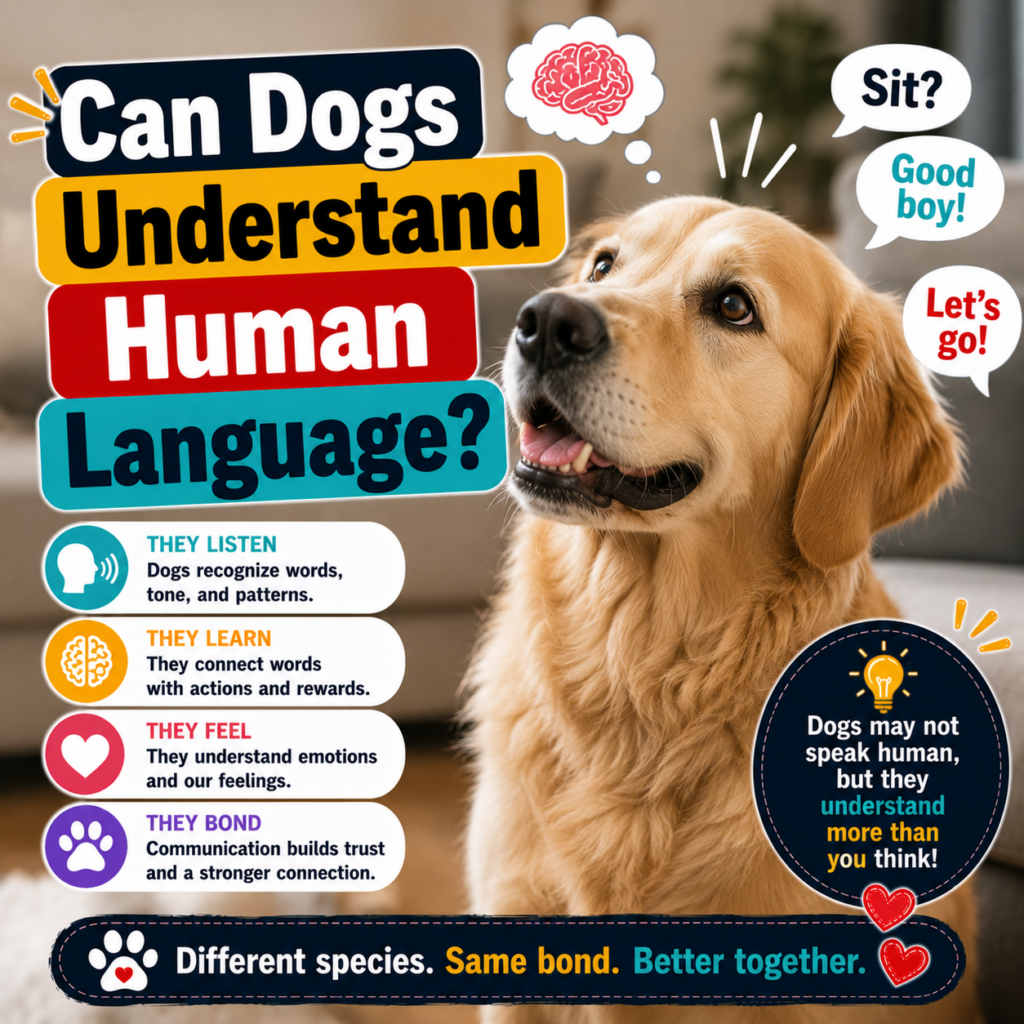
We have all had those moments where we look at our dogs and wonder if they are secretly reading our minds. You say the word “Walk,” and before you can even reach for the leash, your pup is spinning in circles by the front door. You mention the word “Bath” in a casual, low-volume conversation with your partner, and suddenly your dog vanishes underneath the bed.
These incredible reactions leave pet parents asking a classic question: Can dogs understand human language?
Are they actually processing the abstract meaning of our words like a human toddler does, or are they simply reacting to the excited pitch of our voices and our physical body language? Let’s dive into the cutting-edge neuroscience and brain-imaging studies that have finally unlocked the truth.
1. The Neurobiological Proof: How a Dog’s Brain Processes Words
For decades, the traditional scientific community believed that dogs were purely reactive creatures. Critics argued that dogs couldn’t understand vocabulary; they were just decoding human vocal inflections (e.g., a happy tone means good things, a stern tone means bad things).
However, a groundbreaking, landmark study published by neuroscientists at Eötvös Loránd University in Budapest completely shattered this theory using fMRI (functional Magnetic Resonance Imaging) machines.
The Experiment:
Scientists trained conscious, alert dogs to lie completely still inside an fMRI scanner while listening to recordings of their trainers speaking. The trainers mixed high-value praise words (“Clever,” “Well done”) and neutral conjunction words (“However,” “If”) using both enthusiastic, happy inflections and flat, neutral tones.
The Mind-Blowing Result:
The brain scans revealed that dogs process language using the exact same brain hemispheres as humans.
The study proved that a dog’s brain doesn’t just listen to how we say something; they actively separate the literal word meaning from the tone. True praise was only registered in the brain’s reward centers when a high-value word was paired with a matching enthusiastic inflection!
2. Vocabulary Champions: Chaser the Border Collie and Beyond
If you still doubt your dog’s ability to grasp human vocabulary, look no further than the remarkable history of Chaser the Border Collie, widely recognized by behavioral psychologists as the smartest dog in the world.
Trained by psychologist Dr. John Pilley, Chaser successfully learned and retained the proper noun names of 1,022 distinct items, including stuffed animals, balls, and frisbees.
Advanced Grammar and Fast-Mapping
Chaser didn’t just memorize labels; she understood syntactic grammar. If Dr. Pilley told her to “Take the ball to the frisbee,” she would execute the action correctly, and if he reversed the sentence to “Take the frisbee to the ball,” she understood the structural shift in meaning.
Furthermore, Chaser possessed the ability to “fast-map”—a cognitive trait found in human children where an animal can deduce the name of a brand-new object by logically eliminating all the familiar toys they already know.
At a Glance: How Your Dog Decodes Your Conversations
Dogs use a three-tiered sensory network to piece together exactly what your human dialect means in real time.
| Human Communication Trigger | What It Looks Like to Your Dog | How Their Brain Processes It |
| Literal Vocabulary Words | High-value anchors like “Treat,” “Walk,” or “Good boy.” | Left Brain Activation: They match the audio phonemes to a permanent mental database of rewards. |
| Vocal Intonation & Pitch | High-pitched “baby talk” vs. low, flat, or stern tones. | Right Brain Activation: They analyze your emotional state, safety metrics, and urgency levels. |
| Micro-Body Language | Eye contact, pointing fingers, foot direction, and hand placement. | Visual Mapping: They use your physical cues as a contextual map to verify what the spoken word means. |
3. The Human Age Blueprint: The “Toddler” Mental Cap
According to leading animal behaviorists and canine intelligence experts, the average domestic dog possesses the cognitive linguistic capabilities of a two-year-old human toddler.
This means an average family dog can easily master a vocabulary list of roughly 165 to 250 human words, signs, and gestures without any professional training.
They learn human language through a psychological process called associative learning. When you say a word like “Outside” right before opening the back door for years, their brain maps that specific sound sequence as a guaranteed predictor cue for an environmental asset.
💡 The Secret Value of “Baby Talk” (Dog-Directed Speech)
Have you ever felt embarrassed when someone catches you using a high-pitched, sing-song voice to talk to your dog? Don’t be! Animal communication studies show that dogs are biologically hardwired to prefer Dog-Directed Speech. The high-frequency pitch and exaggerated inflections capture their attention instantly, making it significantly easier for their left brain to isolate and memorize individual vocabulary words out of a long sentence.
How to Expand Your Dog’s Language Comprehension
If you want to turn your canine shadow into a master communicator, use these professional training adjustments:
- Be Consistent with Labels: Don’t rotate your vocabulary at random. If you use the word “Dinner” to describe their evening food bowl, don’t swap it out for “Supper,” “Kibble,” or “Food” next week. Pick one strict vocal anchor and stick to it.
- Isolate the Key Word: When teaching a new command, don’t bury the target word inside a long sentence like, “Hey buddy, do you want to sit down on the floor for me?” Instead, say their name, pause, and state the isolated cue clearly: “Max… Sit.”
- Pair Sound with a Visual Accent: Dogs are visual-first mammals. Always accompany a new spoken word with a distinct, consistent hand signal. Connecting the audio note to a physical visual marker hardwires their learning loop twice as fast.
The Bottom Line
Yes, dogs can absolutely understand human language. Through thousands of years of shared evolutionary history, their brains have adapted to decode our literal vocabulary using their left hemisphere, while simultaneously parsing our emotional intentions using their right hemisphere. They listen to what you say, how you say it, and look closely at your body language to stay completely in sync with their human pack leaders. Treat your conversations with them with respect—you aren’t just talking to a pet; you are communicating with a deeply attentive family member who understands your world far better than you think!