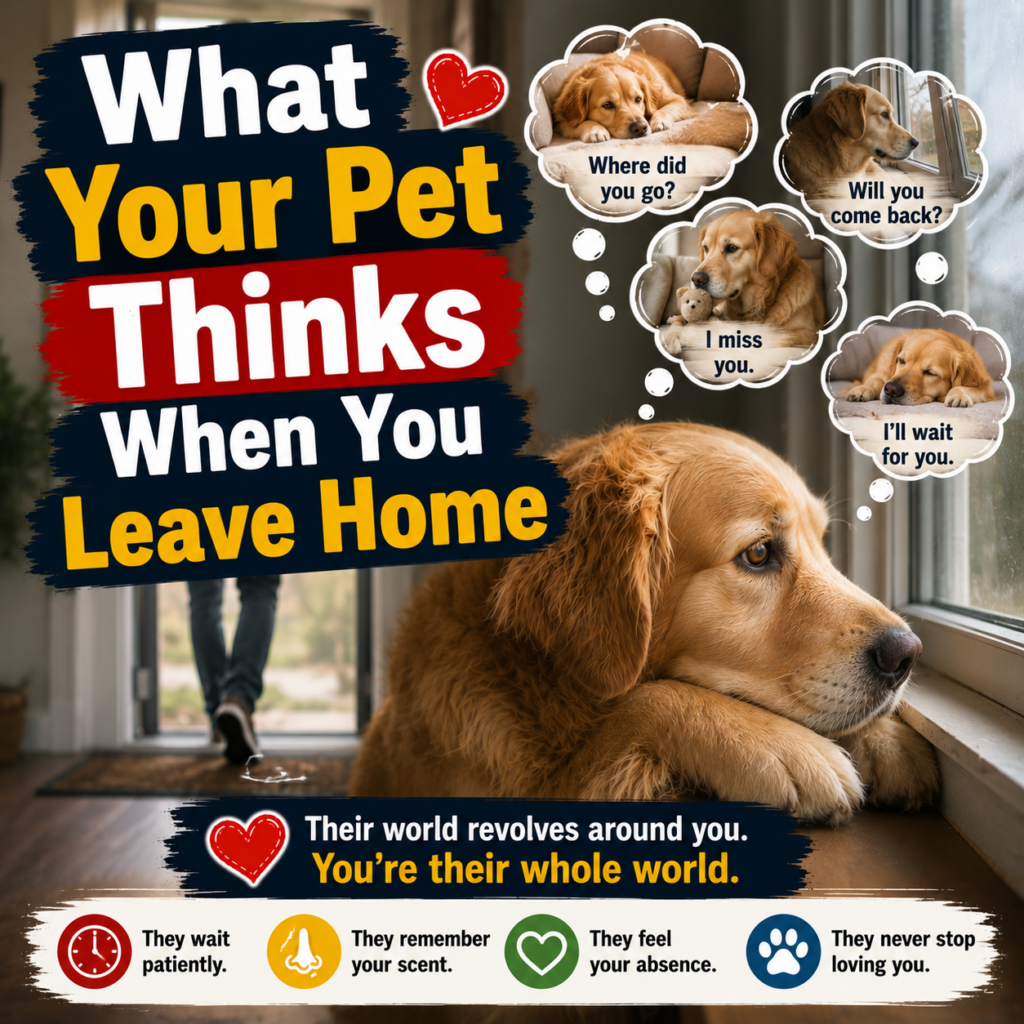
It is a daily departure routine that every pet parent knows by heart. You grab your house keys, slip into your shoes, and pick up your bag. Instantly, the ambient energy in your home shifts. Your dog sits down by the door, looking up with wide, anxious eyes and a tucked tail. Your cat watches intensely from the top of the scratch post, tracking your every move. Or perhaps your companion parrot lets out a sharp, inquiring flock call from their perch.
As you step across the threshold and close the door behind you, a wave of human guilt often washes over you. You find yourself driving to work or running errands wondering: What does my pet think when I leave home?
Do they think you are vanishing forever? Do they understand that you will return after a few hours, or does their primitive brain descend into a temporary survival crisis? Let’s dive into the fascinating neuroscience, time-perception studies, and evolutionary mechanics of animal solitude to unlock the truth.
1. The Time-Perception Gap: Episodic vs. Associative Memory
To decode what your pet thinks when the front door closes, we first have to dismantle a major human misconception. Humans experience time through episodic memory, allowing us to map our day along a strict chronological timeline (“My owner left at 8:00 AM, it is now 1:00 PM, so they will be home in exactly three hours”).
Dogs, cats, and birds do not possess this linear, clock-watching cognitive structure. Instead, they navigate the passing of time through a combination of circadian biological rhythms and associative memory.
When you leave home, your pet does not calculate the specific hours of your absence. However, behavioral research proves that animals absolutely perceive the difference between a short duration and a long duration.
In a landmark canine cognition study, researchers monitored dogs left alone for 30 minutes versus 2 hours. While the dogs remained relatively calm during the initial window, their heart rates, tail-wagging intensity, and frantic joy spiked significantly higher when reunited after the 2-hour mark. Their brains process your absence not as a numerical count, but as a growing, cumulative sensation of missing their primary social anchor.
2. The Olfactory Clock: Smelling Your Absence
One of the most mind-blowing discoveries in animal sensory biology reveals that dogs might actually be able to smell time ticking away while you are gone.
Because your home territory is an enclosed environment, your personal pheromones, skin oils, and unique scent profile saturate the indoor air. The exact second you step outside, your physical scent signature stops regenerating.
Cognitive psychologists hypothesize that your dog uses this predictable, slow evaporation of your scent as an internal olfactory clock. Over years of shared routines, your dog’s brain learns that when your scent profile decays to a specific, faint threshold, it acts as a guaranteed predictor cue that you are about to walk back through the front door.
At a Glance: What Your Pet Experiences During Your Absence
Different species utilize distinct evolutionary scripts to process the quiet hours when their human protectors are away.
| Pet Type | Their Primary Cognitive Focus | What They Do While You Are Gone | The Ultimate Safe Intervention |
| Dogs | Pack Cohesion & Routine Tracking | Waiting by the door, napping on your laundry, or tracking structural ambient outside sounds. | Scent Blankets: Leaving an unwashed t-shirt in their den den to stabilize their oxytocin baseline. |
| Cats | Territorial Surveillance & Conservation | Deep REM sleep cycles, patrolling room boundaries, or observing birds from a window perch. | Vertical Enrichment: Providing window seats and high vantage points to keep their prey drive occupied. |
| Birds (Parrots) | Flock Proximity & Acoustic Safety | Foraging for treats, preening feathers, or calling out caught catchphrases to scan the range. | Audio Shielding: Leaving a soft fan, white noise, or gentle music running to mask sudden ambient noises. |
3. The Parrot Dilemma: The Vulnerability of the Flock Prey Drive
While cats view your departure as a convenient opportunity to execute a territory lockdown and conserve energy through long sleep cycles, exotic pet birds like African Greys, Cockatoos, and Macaws experience your departure through intense flock genetics.
Parrots are highly cognitive, wild prey animals that are genetically hardwired to never be truly alone. In the wild, an isolated bird is a primary target for predators.
When you leave home and leave a parrot in complete silence, their hyper-vigilant survival instincts can accidentally fire. They don’t think you are “abandoning” them out of malice; their primitive brain panics because the flock has fractured, leaving the territory vulnerable.
To ease this cognitive strain, savvy avian handlers never leave a parrot in a completely quiet room. Leaving classical music, a television broadcast, or a gentle audio shield running provides environmental static that tells their brain the territory remains safe and stable.
💡 The Psychology of “The Guarded Laundry”
Have you ever returned home to find your dog or cat curled up fast asleep directly inside your laundry basket or on top of a stray sweater you left on the bed? In companion animal psychology, this is an elite display of self-soothing behavior. Your unwashed clothing holds the highest concentration of your personal biochemical print. By sleeping directly on your items, your pet activates the reward centers of their brain, triggering a release of comforting oxytocin that naturally lowers their resting heart rate while they wait for your return.
How to Make Your Departure Feel Completely Safe for Your Pet
To transform your pet’s internal narrative from panic to peaceful relaxation during your absence, implement these professional animal behavior adjustments:
- Eliminate Departure Rituals: Avoid long, emotional, high-pitched goodbyes like, “Oh my poor baby, I’m going to miss you so much!” This frantic vocal frequency alerts your pet’s right brain hemisphere that a stressful, high-alert event is about to happen. Instead, make your departures completely casual, silent, and monotone.
- The High-Value Distraction Swap: The exact microsecond you open the front door should be linked to the single greatest resource reward of the day. Hand your dog a frozen, treat-stuffed toy, offer your cat a premium lickable puree, or give your parrot a complex fresh foraging puzzle box. This rewrites their associative memory loop: your departure changes from a sad loss into a thrilling jackpot trigger!
- Establish a Predictable Return Anchor: Animals crave environmental predictability. Try to align your departures and returns with stable baseline cues (such as feeding them immediately upon your arrival) so their internal biological clocks can map your schedule with complete confidence.
The Bottom Line
Your companion animals do not spend the day weaving complex, humanized narratives about where you went or why you left them behind. They do not look at your absence with resentment or doubt your love. Driven by ancestral pack mechanics, circadian biological rhythms, and superpowered olfactory tracking systems, they simply adapt to the quiet lull in the household territory. By managing their sensory environment, providing comforting scent anchors, and matching their routine with predictable rewards, you can ensure that the hours you spend apart are entirely peaceful, balanced, and secure—turning every single evening reunion into a beautiful, life-affirming celebration of your unbreakable bond!