
It is an unforgettable spectacle that every single dog parent knows by heart. You could be sitting quietly on the couch when suddenly, a kinetic switch flips inside your dog’s brain. Their eyes go wide, their hindquarters tuck low to the ground, their tail drops into a tight, focused position, and they take off like a rocket.
They tear through the living room, launch themselves off the sofa, spin in dizzying tight circles on the rug, and sprint down the hallway at absolute maximum velocity—only to slide to a sudden stop, panting happily with a massive canine smile.
In the veterinary and animal behavioral science world, this wild, explosive burst of energy has a beautiful, official technical name: Frenetic Random Activity Periods, or FRAPs.
But as you watch your dog complete their fifth lap around the kitchen island, you might find yourself asking a classic cognitive question: Why does my dog get the zoomies? Is it an involuntary muscle spasm, a sign of mental frustration, or a perfectly healthy neurobiological release valve? Let’s look into the fascinating world of canine behavioral psychology to decode the true meaning behind the zoomies.
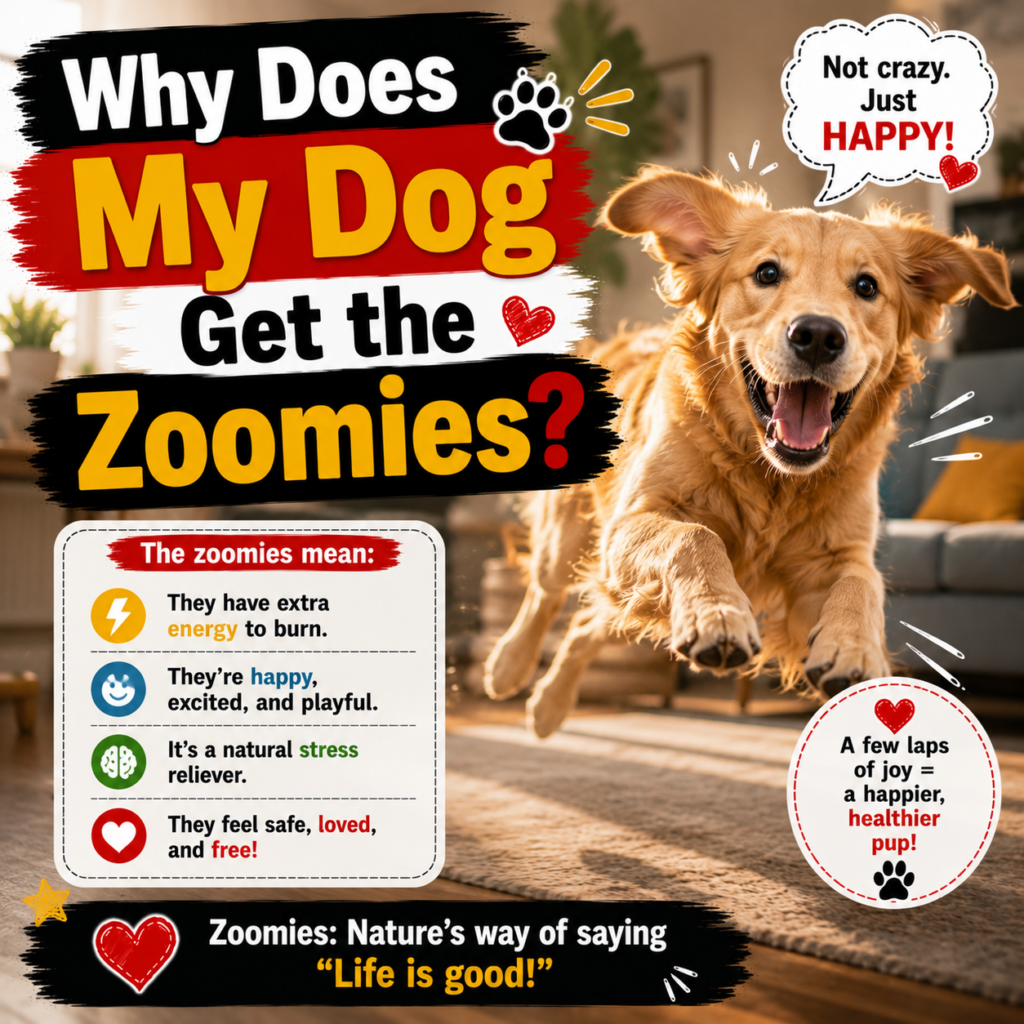
1. The Neurobiological Pressure Valve: Releasing Pent-Up Cortisol
To understand why your dog suddenly transforms into a furry whirlwind, we have to look past our human schedule and step directly into canine emotional homeostasis.
Throughout a typical day, a domestic dog naturally accumulates physical and psychological tension. This build-up isn’t necessarily caused by negative stress; it is simply a collection of baseline arousal hormones like cortisol and adrenaline spinning around their nervous system.
When a dog experiences the zoomies, they are utilizing their large skeletal muscles to execute a rapid, physical chemical dump. By sprinting at top speed, their brain burns through the residual adrenaline and cortisol, dropping their central nervous system back into a peaceful, balanced state of complete relaxation.
2. Tracking the Ultimate Zoomie Catalyst Triggers
While zoomies can look completely random and unprompted, behavioral psychologists have tracked distinct lifestyle milestones that consistently activate a dog’s internal FRAP script.
The Post-Bath Celebration
There is a reason almost every dog on earth gets the absolute highest-velocity zoomies the exact second they are towel-dried after a bath. A bath is an intensely stressful sensory event for a canine—it packs strange perfume scents, wet fur that alters their weight distribution, and a temporary loss of their primary territorial scent profile. The second they escape the tub, the sudden drop in anxiety sets off a massive explosion of relief. They run like wild entities to dry off, restore their body heat, and shake off the emotional tension!
The Poop Zoomie (The Gastrointestinal Rush)
Many pet parents notice their dogs sprint frantically around the yard immediately before or after empty-nesting a bowel movement. This is a fascinating mix of anatomy and neurobiology. A large bowel movement stimulates the vagus nerve, a major neural pathway running between the brain and body. This stimulation can cause a sudden, lightheaded rush of intense physical relief and mild euphoria, causing the dog to translate that good feeling into a full-on celebratory lap around the yard!
At a Glance: Decoding Your Dog’s Zoomie Matrix
Understanding the context of your pup’s high-speed loops can tell you exactly what mixture of play, routine, or relief they are experiencing.
| The Zoomie Catalyst | Accompanying Body Language | The Underlying Scientific Cause | What Your Dog Is Secretly Saying |
| The Post-Bath Sprint | Rubbing their face aggressively on carpets, frantic rolling, body shaking. | Sensory Decompression: Shaking off water weight and artificial perfume stressors. | “I am finally free from the wet zone! I must overwrite this clean scent immediately!” |
| The Evening Ritual (5:00 – 7:00 PM) | Play bows, loose open mouth, inviting direct eye contact from the human anchor. | Circadian Rhythm Spike: A natural biological rise in ancestral hunting/pack activity times. | “The human pack leader is home from the workspace! Let’s transition the energy to active play!” |
| The Cold Weather Blast | High-stepping leaps, head shaking, tail flying high, snapping at air crispness. | Thermoregulation Excitement: Cool air lowers thermal strain, making physical movement effortless. | “The ambient air feels incredibly crisp and cool! My joints feel amazing, let’s sprint!” |
3. The Evolutionary Echo: Ancestral Hunting Hours
If you pay close attention to your household clock, you will likely discover that your dog’s zoomies aren’t as random as they look. Most indoor dogs experience their primary FRAP cycles at two distinct structural checkpoints: early morning right after waking, or early evening right around dinner time.
This timing is a direct evolutionary echo of their wild heritage. Canines are naturally crepuscular animals, meaning their ancestral genetic blueprints hardwire them to be at their absolute peak alertness and physical energy during dawn and dusk—the optimal hunting hours in the wild.
When your dog hits the 6:00 PM zoomie loop, their ancient brain pathways are simply firing a hardwired survival script. Since they don’t have to track down wild prey across an open range to secure food under your roof, they safely redirect that primitive, crepuscular hunting drive into a magnificent, high-octane lap around your living room furniture!
💡 Keeping Your Zooming Pup Safe
Zoomies are a 100% normal, healthy, and vital part of being a happy dog, and you should never scold or punish your dog for expressing their natural energy. However, you can make their high-speed loops safer with a few minor environment tweaks:
- Secure the Footing: If your home features slippery hardwood or slick tile floors, your dog can easily slide out of control, risking a painful ligament tear or joint injury. Toss down secure, non-slip area rugs across their favorite high-velocity corner zones to give them premium traction.
- Do Not Chase Them: If your dog gets the zoomies, never run directly after them in a frantic manner. To a canine brain, a human running toward them mimics an aggressive herding or predatory chase pattern, which can turn their fun zoomie into an anxious, high-cortisol escape sprint. Instead, run away from them or toss a toy to turn it into a cooperative game!
The Bottom Line
When your favorite canine companion hits the zoomie switch and starts flying across your home range like a majestic, unhinged blur, science shows you should sit back and celebrate the moment. It isn’t an act of defiance, and it isn’t a sign of behavioral malfunction. It is a beautiful, involuntary manifestation of a happy, well-adjusted dog letting off a safe burst of evolutionary steam. Your dog runs because they feel completely secure in their home sanctuary, safe under your protection, and biologically bursting with pure, unadulterated joy. Smile, clear a path, and enjoy the show—it is one of the most honest displays of pure happiness in the natural world!