
If you share your home with a parrot—whether it is a tiny, energetic Budgie, a striking Cockatiel, an elite intellectual African Grey, or a magnificent Macaw—you know that living with a bird is a highly sensory experience. Because parrots are non-verbal communication masters, they do not express their inner world using human vocal syntax. Instead, they write their emotions across their bodies, utilizing a complex dialect of eye movements, beak clicks, and feather configurations.
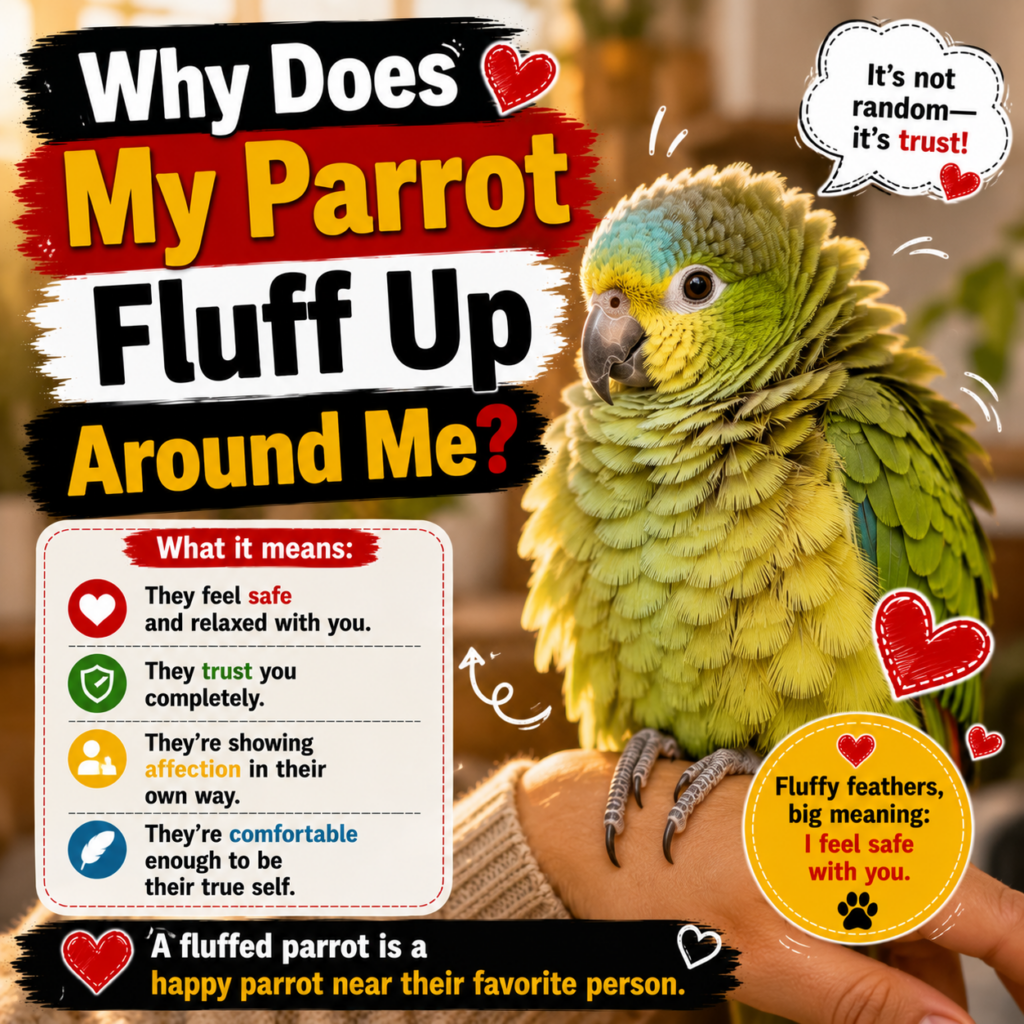
Among these behaviors, one of the most common and fascinating sights is the “feather fluff.” You walk into the room, approach their perch, and your parrot suddenly shakes their body, puffing their feathers out until they look like a soft, round ball.
It is an incredibly cute sight that instantly makes you want to reach out. But as you admire their plush appearance, it leaves you asking an important behavioral question: Why does my parrot fluff up around me?
Is it a sign of pure love, a mechanical physical reaction to room temperature, or a subtle warning that you are violating their boundaries? Let’s look into the cutting-edge science of avian neurobiology and behavior to unlock the true meaning behind the fluff.
1. The Physical Reset: Relieving Environmental and Cognitive Tension
The primary reason your companion parrot fluffs out their feathers when you approach isn’t a complex emotional calculation—it is a healthy, mechanical body reset button.
Parrots possess thousands of individual feathers, each connected to a sophisticated network of tiny subcutaneous muscles controlled by their central nervous system. When a bird sits quietly or focuses intensely on a task (like chewing a wood block or watching a room transition), their muscles accumulate a small baseline of physical and neurological tension.
When you enter their visual range, your presence acts as a positive behavioral catalyst. Your bird fluffs up, shakes their entire frame, and lets out a soft sighing sound. This mechanical movement sheds trapped dander, realigns their feather tracts, drops their baseline cortisol (stress hormone) levels, and transitions their brain into an active, ready state to engage with their human flock mate!
2. Deep Relaxation, Safety, and the “Pre-Nap” Comfort Zone
Beyond a quick physical reset, sustained feather fluffing is the ultimate, universal avian sign of absolute psychological safety and contentment.
In the wild architecture of avian survival, parrots are highly targeted prey animals. To stay alive, their primitive brain pathways keep their feathers pressed tightly and sleekly against their bodies. A sleek profile keeps a bird streamlined, aerodynamic, and ready to take flight at the exact microsecond a predator emerges.
When your parrot sits next to you on a couch or on your shoulder and slowly fluffs out their chest and cheek feathers until their beak is halfway buried in downy fluff, they are rendering themselves completely vulnerable.
By loosening their feathers, they are telling you that their defensive walls have dropped to zero. They feel so safe under your protection that they do not feel the need to maintain an emergency flight posture. It is the avian equivalent of a deep, peaceful human sigh.
At a Glance: Translating Your Parrot’s Feather Fluffing
To accurately interpret what your feathered companion is broadcasting, you must analyze the duration of the fluffing and watch for accompanying body language markers.
| The Fluffing Style | Accompanying Avian Body Language | The Underlying Catalyst | What It Means in Bird Language |
| The Quick Shake-Off | A momentary puff of the whole body, a rapid full-frame shake, followed by a sleek return. | Physical & Neural Decompression: Realigning feathers and clearing dust. | “Whew! I am resetting my body and clearing out tension so I can play with you.” |
| The Relaxed Ball | Slow beak-grinding, sleepy crinkled eyes, standing on one tucked foot. | Absolute Safety & Contentment: Total relaxation within the family flock. | “I feel completely secure in your presence. I am going to decompress and rest easy.” |
| The Crowning Display | Neck feathers puffed, eyes pinning (pupil pinning), fanned tail, pacing the perch. | Hormonal Courting or Territorial Alert: Highly aroused emotional state. | Handle with Caution: “I am claiming this boundary space, back off!” or “I view you as my exclusive mate.” |
| The Continuous Fluff | Wings drooping, eyes dull/closed all day, sitting low on the perch, lethargy. | Thermoregulation Fault / Illness: Attempting to trap body heat due to poor health. | Requires a Vet Evaluation: “My immune system is compromised. I am struggling to stay warm.” |
3. The Evolutionary Mirror: Flock Greeting and Communication Cues
Because parrots are long-lived, highly cognitive flock animals, their survival has depended entirely on building deep alliances with their group mates.
Deep inside their complex forebrain sits an advanced network of mirror neurons. These specialized cells fire when an animal observes an action being performed by a social partner, allowing them to mentally map and mirror emotional states.
When your parrot sees you walk over with a warm, relaxed facial profile and soft body mechanics, their mirror neurons register that the environment is peaceful.
By fluffing out their head and neck feathers and bowing their head toward you, they are requesting a social grooming session (allopreening). In wild flock dialect, allowing a trusted partner to preen the feathers around the eyes and neck—areas the bird cannot physically reach themselves—is the absolute highest display of mutual trust and familial love.
⚠️ The Critical Red Flag: Continuous Fluffing vs. Illness
While 90% of fluffing behaviors around you are beautifully positive, every bird parent must understand the avian sick mask. Because wild birds hide illness to avoid tracking by predators, a sick parrot will suppress their symptoms until they physically cannot handle them anymore. If your parrot stays puffed up like a ball for hours at a time, crouches low on the perch with drooping wings, and closes their eyes constantly when you aren’t actively engaging with them, this is a medical emergency. They are fluffing their feathers continuously to trap a layer of warm air against their skin because their body is burning metabolic energy to fight an internal infection. Seek an avian veterinarian immediately!
How to Correctly Respond to Your Parrot’s Feather Language
To permanently protect your connection and keep your bird’s emotional baseline balanced, adjust your social feedback loops using these science-backed animal psychology tips:
- Offer Safe Allopreening: If your parrot approaches you, fluffs their cheek feathers, and lowers their head, they are asking for a head scratch. Use a gentle, soft touch to preen the pinfeathers strictly around their head, cheeks, and neck. Avoid petting them down their back, wings, or torso, as these areas carry heavy reproductive nerve pathways that can trigger stressful, frustrated hormonal courting loops.
- Respect the “Pre-Nap” Grinding: If your bird is puffed up and starts sliding their upper and lower beak mandibles together to create a soft, clicking, grinding sound, leave them be. Beak-grinding is the ultimate sign that their hyper-vigilant prey instincts have completely dropped for the evening. It proves they are drifting off into a deep, happy sleep cycle, confident that their human guardian is watching the room range.
- Provide Complex Brain Enrichment: If you notice your bird’s quick fluff-and-shakes turning into frustrated, frantic feather-plucking or pacing, their brilliant brain is starving for stimulation. Turn your home into a safe sanctuary by introducing complex cardboard foraging boxes, hidden seed puzzles, and fresh branches to safely chew through.
The Bottom Line
When your favorite feathered shadow looks directly into your eyes and fluffs up their feathers around you, science shows you are witnessing a profound, multi-layered display of avian trust and intelligence. Driven by an evolutionary need to mechanically shed muscle tension, a primal desire to initiate deep flock bonding, and a neurochemical state that feels 100% safe from environmental threats, their puffing is a beautiful validation of your care. Treat their expressive body language with the deep patience, love, and mental enrichment it deserves—it is just another wonderful daily reminder that you are the absolute anchor of their vibrant world!