
It is a heartwarming daily ritual that every dog parent knows by heart. Your dog approaches you with a loose, fluid gait, their tail executing a relaxed “noodle wag.” Suddenly, they drop to the floor planks, roll onto their back, splay their legs into the air, and look up at you with soft, squinty eyes.
The message is loud, clear, and completely non-verbal: “Please scratch my belly right now.”
The exact second your fingers make contact with their exposed underside, your dog enters a state of visible euphoria. Their back leg might start kicking like a rhythmic piston, their jaw drops open into a happy canine smile, and they let out a deep, satisfied structural sigh.
This universal canine obsession leaves many pet parents asking a classic behavioral question: Why do dogs love belly rubs so much?
Is it just a simple, feel-good physical itch, or is there a deep, neurobiological and evolutionary blueprint that turns a basic tummy scratch into an elite emotional experience? Let’s dive into the cutting-edge neuroscience of canine cognitive psychology to unlock the truth.
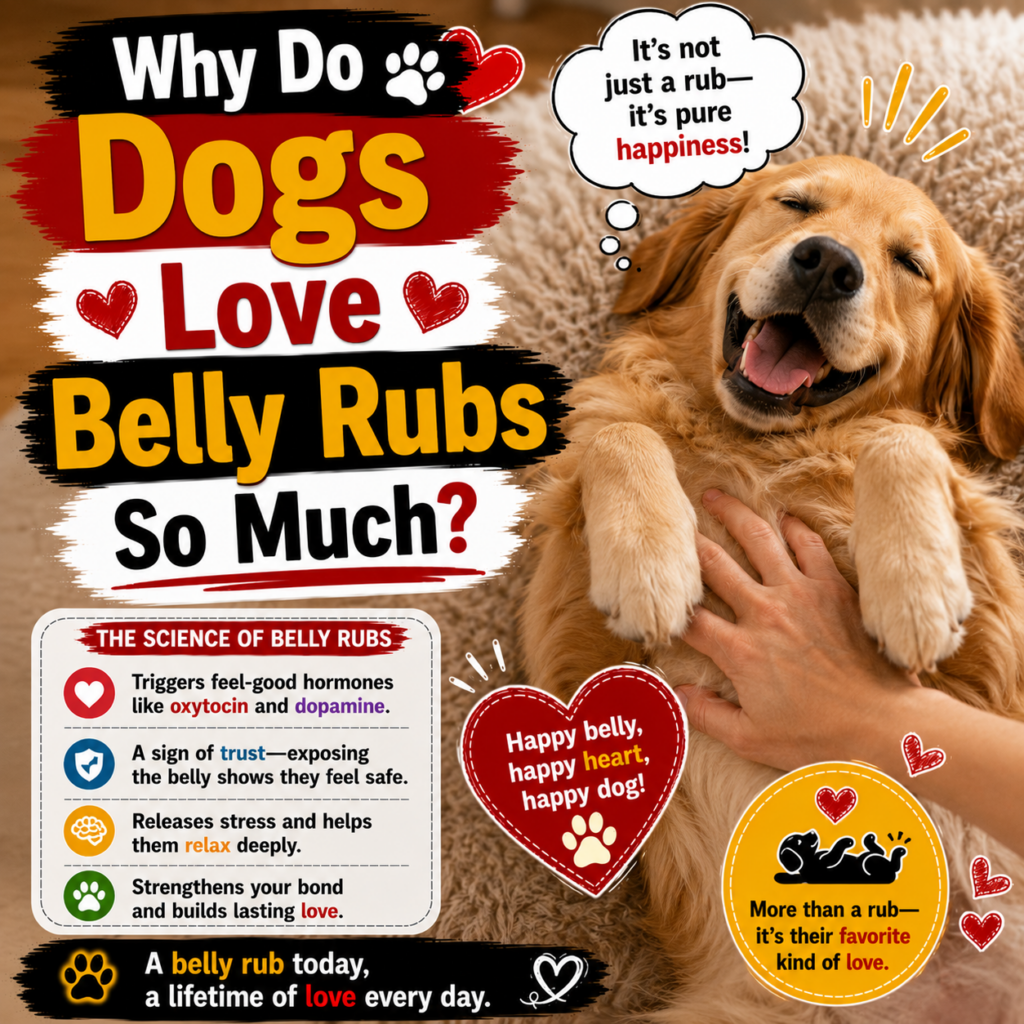
1. The Superpowered Nerve Highway: Stimulating the Hair Follicles
The primary reason your canine companion melts into a puddle during a belly rub isn’t just a subjective preference—it is a direct manifestation of advanced sensory neurobiology.
While humans enjoy a back massage or a head rub, a dog’s underside is engineered around a highly specialized network of tactile receptors. A dog’s belly features a much lower density of guard hairs and a significantly higher concentration of sensitive hair follicles equipped with microscopic nerve endings.
When you scratch or rub your dog’s exposed stomach, you aren’t just petting their skin; you are actively firing up an elite neural highway. This specific touch stimulates specialized mechanoreceptors that send lightning-fast signals straight to their brain’s reward centers, flooding their central nervous system with endorphins and dopamine.
It delivers a distinct physical pleasure that easily eclipses a standard scratch behind the ears!
2. The Oxytocin Mirror: The Ultimate Bond Stabilizer
Beyond the raw physics of tactile nerve stimulation, receiving a belly rub is a deeply sacred emotional milestone that relies heavily on a powerful mammalian hormone: oxytocin.
Oxytocin is often referred to by cognitive neuroscientists as the “love, trust, and social bonding molecule.” It is the exact same chemical that fires when a human mother locks eyes with her newborn child, cementing an unshakeable maternal alliance.
Neuroscientific fMRI brain imaging tracks a magnificent phenomenon during a tummy-scratch session:
The Shared Oxytocin Mirror Loop:
When a dog parent sits on the floor and delivers steady, loving belly rubs to their pup, both the human and the canine experience a massive, simultaneous spike in oxytocin levels.
This chemical surge triggers an immediate drop in cortisol (the stress hormone), lowering your pup’s resting blood pressure and stabilizing their resting heart rate. Your dog begs for a belly rub because your hand operates like a biological security blanket, drowning their brain in a wave of unconditional love and safe domestic comfort.
At a Glance: Decoding Your Dog’s Underbelly Body Language
Not every rollover is an open invitation for physical contact. Dog parents must learn to differentiate between a true request for love and a defensive survival script.
| The Posture | Accompanying Body Language | The True Emotional State | What It Means in Dog Language |
| The Joyous Flop | Loose open jaw, soft squinty eyes, slow tail-wag, completely limp muscle weight. | Pure Trust & Contentment: Actively soliciting physical bonding. | “I feel 100% safe in our household territory. Please deliver my premium belly scratch now!” |
| The Submissive Freeze | Stiff rigid frame, tail tucked tightly against the groin, lip-licking, showing the whites of eyes (whale eye). | Fear / Social Appeasement: Attempting to diffuse an erratic or threatening variable. | “I am completely non-threatening and submissive. Please do not harm me or invade my boundary lines.” |
| The Kick Reflex | One hind leg thumping rhythmically while you scratch a specific, localized zone. | Involuntary Spinal Reflex: Stimulating a phantom itch network. | “Ooh, you hit the exact spot! My nerves are misfiring a walking command, but it feels incredible!” |
3. The Evolutionary Blueprint: The Ultimate Display of Structural Trust
Why does the act of displaying the stomach carry so much weight in canine behavioral psychology? The answer is written directly into their ancestral evolutionary history.
In the wild architecture of survival, an animal’s underbelly is their absolute weakest, highest-risk structural anatomical zone. It houses all of their life-sustaining internal organs—their stomach, liver, and major blood supply vessels—completely unprotected by a rigid rib cage or dense skeletal plating.
When your dog voluntarily collapses onto their back and exposes their belly to you, they are executing the ultimate act of psychological surrender.
They are placing themselves in a physically helpless position, turning their primary blind spots and high-vulnerability targets over to you. By doing this, their primitive brain tracks your historical record and concludes with absolute confidence: “This human is my trusted pack leader. They will protect my nest range, not violate my safety.”
💡 The Secret of the Leg Kick: Is It a Good Sign?
Have you ever hit a specific, localized sweet spot on your dog’s rib cage or lower belly that causes one of their hind legs to start scratching the air frantically? This is known as the scratch reflex. It is an completely involuntary, spinal-cord reflex designed as a wild survival mechanism to shake off biting parasites, fleas, or stinging insects. While it looks hilariously cute and can indicate you’ve found a highly stimulating nerve cluster, it isn’t an intentional expression of joy. If your dog turns their head or tenses their jaw when the leg kicks, move your hand to a broader, smoother stroking motion to keep the experience completely relaxing!
The Bottom Line
When your favorite canine shadow drops to the carpet range and proudly offers you their belly, science shows you should celebrate it as the ultimate moral compliment an animal can give. They aren’t behaving out of random territorial dominance, and they aren’t just executing a basic trick for resource rewards. Driven by an elite neural network packed with hyper-sensitive hair follicles, a powerful neurochemical loop that bathes both your brains in loving oxytocin, and an ancient pack drive that views you as their ultimate family sanctuary, their tummy roll is a beautiful monument to your bond. Drop what you are doing, sit on the floor, and deliver that scratch—it is the ultimate, living proof that you are the absolute center of their intelligent, loving universe!