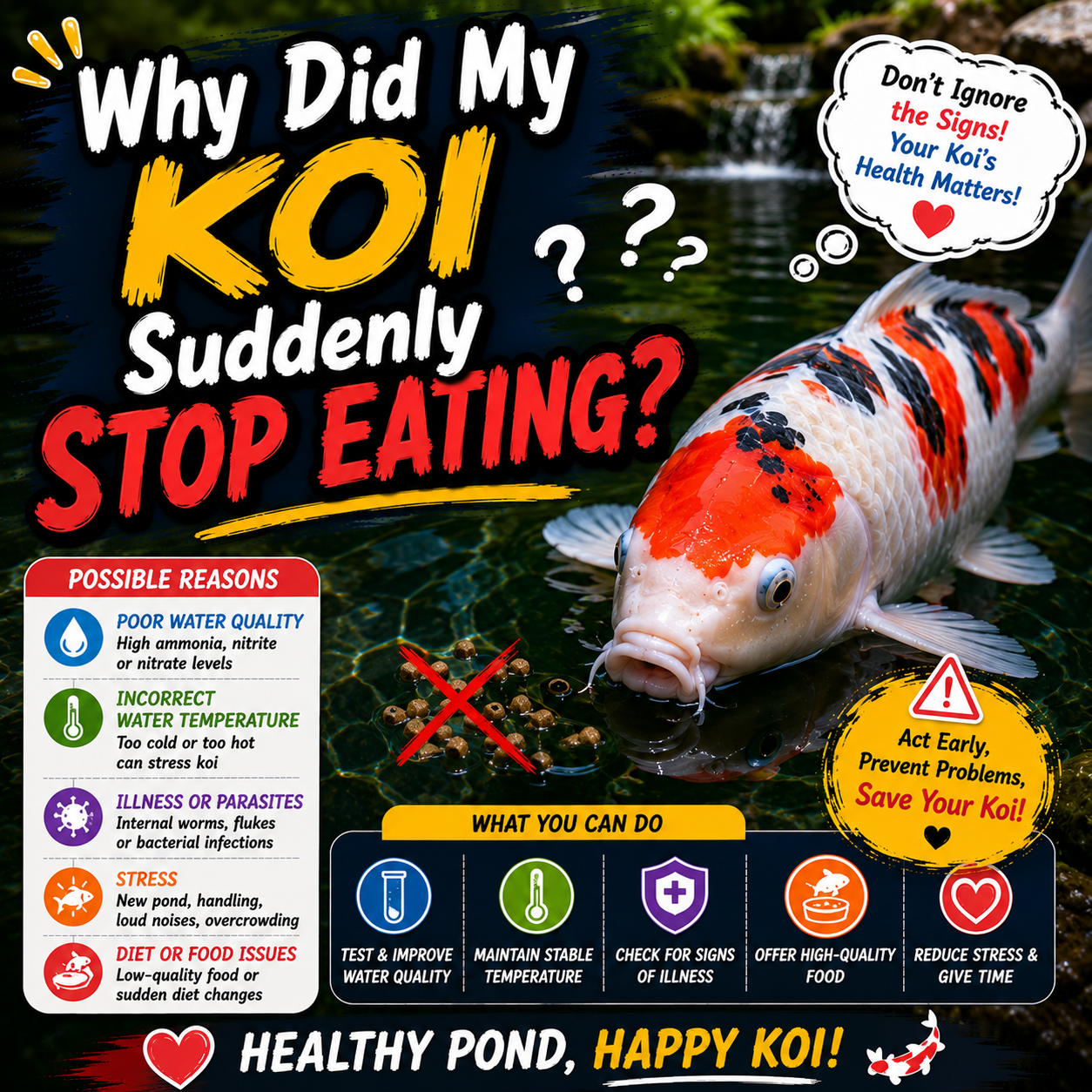
There are few sights more rewarding for a pond keeper than walking up to the water’s edge and being greeted by an enthusiastic, swirling vortex of colorful koi eager for their morning meal. Koi are famous for their massive appetites and active foraging habits.
Because they are naturally greedy eaters, a sudden behavioral shift where your koi completely ignore food is a major red flag. In the aquatic world, a sudden loss of appetite is one of the first and most reliable distress signals a fish can send.
So, why did your koi suddenly stop eating? Let’s look at the biology of these “living jewels” and uncover the 5 critical reasons behind this behavior, along with how to fix it fast.
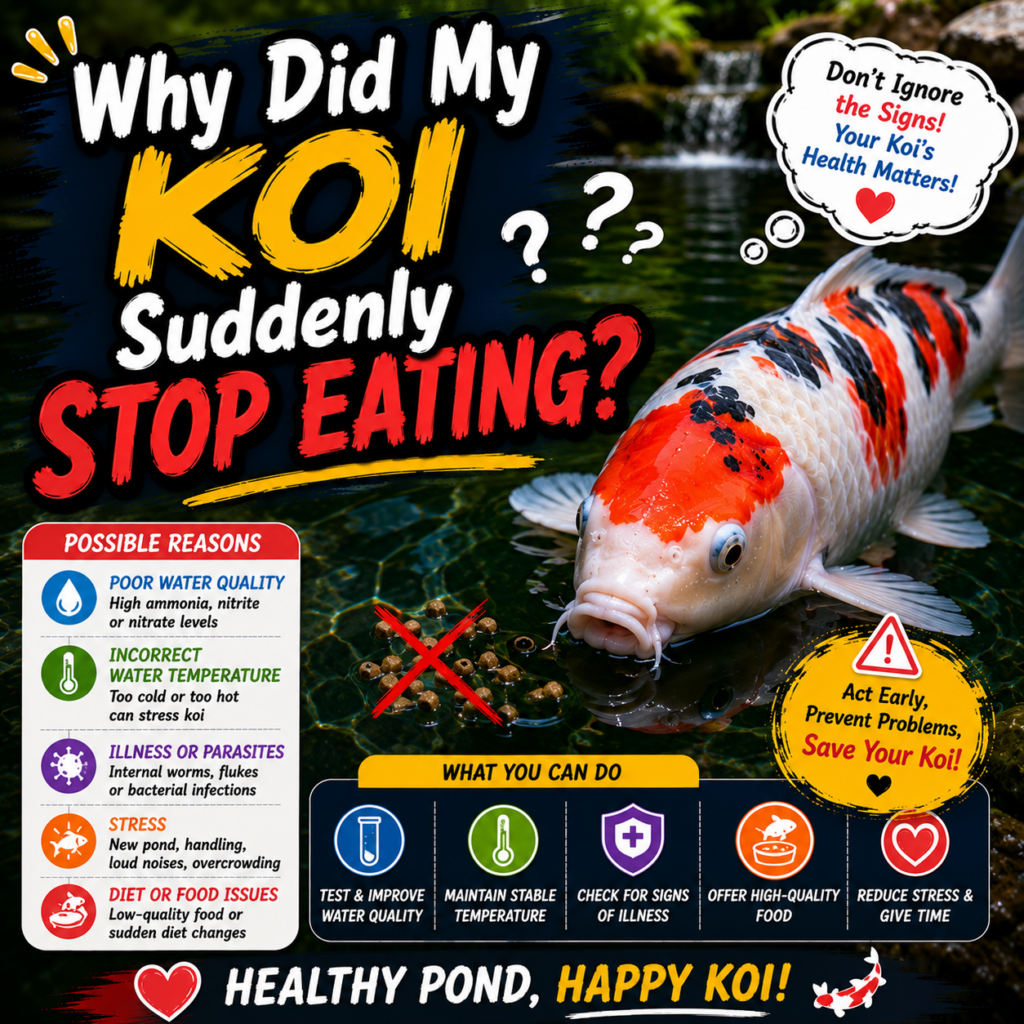
1. A Sudden Drop in Water Temperature (The Metabolic Switch)
Before you worry about complex pathogens, look at your pond thermometer. Because koi are ectothermic (cold-blooded) reptiles and fish, their internal metabolism is governed entirely by the temperature of the water around them.
As water temperatures cool down, a koi’s digestive tract slows to a crawl.
- The Behavioral Threshold: When water temperatures drop below 50°F to 53°F (10°C to 12°C), a koi’s ability to produce digestive enzymes disappears completely. They will instinctively stop eating to prevent food from sitting and rotting inside their gut.
- The Fix: If autumn or winter is setting in, this is completely normal. Stop feeding them standard food entirely and switch to a light, easily digestible wheatgerm pellet if temperatures are still hovering just above the cutoff point.
2. Spikes in Toxic Ammonia or Nitrites (Poor Water Chemistry)
If the weather is blazing hot but your fish are boycotting dinner, your water quality has likely crashed. Koi produce heavy organic bioloads. If your biological filter is overwhelmed, invisible toxins will accumulate rapidly.
High levels of ammonia or nitrites act like chemical acid on a fish. It severely burns their delicate gills, irritates their slime coat, and induces extreme physical stress. A fish that is struggling to breathe due to chemical burns will completely refuse food.
- The Action Plan: Instantly test your pond water using a liquid droplet testing kit. If ammonia or nitrites register above 0 ppm, perform an immediate 25% to 30% water change, add a heavy dose of water conditioner to neutralize toxins, and back off on feeding until the filter restabilizes.
3. Microscopic Parasites or Bacterial Infections
If your water chemistry is flawless but one or two specific koi are refusing to eat, an underlying medical issue is brewing.
Microscopic parasites (such as Ich, Costia, or skin flukes) or internal bacterial infections drain a koi’s physical energy. When a fish is fighting an illness, its metabolic drive shuts down so it can redirect all energy toward its immune response.
⚠️ Look for Accompanying "Sick Fish" Signals:
[ Flashing ]     ──► Swimming erratically and scraping their sides against pond walls.
[ Clamped Fins ] ──► Hovering near the bottom with their fins pinned tightly to their sides.
[ Isolation ]    ──► Separating themselves from the school, sitting alone near water returns.
- The Fix: Move the sick individual into a separate, aerated quarantine tank and consult an exotic vet or koi specialist for a targeted parasite scrape or antibacterial medication.
4. Severely Low Dissolved Oxygen Levels (Hypoxia)
Digesting a heavy meal requires an immense amount of metabolic oxygen. If your pond lacks proper aeration, your koi will recognize that eating could literally cause them to suffocate.
Oxygen levels naturally drop to dangerous lows during hot summer nights, during sudden atmospheric storm fronts, or if your pond has a massive green algae bloom (since dying algae consumes oxygen).
- The Sign: If your koi are not eating and are instead gathering near the waterfall or hovering at the surface gasping for air (piping), your pond is critically low on oxygen.
- The Fix: Turn on heavy-duty air pumps, add extra air stones, and keep your waterfalls running 24/7. Never turn off your aeration systems at night!
5. Predator Stress (A Recent Fright)
Did a blue heron, raccoon, or neighborhood cat visit your garden pond last night? Even if the predator failed to catch a fish, the mere attempt triggers a massive surge of adrenaline and fear throughout the entire school.
Koi have highly developed survival instincts. If they are terrified, they will enter a defensive lockdown phase. They will hide in the deepest zones of the pond, stay perfectly still, and refuse to rise to the surface to eat floating pellets because they view the surface as a lethal danger zone.
- The Fix: Be patient. Give them 24 to 48 hours to calm down. You can temporarily drop a few sinking pellets to the bottom so they can eat safely in hiding while you invest in predator decoys or surface netting to secure the perimeter.
The Appetite Diagnostic Checklist
Use this quick matrix to guide your next steps:
| Accompanying Symptoms | Likely Root Cause | Immediate Solution |
| Water is below 50°F (10°C). | Normal Seasonal Hibernation | Stop feeding completely until spring. |
| Fish are scraping against rocks (flashing). | Parasite Infestation | Treat pond with safe anti-parasitic metrics. |
| Fish are gasping at the surface (piping). | Critical Oxygen Shortage | Crank up air pumps and waterfalls immediately. |
| Water test shows Ammonia > 0 ppm. | Filter Failure / Overstocking | Perform a 30% water change and add a water conditioner. |
Conclusion: Act on the Signal
At the end of the day, a koi that suddenly stops eating is issuing a biological warning. Before tossing more pellets into the water—which will only rot and make the water worse—grab your pond thermometer and your water testing kit. By checking your temperatures, clearing out invisible chemical spikes, and maximizing your oxygen levels, you will quickly restore the health, safety, and legendary appetites of your aquatic companions!