
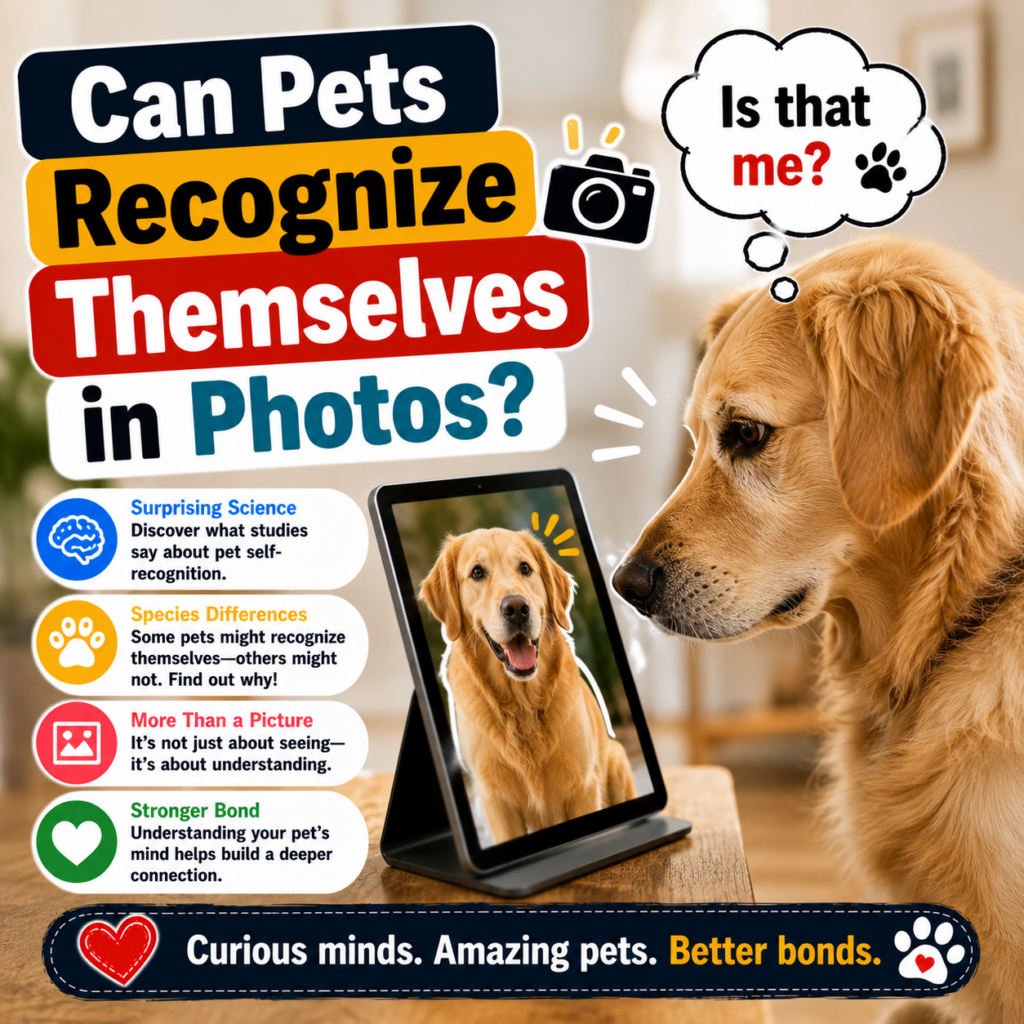
We live in a golden age of pet photography. Our smartphones are packed with thousands of portraits of our dogs sleeping in awkward positions, our cats staring elegantly into space, and our parrots striking colorful poses. Naturally, we love showing these pictures to our animals, pointing at the screen and saying, “Look! That’s you!”
Sometimes, your pet might stare intensely at the phone, paw at the screen, or let out a soft whine.
This behavior leaves many pet parents asking a fascinating question: Can pets recognize themselves in photos? Do they actually look at a digital image and understand their own identity, or are they seeing something completely different through their unique animal eyes? Let’s look into the cutting-edge neuroscience and evolutionary psychology behind animal vision to find out.
1. The Mirror Test vs. The Photo Dilemma
To understand if an animal can recognize itself in a 2D photograph, we first have to look at how science measure. For decades, the gold standard has been the Mirror Self-Recognition (MSR) test, developed by psychologist Gordon Gallup Jr. in 1970.
In this test, a harmless, odorless mark is placed on an animal’s body in a spot they can only see using a mirror. If the animal looks in the mirror and touches the mark on their own body, it proves they possess an abstract concept of self.
Who Passes the Test?
Only a very elite club of highly cognitive animals have ever passed the visual mirror test:
- Chimpanzees and Orangutans
- Bottlenose Dolphins
- Asian Elephants
- Eurasian Magpies
Domestic dogs and cats fail the visual mirror test completely. Because they cannot even recognize their own real-time reflection in a moving mirror, it is scientifically impossible for them to recognize their static self in a 2D photograph.
2. The Olfactory Blindspot: Why Photos Mean Nothing to a Dog
The biggest mistake we make as human parents is projecting our visual-first worldview onto our pets. Humans are primates; our brains are hardwired to process reality primarily through sight.
Dogs, however, live in an olfactory universe.
A dog’s sense of smell is up to 100,000 times more sensitive than ours. They map their identity, territory, and family unit entirely through pheromones and scent anchors. When a dog looks at a photo of themselves, they see shapes and colors, but there is a 0% scent profile. To a dog’s brain, an entity that has a face but absolutely no smell is a logical impossibility. It is simply ignored as meaningless environmental static.
At a Glance: How Different Pets Process 2D Images
Every companion animal utilizes a distinct sensory blueprint to analyze screens and printed photographs.
| Pet Type | Primary Sensory Driver | Can They See the Image? | Do They Recognize Themselves? |
| Dogs | Olfactory (Smell) | Yes, but modern screens often look like a flickering flipbook due to their high flicker-fusion frequency. | No. Without a unique scent signature, the image carries zero personal meaning. |
| Cats | Movement & Depth | Yes, but they struggle with 2D depth perception and flat, static shapes. | No. They require motion cues and pheromone markers to recognize any living entity. |
| Birds (Parrots) | Visual (Ultraviolet) | Yes, with extreme clarity. Their vision is far superior to human vision. | No, but they recognize species. They might react to a photo of a bird, but think it is a rival or a flock mate. |
3. What Does a Cat See When Looking at a Phone?
If you hold a smartphone in front of your cat’s face, they might sniff the corner or focus on the screen for a brief second before walking away.
Cats are ambush predators whose eyes are highly attuned to detecting rapid, horizontal movements in low-light environments. They struggle to see objects clearly if they are closer than 25 centimeters (10 inches) from their eyes, making a smartphone screen blurry up close.
Furthermore, cats do not possess the cognitive hardware for two-dimensional representation mapping. They cannot look at a flat piece of glass and translate those pixels into a three-dimensional concept of an animal. If they see a photo of another cat, they might react briefly to the silhouette, but they will never look at it and realize, “Hey, that’s me from last Tuesday!”
💡 The Olfactory Mirror Test: The True Measure of Canine Self-Awareness
Just because dogs can’t recognize themselves in a photo doesn’t mean they aren’t self-aware. In a brilliant study, animal behaviorist Dr. Alexandra Horowitz developed the “Yellow Snow” test. She presented dogs with canisters containing their own urine scent and the urine of other dogs. The dogs spent significantly less time sniffing their own scent, proving they have a clear, sophisticated understanding of “self” vs. “other”—they just write that identity in smells, not pictures!
4. Parrots: The Visual Exception (But There’s a Catch)
Exotic pet birds like African Greys or Macaws possess an absolutely magnificent visual system. They see a wider spectrum of colors than humans, including ultraviolet (UV) light, and their brains process visual data at a much higher speed.
If you show a parrot a high-definition photograph of a bird, they will see it with pristine, crystal clarity.
However, their reaction is driven by flock genetics, not self-awareness. If you show a lonely parrot a photo of another bird, they may bob their head, vocalize, or display mating behaviors. They don’t realize they are looking at their own image; they genuinely believe a completely new flock member or a rival has suddenly appeared in their territory.
The Bottom Line
While it is a beautiful human sentiment to think our animals are admiring their own portraits on our phones, the scientific reality is that pets cannot recognize themselves in photos. Dogs are blinded by the lack of scent, cats are restricted by flat 2D shapes, and birds see a stranger rather than a reflection.
But don’t let that discourage you from taking photos! Your furbaby or feathered companion doesn’t need a digital image to know who they are. They find their true purpose, identity, and ultimate safety right beside you—written in the real-time warmth of your presence, the sound of your voice, and the loving bond you share every single day.