
We have all witnessed it or experienced it firsthand. A new person walks into your home range. On paper, they are completely polite, friendly, and smiling. Yet, your normally social dog stays rooted in the corner, letting out a low, vibrating growl, or your affectionate cat vanishes underneath the deepest bed cabinet the exact second they step through the door.
Instantly, an eerie thought crosses your mind: “Does my pet see something I can’t? Can animals inherently smell evil or sense bad people?”
It is a deeply rooted cultural belief that a pet’s judgment of character is a foolproof moral compass. But can pets truly sense bad people?
Are they tapping into a mystical, supernatural aura, or is there a perfectly rational, hyper-developed sensory and neurobiological explanation behind their dramatic character reviews? Let’s look into the cutting-edge science of canine, feline, and avian cognitive psychology to uncover the truth.
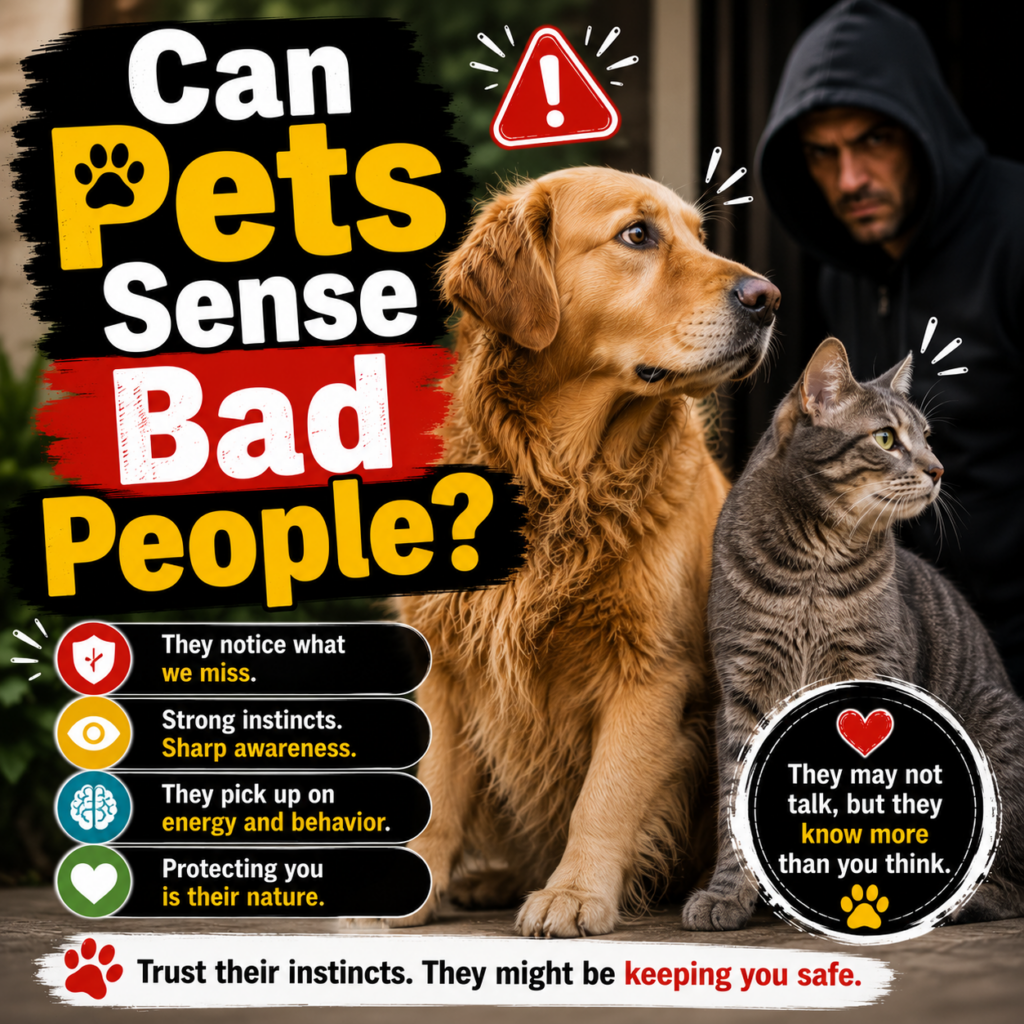
1. The Walking Chemical Print: Smelling Human Cortisol and Adrenaline
The primary reason your pet reacts intensely to certain individuals isn’t a supernatural moral filter—it is a superpowered biochemical tracking engine.
Humans are visual-first creatures, but dogs and cats experience the surrounding world through an advanced grid of chemical pheromones. To a dog’s nose—which possesses up to 300 million olfactory receptors compared to a human’s mere 6 million—or a cat’s highly specialized Jacobson’s organ, human emotions carry a distinct physical scent.
When a person enters your household territory harboring hidden anger, tense anxiety, social hostility, or a deceptive mindset, their body undergoes a chemical shift, secreting cortisol and adrenaline through their sweat glands and breath.
Your pet cannot read their human mind, but they can physically smell the biochemical stress print of a high-risk person. They do not label the person as “morally bad”; they simply classify them as an erratic, unpredictable threat to the safety of the nest.
2. Master Decoders of Human Micro-Body Language
Beyond their olfactory prowess, domestic companion animals and highly cognitive exotic birds are world-class observers of human body mechanics and facial profiles.
Because domestic pets have co-evolved alongside humans for thousands of years, their survival has depended entirely on cracking the code of human behavioral patterns. They notice tiny physical cues that pass completely under our human radar.
A person who dislikes animals, feels uncomfortable, or is harboring negative intentions will display specific micro-tension signals:
- Stiffening their shoulder posture and moving with rigid, unnatural kinetic weight.
- Holding a long, unblinking, direct stare—which in wild canine and feline language is interpreted as an aggressive predatory challenge.
- Altering their vocal frequency, using a forced, tight pitch that does not match their smiling micro-expressions.
When your pet backs away or growls, they are reacting to these subtle, discordant physical cues. They spot the internal tension behind the fake human smile long before you do.
At a Glance: How Different Pets Assess New Human Guests
Every domestic species utilizes a distinct sensory playbook to evaluate whether a new human guest is a safe asset or an environmental risk.
| Pet Type | Their Main Character Evaluation Tool | What Their Red Flag Reaction Looks Like | The Root Biological Mechanism |
| Dogs | Olfactory tracking + tracking human social fairness. | Staying frozen by your shins, low vibrating growl, or direct tail-tuck. | Pack Protection: Scanning for chemical adrenaline spikes and micro-body stiffness. |
| Cats | Environmental predictability & territory defense. | Disappearing completely into dark corners, dilated pupils, or a thumping tail. | Apex Prey Instincts: Refusing to engage with loud, high-energy, or unpredictable kinetic movements. |
| Birds (Parrots) | High-definition visual mapping & pupil tracking. | Pinning their eyes, puffing back neck feathers, or emitting a sharp flock alarm call. | Flock Survival: Pinpointing direct eye stares and forced vocal pitches as immediate hawk/predator threats. |
3. The Social Fairness Mirror: The Kyoto University Study
If you think your pet is only tracking basic scents, think again. A fascinating, groundbreaking study conducted by behavioral psychologists at Kyoto University in Japan demonstrated that dogs actively monitor human social interactions and reject people who treat their owners poorly.
The Experiment:
Researchers had dog owners attempt to open a sealed plastic container while their dog watched closely. The owners asked two actors for assistance.
- Condition A: The actor actively helped the owner open the box.
- Condition B: The actor sat completely still and ignored the request.
- Condition C: The actor aggressively refused to help, turning their body away with a harsh gesture.
The Brilliant Result:
After the scene unfolded, the actors offered high-value treats to the observing dogs. The dogs happily accepted food from the helpful actors and the neutral actors. However, the vast majority of the dogs flatly refused to take food from the actor who was rude to their owner.
This study proved that companion dogs use their cognitive brainpower to judge how humans interact with their primary human anchor, actively blacklisting people they perceive as unsupportive or hostile to their family pack!
💡 The Emotional Mirror Effect
Sometimes, your pet’s negative reaction to a new person has absolutely nothing to do with that person’s character—it is a direct reflection of your internal anxiety. Pets possess an uncanny ability to mirror our emotional baselines. If a guest enters your home range and you internally feel stressed, protective, or nervous, your dog or cat instantly logs your physical heart rate spike and subtle shift in breathing. They conclude: “My human leader is frightened of this person, which means I must be on high alert too!”
The Bottom Line
Do pets possess a magical, supernatural radar to sense bad people? Not quite—but their elite evolutionary senses are so advanced that they might as well be magic. When your furbaby or feathered soulmate rejects a new human guest, they are executing a masterclass in survival analysis. By tracking chemical cortisol secretions, mapping human micro-body tension, and actively analyzing social fairness, they protect the integrity of the home sanctuary. Trust their brilliant biological filter—it is just another wonderful daily reminder that your animal companions are fiercely dedicated to keeping you safe, balanced, and loved under your own roof!