
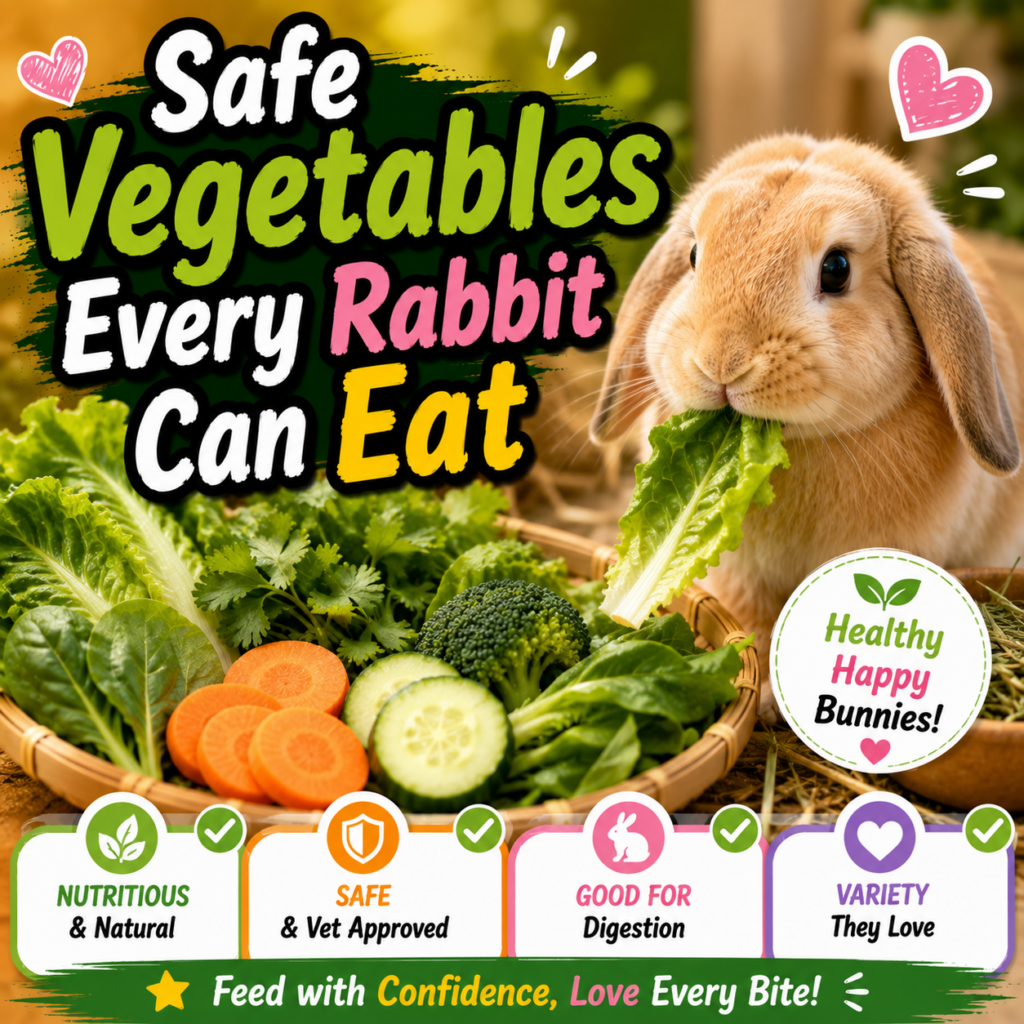
If you’ve ever watched a rabbit joyfully munching on a piece of crisp lettuce, you know how much these animals love their fresh greens. Providing fresh vegetables is one of the best ways to keep your bunny hydrated, mentally stimulated, and packed with essential vitamins.
However, a rabbit’s digestive system is incredibly sensitive. While they are herbivores, not all vegetables are created equal. Feeding the wrong green—or too much of it—can disrupt their delicate gut bacteria and lead to a life-threatening condition called GI Stasis (Gastrointestinal Stasis).
So, what are the safe vegetables every rabbit can eat daily? Let’s unpack the ultimate bunny-safe veggie list and learn how to build the perfect salad for your pet.
The Golden Rule: Hay First, Veggies Second
Before loading up your rabbit’s bowl, it is vital to understand the foundational pyramid of rabbit nutrition. Fresh vegetables should never replace their primary food source.
- 80–85% of their diet must be fresh, high-quality Timothy hay or orchard grass. Hay provides the essential fiber needed to keep their digestive tract moving and wear down their continuously growing teeth.
- 10–15% of their diet should be a variety of safe, fresh vegetables.
- 5% of their diet should consist of fortified pellets and occasional treats.
Daily Leafy Greens: The Core of Your Bunny’s Salad
The majority of your rabbit’s fresh food intake should consist of dark, leafy greens. As a rule of thumb, you can offer 1 cup of packed leafy greens per 2 pounds (1 kg) of adult body weight every day. Try to mix 3 different types from this list to ensure a balanced nutrient profile:
- Romaine Lettuce: Crisp, highly hydrating, and a universal bunny favorite. (Note: Avoid Iceberg lettuce entirely, as it contains zero nutritional value and can cause severe diarrhea).
- Red and Green Leaf Lettuce: Gentle on the stomach and perfectly safe for daily consumption.
- Bok Choy: An excellent source of vitamins and minerals.
- Cilantro (Coriander): Highly fragrant, delicious, and fantastic for a rabbit’s digestion.
- Parsley: Packed with iron, though it should be rotated occasionally due to its moderate calcium content.
- Mint and Basil: Perfect aromatic herbs that rabbits absolutely love. They are also great for encouraging a sick rabbit to start eating again.
- Watercress: A nutrient-dense option that adds a nice variety to their daily bowl.
Non-Leafy Vegetables: Feed in Moderation (Treats)
These crunchy vegetables are safe but should be limited to small portions—about 1 tablespoon per 2 pounds of body weight per day—because they are denser or contain higher amounts of natural sugars and starches.
- Bell Peppers: Green, red, and yellow bell peppers are safe, crunchy treats packed with Vitamin C. (Always remove the seeds and stem first).
- Cucumber: Incredibly hydrating and cooling during hot summer months. Feed in small slices to avoid watery stools.
- Zucchini: Mild and perfectly safe in small cubes.
- Celery: Highly crisp and loved by bunnies, but its long fibers can act like strings in their digestive tract. Always chop celery into tiny, bite-sized pieces before feeding.
The Truth About Carrots: Use Like Candy!
Thanks to popular cartoons, almost everyone assumes rabbits should eat carrots all day long. In reality, carrots are incredibly high in sugar.
Feeding your rabbit a whole carrot is equivalent to giving a human child a giant bag of candy. It can cause dental decay, obesity, and severe stomach upsets. You should only feed carrots (and carrot tops) as an occasional, bite-sized reward.
Vegetables to AVOID Completely ❌
Some household vegetables are highly toxic, cause dangerous gas buildup, or block calcium absorption in rabbits. Keep these completely away from your bunny’s cage:
- Iceberg Lettuce: Contains laudanum, which can be toxic in large quantities, and is mostly water, leading to diarrhea.
- Onions, Garlic, Leeks, and Chives: These belong to the allium family and cause hemolytic anemia (destroying red blood cells).
- Potatoes and Sweet Potatoes: Way too high in starch and carbohydrates, which completely shuts down a rabbit’s cecum.
- Rhubarb: All parts of the plant are highly toxic to rabbits.
- Tomato Leaves and Stems: While a tiny piece of tomato fruit is a rare, safe treat, the green parts of the plant contain toxic solanine.
How to Introduce New Vegetables Safely
To avoid shocking your bunny’s stomach, always follow the One-at-a-Time Rule:
- Start Small: Introduce only one new vegetable at a time, offering a piece no larger than a postage stamp.
- Monitor for 24 Hours: Watch your rabbit’s behavior and droppings closely. If their poop remains round, hard, and dry, the veggie is safe.
- Watch for Wet Stools: If you notice soft droppings, diarrhea, or a loud, gassy tummy, stop feeding that vegetable immediately and stick to a strict diet of pure Timothy hay and water until they recover.
Conclusion: Variety and Balance Make a Happy Bunny
Feeding fresh vegetables is a wonderful way to bond with your rabbit and keep their meals exciting. By building a daily salad based on safe leafy greens like romaine lettuce and cilantro, tossing in a few crunchy slices of bell pepper as a treat, and keeping sugars at bay, you’ll ensure your fluffy companion stays happy, vibrant, and bouncing for years to come!