
Few things match the serene beauty of watching koi move smoothly across a garden pond. However, if you notice one or more of your koi fish swimming in repetitive circles, loops, or tight spirals, it can instantly disrupt that peace and trigger a wave of worry.
In the aquatic world, circular swimming is a highly telling symptom. While it can sometimes be a perfectly normal part of their social or reproductive lives, it can also serve as a critical warning sign of environmental stress, poor water chemistry, or neurological damage.
So, why do your koi fish swim in circles? Let’s break down the fascinating psychology and biology behind this behavior, helping you separate completely normal behavior from urgent medical emergencies.
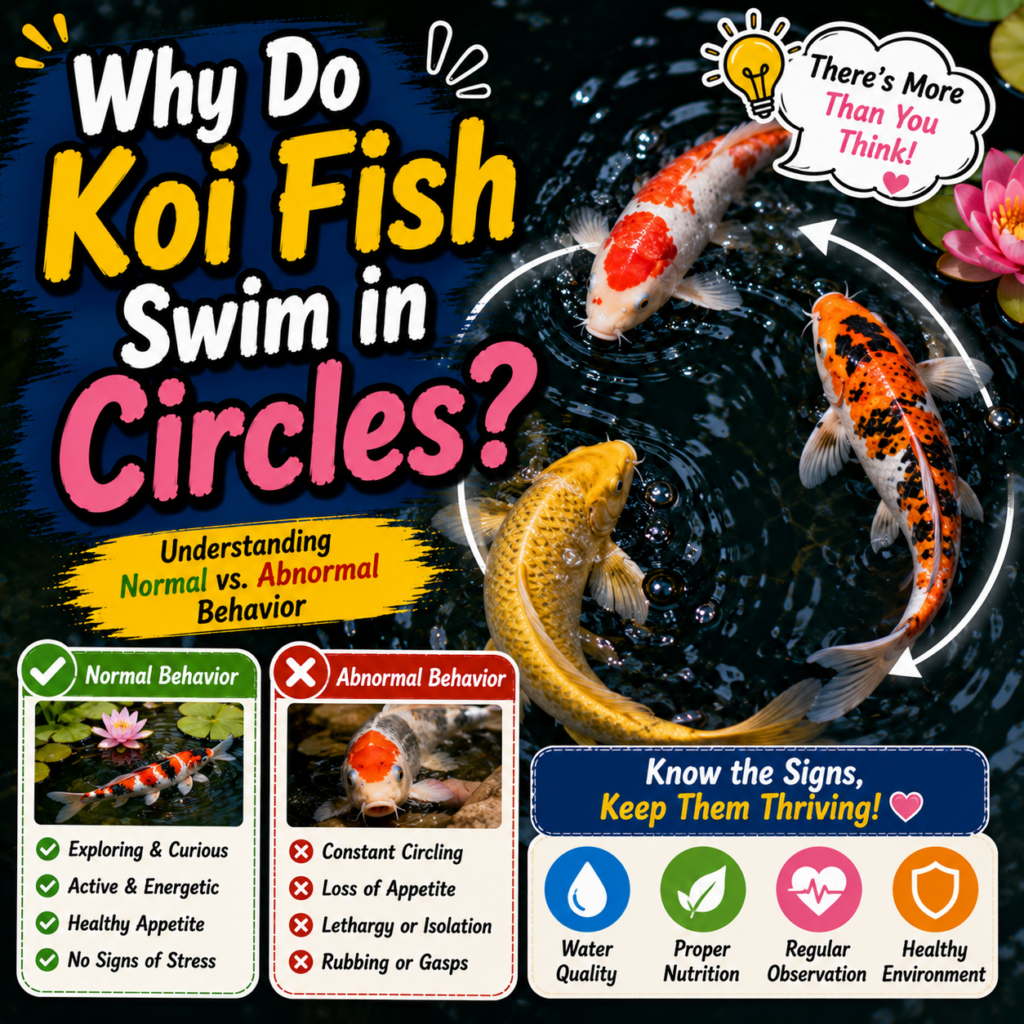
1. Normal Reasons Koi Swim in Circles (No Need to Panic)
If your fish are healthy and the water is clean, circling is usually an expression of their social structure, reproductive instincts, or environmental curiosity.
The Spring Spawning Dance (Mating Behavior)
If you notice multiple koi swimming in tight, frantic circles around each other during the spring or early summer, you are likely witnessing a spawning ritual.
- The Dynamic: Several male koi will closely pursue a single female, circling her tightly, nudging her sides, and driving her toward shallow water or aquatic plants to encourage her to release eggs.
- The Verdict: This is highly natural. Just monitor the pond to ensure the males do not accidentally injure the female against rough rocks or pond walls.
The Feeding Swarm (Classical Conditioning)
When you walk up to the water’s edge, do your koi instantly gather and swim in a tight, swirling circle near the surface? This rhythmic vortex is simply a learned response to food. Your fish are excited, and because they are social “shoaling” animals, they move as a synchronized unit to vie for the best position to catch floating pellets.
Environmental Mapping and Foraging
Koi are naturally curious and highly intelligent. When introduced to a new pond, or when you add new decorations and plants, they will swim in exploratory circles to map out the physical parameters of their new domain. They also swim in slow, steady circles along the pond floor to stir up debris and forage for hidden insects or algae.
2. Abnormal Reasons Koi Swim in Circles (Urgent Warnings)
If a single koi is spinning isolated from the school, or if the circling looks erratic, frantic, and uncoordinated, you are likely dealing with one of these critical issues:
High Stress from Poor Water Quality
When toxic chemicals like ammonia or nitrites spike, or if the pH drops drastically, it can physically burn a koi’s skin, eyes, and gills. Stressed, burning fish will often exhibit a frantic behavior called “flashing”—where they swim in rapid, erratic circles and rub their bellies against rocks to rid themselves of the discomfort.
Parasitic or Fungal Infections
Microscopic parasites such as Ich, Costia, or Chilodonella target a koi’s skin and respiratory system. If a parasite invades a koi’s ear canal or damages its lateral line (the sensory organ used for balance and vibration detection), the fish completely loses its spatial awareness. It will begin swimming in continuous, uncoordinated loops because its brain cannot process which way is up.
Neurological Damage or “Whirling Disease”
If a koi continuously spins like a corkscrew or swims in circles with a permanently bent or curved spine, it may be suffering from structural neurological damage. This can be caused by:
- A severe physical injury (such as escaping a heron or raccoon attack).
- A lightning strike near the pond, which shocks their nervous system.
- Whirling Disease (Myxobolus cerebralis), a parasitic condition that attacks the cartilage and nervous system of the fish, causing them to tail-spin uncontrollably.
Hypoxia (Severely Low Oxygen)
During scorching summer days, warm water loses its ability to retain dissolved oxygen. While suffocating fish usually hover at the surface gasping for air, extremely weak or hypoxic fish can lose motor control entirely, causing them to drift sideways and swim in slow, lethargic circles as their organs begin to shut down.
Normal vs. Abnormal Circling: The Diagnostic Checklist
To help you decide whether to grab a treat or a quarantine tank, use this quick guide:
| Behavior Profile | Likely Diagnosis | Urgency Level |
| Multiple fish circling a female near plants in Spring. | Spawning Ritual | 🟢 Normal |
| Entire school swirling at the surface when you walk by. | Anticipating Food | 🟢 Normal |
| Single fish spinning rapidly, scraping against rocks. | Parasites / Poor Water | 🟡 Moderate Risk (Test water) |
| Fish swimming like a corkscrew with a bent spine. | Neurological Damage | 🔴 Critical Emergency |
| Lethargic circling paired with gasping at the surface. | Severe Oxygen Lack | 🔴 Critical Emergency |
Conclusion: Observe the Dynamic
Ultimately, decoding why your koi fish swim in circles comes down to observing the context and the group dynamic. If it’s a synchronized dance at feeding time or a seasonal courtship, you can sit back and enjoy the show. But if a single fish isolates itself to spin erratically, act fast—test your water chemistry, ramp up your pond’s aeration system, and prepare a quarantine tank to safeguard your precious aquatic family.