
If you’ve ever watched your tiny hamster pack pellet after pellet, seed after seed, into its mouth until its head expands to twice its original size, you’ve likely found it both hilarious and mesmerizing.
A hamster’s ability to transform its face into a giant, furry balloon is one of its most defining characteristics. In fact, the word “hamster” originates from the Old German word hamstra, which translates directly to “to hoard.”
So, why does your hamster keep stuffing food into its cheeks? Let’s dive into the fascinating biology of these pocket pets and look at the 4 evolutionary reasons behind this quirky behavior.
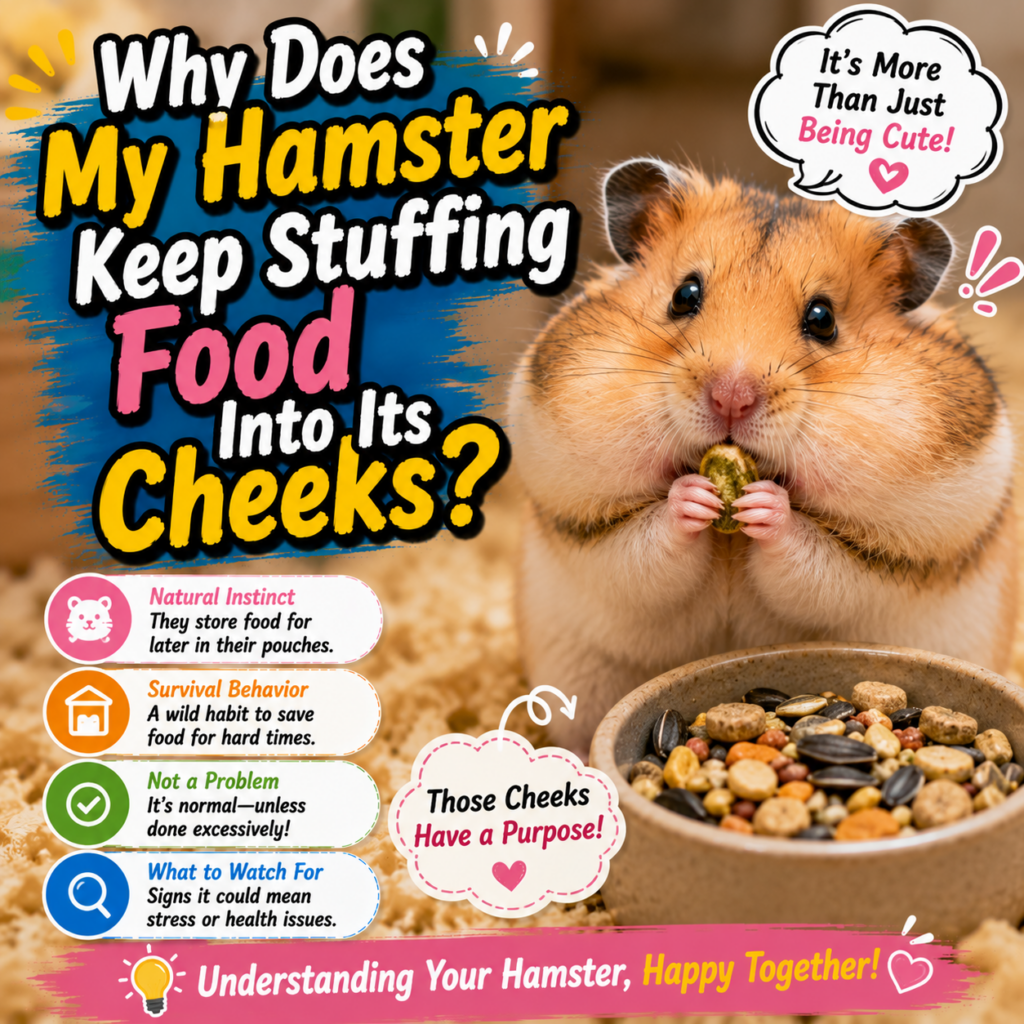
1. Incredible Anatomy: The Expandable Cheek Pouches
To understand why they do it, you first have to marvel at how they do it.
Hamsters possess highly specialized cheek pouches (sacci buccales) that are completely unique in the rodent world. These pouches are essentially loose folds of skin that extend all the way from their jaw down to their shoulders.
What makes them truly incredible? They contain no saliva glands. This means the inside of a hamster’s cheek is completely dry. When a hamster stuffs food into its cheeks, the food stays perfectly crisp, dry, and preserved, preventing seeds from sprouting or molding while being transported.
2. The Ancient Survival Instinct (The Hardwired Hoarder)
In the wild, hamsters are small prey animals native to dry deserts and grasslands. Venturing out into the open to look for food is an incredibly dangerous mission. If a hamster sat out in the open chewing on a nut, a predatory hawk or fox would catch them instantly.
To survive, hamsters adapted a “grab-and-go” strategy:
$$\text{Find Food} \longrightarrow \text{Stuff Pouches Instantly} \longrightarrow \text{Sprint Back to Safety}$$
By stuffing their cheeks to maximum capacity within seconds, they can gather massive amounts of food and quickly retreat to the absolute safety of their underground burrows to eat in peace.
3. Creating a “Life Insurance” Food Hoard
Even though your pet hamster lives in a luxury cage with a guaranteed daily bowl of food, they don’t know that. Their ancestral biological clock is constantly telling them that a harsh winter or a food shortage could happen at any moment.
When your hamster stuffs their cheeks at the food bowl, they aren’t actually eating. They are transporting the food to a specific corner of their cage to build a hoard (or cache).
To a hamster, a massive pile of hidden food hidden under 6 inches of bedding is their ultimate comfort blanket. It reduces their stress levels and makes them feel completely secure in their environment.
4. Transporting Bedding and Nesting Materials
Did you know that hamsters don’t just use their cheeks for food? If you watch closely during cage cleaning day, you might see your hamster stuffing their cheeks with clean paper bedding, tissues, or hay.
Because they lack hands to carry large bundles, their cheek pouches act like built-in shopping bags. They pack their cheeks full of soft materials to comfortably transport them across the cage and build the ultimate cozy, insulated sleeping nest.
Should You Ever Empty Your Hamster’s Cheeks?
As a rule of thumb: No, never try to manually empty or squeeze your hamster’s cheeks.
A hamster is fully capable of un-stuffing their own cheeks using their front paws to gently massage the food out from back to front. Trying to force food out can tear their delicate cheek linings or cause severe psychological stress.
When to Worry: If your hamster’s cheeks stay permanently swollen for more than 24 hours, or if you notice a foul odor coming from their mouth, they may be suffering from an impacted cheek pouch. This happens when sticky food (like peanut butter or soft fruit) or sharp bedding gets stuck and rots, causing an infection that requires a quick visit to an exotic vet.
Conclusion: Respect the Hoard!
At the end of the day, a hamster stuffing its cheeks is simply exercising its natural, healthy wild instincts. It is a sign of a highly active, focused, and happy pet.
When you clean their cage, try your best to leave their main food hoard alone (unless it contains rotting fresh food). By letting them keep their stuffed treasures, you’ll ensure your little friend stays relaxed, confident, and delightfully chubby-cheeked!