
Every cat owner has witnessed this hilarious and mind-boggling phenomenon: you spend hard-earned money on a large, plush, state-of-the-art orthopedic cat bed. You set it up beautifully in the corner of your living room, expecting your cat to lounge in absolute luxury. Instead, your feline companion completely bypasses it, walks across the room, and squeezes their entire body into an empty, discarded shoe box, a cramped dresser drawer, or a tiny paper shopping bag.
This comical routine leaves many pet parents asking the ultimate cognitive question: Why does my cat sleep in tiny spaces?
Are they just being intentionally stubborn, are they trying to stay warm, or is there an ancient evolutionary blueprint hidden inside their desire to compress themselves into the smallest corners of your house? Let’s dive into the fascinating world of feline behavioral psychology to find out.
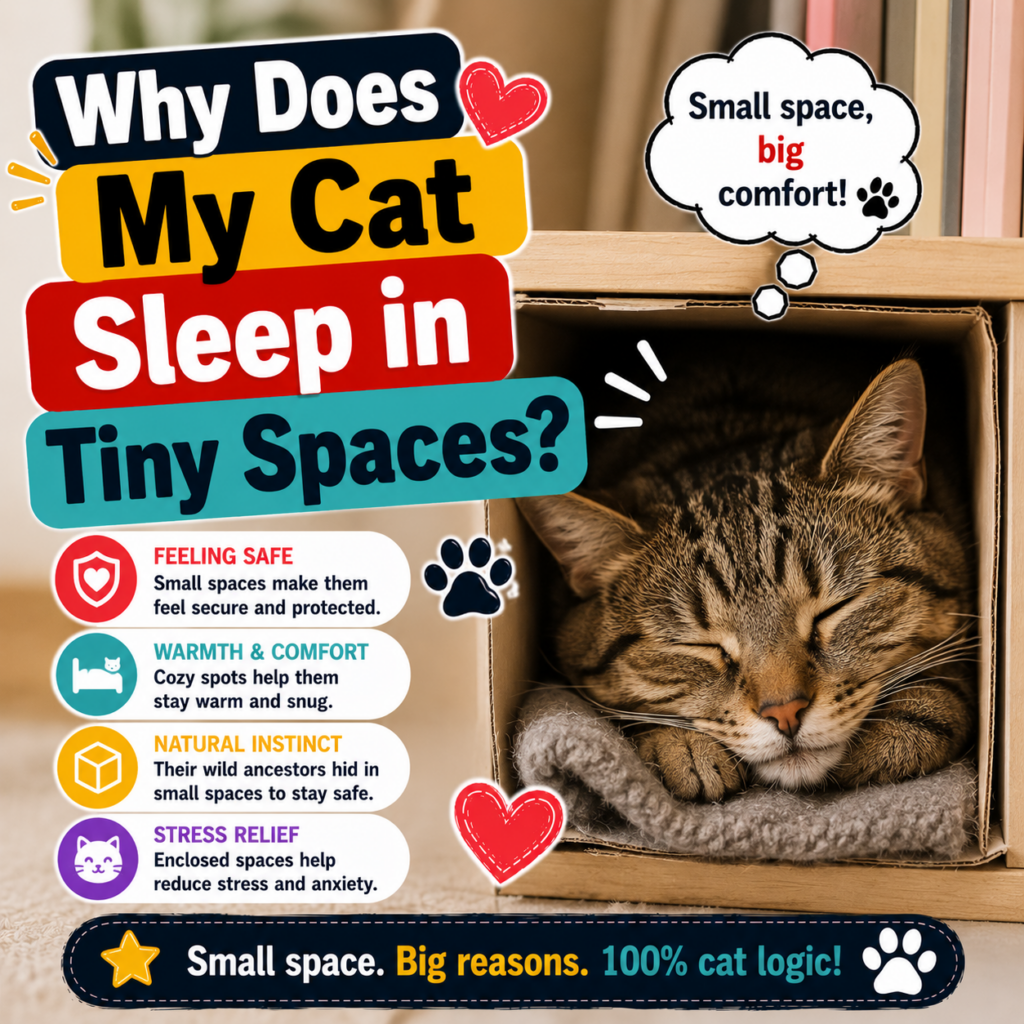
1. The Prey Instinct: Lowering the “Vulnerability Factor”
To understand why a cat loves a tight squeeze, we have to look past their status as household rulers and step directly into their evolutionary history. In the wild, small felines hold a unique, dual position in the food chain: they are highly specialized apex predators to rodents and birds, but they are also small enough to be targeted as prey by larger carnivores like coyotes, eagles, and foxes.
Because sleep is the most vulnerable time of an animal’s day, closing their eyes in an wide-open room triggers an immediate survival panic.
When a cat wedges themselves into a tiny space—like a cardboard box or a tight gap between pillows—they are physically eliminating their blind spots. With a solid wall protecting their back, left, and right flanks, they only have to monitor a single, narrow entry point. This structural security causes their baseline stress levels to plummet, allowing their brain to drop its defensive walls and slide into a deep, peaceful sleep.
2. True Thermodynamic Luxury: Conserving Metabolic Heat
While the psychological reasons are deeply rooted in survival, a cat’s obsession with small spaces is also governed by a fundamental rule of animal biology and thermal regulation.
The normal baseline body temperature of a healthy domestic cat ranges between 38°C and 39.2°C (101°F to 102.5°F), which is significantly higher than a human’s average 37°C baseline. Because of this high internal temperature, cats are intensely sensitive to ambient cold.
When a cat curls into a tight ball inside a cramped space, they are creating a highly efficient micro-climate. The surrounding cardboard, fabric, or wood acts like a premium insulation barrier. It captures and reflects their own radiant body heat right back onto their fur, preventing cold drafts from cooling their joints. Squeezing into a tiny space is essentially the feline equivalent of climbing under a heated electric blanket—it lets them maintain their high body temperature without expending valuable metabolic energy!
At a Glance: Decoding Your Cat’s Favorite Tiny Safe Zones
Where your cat chooses to hide can tell you exactly what mixture of security, warmth, or environmental control they are looking for.
| Favorite Tiny Space | The Root Biological Drive | What It Tells You About Their Mood |
| Cardboard Boxes & Cartons | Tactile Security: Cardboard is a magnificent insulator and perfect hiding zone. | High Contentment: They are using a classic evolutionary anchor to decompress and rest. |
| Deep Wardrobes / Drawers | Scent & Height Security: Seeking an unmapped, dark perimeter that smells like you. | Seeking Privacy: They want to escape a busy household schedule or loud ambient noises. |
| Tucked Behind the Sofa / Bed | Hyper-Vigilant Hiding: Minimizing all visual exposure to the open room. | Minor Environmental Stress: A sudden trigger (like a thunderstorm or house guests) has spiked their anxiety. |
| Squeezed Into Your Sink | Contoured Thermal Mapping: The smooth porcelain molds tightly to their spine. | Cooling Down or Seeking Solitude: They enjoy the custom shape and the quiet bathroom sanctuary. |
3. The Power of “Enclosure Therapy” (Lowering Cortisol)
The psychological benefit of tight spaces isn’t just a theory; it has been proven by hard veterinary science.
A famous study conducted at Utrecht University in the Netherlands looked at the stress levels of newly arrived shelter cats. The researchers divided the incoming cats into two groups: one group was provided with a simple cardboard hiding box in their kennel, while the second group had to sleep in an open environment.
The results were staggering. The cats equipped with the tiny hiding boxes adapted to their new environment significantly faster. Their cortisol (stress hormone) levels dropped rapidly within the first three days, and they showed a massive increase in social confidence. This clinical data proves that small, enclosed spaces act like immediate psychological medicine for a cat’s nervous system, providing them with a profound sense of coping control over an unpredictable world.
💡 How to Respect and Optimize Their Safe Spaces
While it is fun to laugh at your cat’s ridiculous hiding choices, pet parents can actively support their mental health by setting up healthy household boundaries:
- The “Sanctuary Rule”: Never, ever reach your hand into your cat’s favorite tiny space to drag them out for a hug, medication, or grooming. If their ultimate safe zone is violated by a human, their safe anchor erases, leading to heightened baseline anxiety.
- Leave the Delivery Box: When you receive a cardboard package in the mail, don’t throw it away immediately. Leave it on the floor for 48 to 72 hours. Allowing your cat to explore, scent-mark, and nap inside the box gives them a rotating stream of fresh mental enrichment.
The Bottom Line
When your cat chooses a tiny cardboard box over a beautifully styled, expensive pet cushion, do not take it personally. It isn’t a critique of your interior design choices—it is a beautiful, involuntary display of their magnificent evolutionary programming. Tiny spaces fulfill a cat’s primary biological requirements for absolute physical protection, metabolic warmth, and emotional grounding. By understanding and respecting their need for these miniature sanctuaries, you are helping your favorite feline shadow live a deeply secure, happy, and balanced life under your roof!