
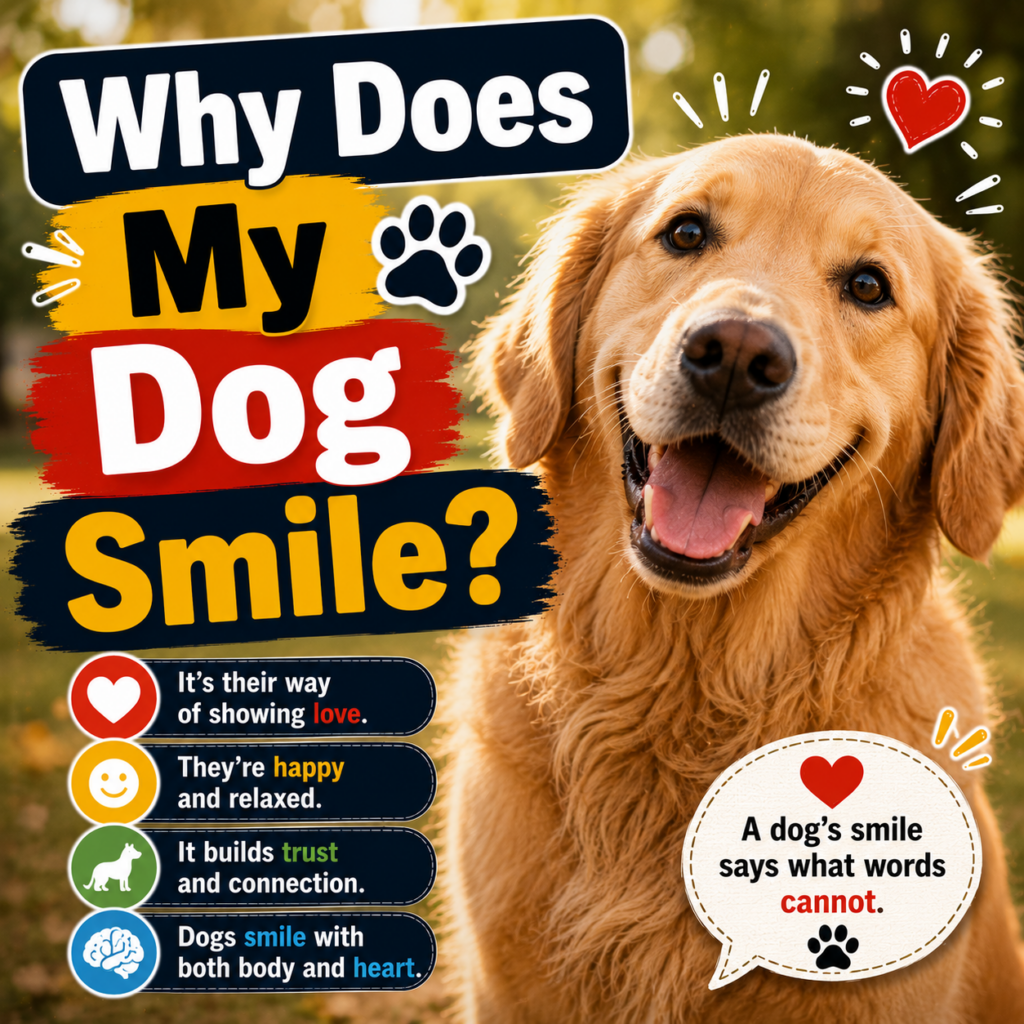
Few things can instantly brighten a pet parent’s day like looking down to see their dog looking up with a wide, unmistakable grin. Their jaw is relaxed, the corners of their mouth are turned upward, their tongue is lolling out happily, and their eyes are soft and crinkled. It looks so uncannily human that you can’t help but smile back and reach down for a head scratch.
But as you snap a quick photo to share with friends, you might find yourself wondering about the true cognitive biology behind the look: Why does my dog smile?
Are they genuinely experiencing a human-like emotion of joy, are they just trying to cool their body down, or have they masterfully cracked the code of human body language to get what they want? Let’s look into the cutting-edge neuroscience and evolutionary history of canine facial structures to find out.
1. The Adaptive Mirror: Neoteny and Human Co-Evolution
To decode why a dog smiles, we have to look past their wolf ancestors and step directly into thousands of years of shared history with humans. Wolves do not smile; in wild canine language, showing teeth or pulling the lips back is almost always a strict marker of tension, warning, or defensive ranking.
Domestic dogs, however, are evolutionary masterpieces of adaptation. Over generations of living alongside humans, dogs underwent a process called neoteny—the retention of juvenile, flexible traits into adulthood—and developed specialized facial muscles that wild wolves simply do not possess.
Dogs are world-class observers of human micro-expressions. When an early domestic dog casually pulled the corners of their mouth back out of relaxation or panting, humans reacted with overwhelming joy—cooing at them, tossing premium food rewards, and showering them with physical affection. Because dogs are geniuses at associative learning, their brains quickly figured out that mimicking a human smile is an incredibly effective way to capture our attention and secure resources!
2. The Feel-Good Chemical Release: The Oxytocin Loop
A canine smile isn’t just a calculated trick to get treats; it is also a physical reflection of a relaxed, content internal state.
Neuroscientific research utilizing brain-imaging data confirms that when a dog spends time interacting peacefully with their primary human anchor, both the human and the dog experience a massive, simultaneous surge of oxytocin—the universal bonding, trust, and love hormone.
This chemical drop sets off a magnificent chain reaction in your dog’s central nervous system:
- Their baseline cortisol (stress hormone) levels plummet to zero.
- Their blood pressure stabilizes, and their heart rate drops to a peaceful resting zone.
- Their facial muscles completely lose their hyper-vigilant tension, causing the jaw to drop open naturally and the lips to curve upward into a soft “smile” posture.
At a Glance: Decoding Your Dog’s Smiles and Grins
Not all canine grins mean the same thing. Dog parents must pay close attention to the surrounding body language markers to accurately translate what their pup is saying.
| Type of Canine Smile | Key Visual Body Language Clues | The True Emotional State | What It Means in Dog Language |
| The Contented Smile | Relaxed, open jaw; soft, squinty eyes; lazy, slow-wagging tail or full “noodle” body wiggle. | Pure Joy & Psychological Safety: They feel completely secure in their home sanctuary. | “The ambient household energy is stable, I love you, and I am completely at peace.” |
| The Submissive Grind | Front teeth exposed completely (the submissive smile), head lowered, ears pinned flat back, low tail wag. | Appeasement & Social Alignment: A respectful acknowledgment of your leadership rank. | “I see you are paying attention to me! I am showing you I am completely peaceful and friendly.” |
| The Heat Regulation Smile | Wide open mouth, rapid panting, tongue hanging out far, tense or stiff posture. | Thermoregulation / Physical Overexertion: They are actively trying to drop their body temperature. | “I am not necessarily happy; I am just very hot right now and need cool water or shade.” |
3. The “Submissive Smile”: A Display of Ultimate Peace
One of the most fascinating and frequently misunderstood facial expressions in animal behavior is the submissive smile. This happens when a dog pulls their lips back vertically to expose their front incisors and canines in a bright grin, often accompanied by a lowered head, squinted eyes, and a frantic, low tail wag.
To a human who doesn’t understand canine body language, an exposed set of teeth looks like a threat of aggression. But in context, it is the exact opposite.
In the wild architecture of wolf and dog communication, displaying the teeth in a non-threatening, submissive manner is an elite tool for conflict resolution. Your dog uses this specific smile to proactively show submission and appease you, broadcast that they have zero aggressive intentions, and re-establish a peaceful, harmonious balance within the family pack.
💡 The Value of Smiling Back
Did you know that your dog actively monitors your own smiles too? Animal behavior studies demonstrate that dogs can easily differentiate between a happy human face and an angry or neutral one. When you look at your dog and flash a genuine, warm smile, their brain recognizes it as a high-value safety cue. It signals that their human protector is content, allowing their own defensive walls to drop completely and encouraging them to mirror your happy, relaxed energy right back to you!
The Bottom Line
When your favorite canine companion looks up at you with a wide, adoring smile, science shows it is a beautiful mixture of evolutionary genius and genuine emotional contentment. Driven by thousands of years of co-evolutionary mirror mapping, a neurochemical rush of feel-good oxytocin, and an innate pack desire to keep the household energy peaceful, their smile is a profound testament to the strength of your bond. Enjoy the spectacular view—it is just another wonderful daily reminder that you are the absolute center of their universe and that they feel completely safe, loved, and happy under your protection!