
For decades, humanity operated under a severe cognitive bias. We looked at the animal kingdom and assumed that if a creature lacked a large mammalian brain or a neocortex, it was simply incapable of abstract logic, reasoning, or emotional depth. We dismissed birds as simple-minded, coining the phrase “bird brain” to denote low intelligence.
Then came the African Grey parrot (Psittacus erithacus).
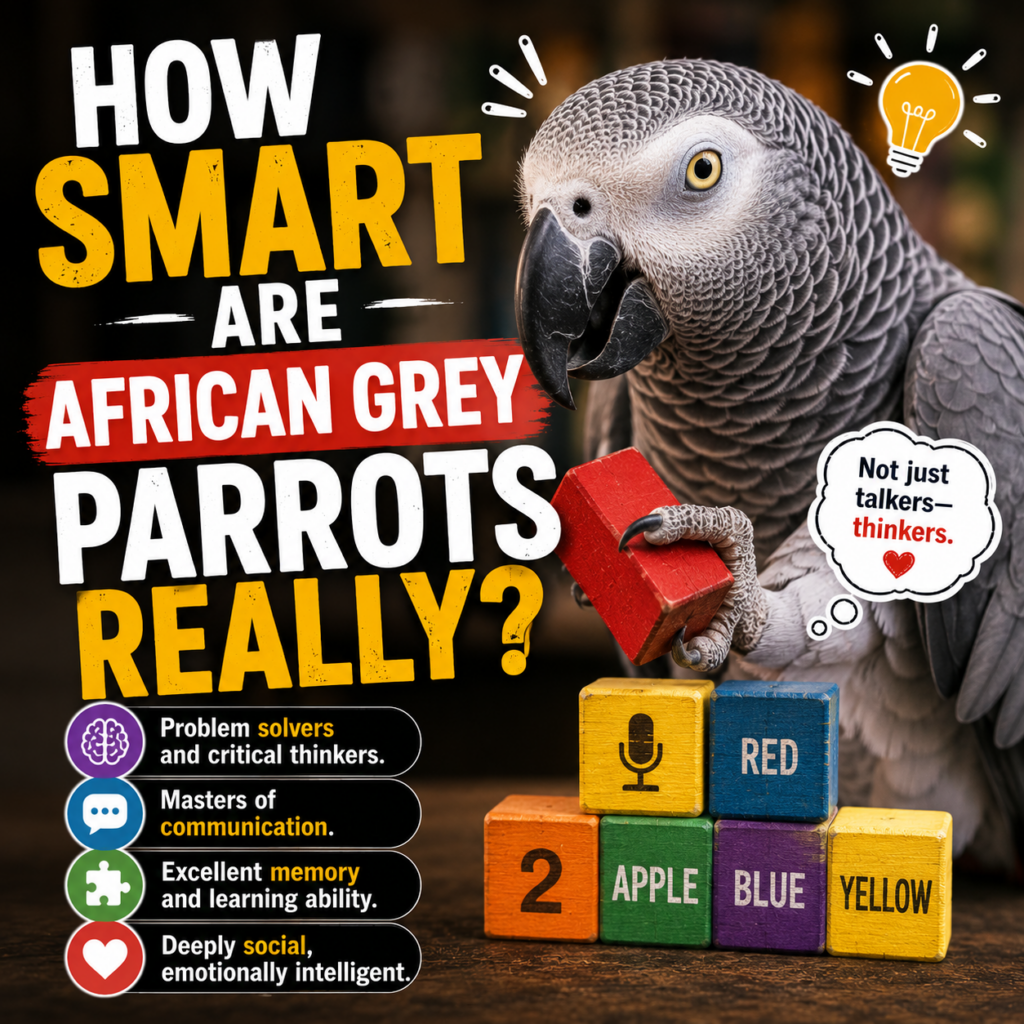
Whether you watch a viral video of an African Grey casually identifying complex shapes and colors, asking philosophical questions, or outsmarting their human handlers in memory games, it leaves you wondering: How smart are African Grey parrots really?
Are they just highly evolved audio tape recorders that mimic sounds at random to secure treats, or are they experiencing a vibrant, complex inner world filled with logic, emotion, and self-awareness? Let’s look into the cutting-edge neuroscience and breakthrough cognitive experiments that have finally unlocked the truth.
1. The Toddler Milestone: The Cognitive Capacity of a 5-Year-Old
When animal psychologists evaluate the intelligence of an African Grey, they aren’t just measuring their ability to speak human words—they are looking at convergent problem-solving skills.
According to leading avian behaviorists, an adult African Grey parrot possesses the emotional baseline of a two-year-old human toddler, but the raw cognitive, linguistic, and logical capabilities of a five-year-old human child.
This means an African Grey doesn’t just link a sound to a food reward through simple conditioning. They can categorize objects by their intrinsic properties—such as color, material, shape, and quantity. If you show them a green plastic square and a green wooden circle, their brain can independently isolate what is same (the color) and what is different (the shape and material) with shocking accuracy.
2. The Legend of Alex: The Bird Who Rewrote Avian Science
You cannot discuss the true scope of African Grey intelligence without honoring Alex (an acronym for Avian Learning Experiment), a parrot trained by cognitive scientist Dr. Irene Pepperberg at Harvard and Brandeis Universities.
Before Alex, the scientific community confidently asserted that parrots were purely associative mimics. Dr. Pepperberg utilized a revolutionary training system called the Model/Rival technique to see if a bird could grasp true human language syntax.
Alex’s Mind-Blowing Academic Milestones:
- Massive Categorization: Alex successfully learned a vocabulary list of over 100 spoken English words. He could identify 50 distinct objects, 7 colors, and 5 geometric shapes.
- The Concept of Zero: In a famous experiment, when shown an array of blocks and asked how many were green, Alex looked at the tray, realized there were zero green blocks, and proudly stated, “None.” This proved he understood the complex, abstract mathematical concept of zero—a milestone human children don’t cross until roughly age four.
- The First Abstract Question: Alex remains the only non-human animal in history to have ever asked an abstract question about himself. While looking directly into a mirror, he tilted his head, analyzed his reflection, and asked, “What color?” (He was taught the word “gray” immediately after).
At a Glance: How African Grey Intelligence Compares Across Species
African Greys process information using an incredibly dense, fast-running neural framework that rivals the smartest mammals on earth.
| Cognitive Metric | Dogs / Cats | Primates (Chimpanzees) | African Grey Parrots |
| Primary Learning Style | Associative learning and micro-body language reading. | Spatial mapping, high tool usage, and social hierarchy tracking. | Abstract Categorization: Logical deduction, syntax, and phonetic assembly. |
| Linguistic Capacity | Comprehends up to 165–250 spoken words/gestures; cannot speak. | Uses sign language or symbols; cannot produce human speech. | True Contextual Speech: Can form novel combinations of words to convey distinct desires. |
| Anatomical Edge | Mammalian neocortex. | Highly developed primate brain structure. | Dense Nidopallium: Doubles the number of neurons per square millimeter compared to primates. |
3. Anatomical Synergy: packing Prime Power into Tiny Spaces
How is it biologically possible for a bird with a brain the size of a walnut to match the cognitive performance of a young child or a chimpanzee? The secret is written directly into their neuroanatomy.
A groundbreaking study revealed that birds don’t require a large, heavy mammalian neocortex to think critically. Instead, evolution packed their neurons into an ultra-dense, specialized forebrain structure called the nidopallium.
Parrots possess double the number of neurons per square millimeter compared to primates. This compact, hyper-efficient structural wiring allows for lightning-fast electrical processing speeds across the brain’s hemispheres without adding heavy, dead weight that would ruin an exotic bird’s ability to fly.
💡 The Scent and Sound of Emotional Sensitivity
Because African Greys are so remarkably intelligent, they possess an incredibly fragile emotional baseline. In the wild, they are highly social, lifelong flock animals that rely on deep emotional bonds to survive. When kept as household companions, they view their human family as their primary flock. If they are starved of mental stimulation, locked in a bare cage, or subjected to a chaotic household schedule, their highly active brains turn inward, often leading to severe psychological distress, chronic anxiety, and self-destructive feather-plucking behavior.
4. Logical Deduction: The “Cup and Nut” Experiment
To prove that African Greys can think systematically, researchers often use the deduction by exclusion test.
A scientist will place two opaque cups face down on a table. In front of the parrot, they will hide a high-value treat (like a fresh walnut) under one of the cups without letting the bird see which one. The scientist will then lift one cup to show it is empty.
An animal operating purely on basic instinct will wander around randomly or guess. An African Grey, however, will look at the empty cup, instantly execute a logical equation in their mind (“If it is not in Cup A, it must be in Cup B”), walk straight over, and flip the second cup to claim their reward. They understand hidden variables, cause-and-effect, and unseen realities perfectly.
The Bottom Line
How smart are African Grey parrots really? Science shows they are evolutionary geniuses. They do not just mimic the sounds of your phone pings, appliances, or catchphrases at random; they are deeply analytical observers who process human vocabulary, abstract geometry, and mathematical concepts using an ultra-dense, hyper-efficient neural matrix. Sharing your home with an African Grey isn’t like owning a standard household pet—it is the equivalent of living alongside a brilliant, highly sensitive, non-human mind. Treat their intellect with the profound respect, patience, and mental enrichment it deserves!