
Few things are more stressful for a pet owner than when their usually enthusiastic eater suddenly refuses food. If your turtle has turned its nose up at its favorite pellets, shrimp, or fresh greens, you are likely feeling incredibly anxious.
The good news? A turtle striking on food is a common issue that reptile keepers face. Because turtles are cold-blooded creatures, their appetite is deeply tied to their environment, stress levels, and seasonal changes.
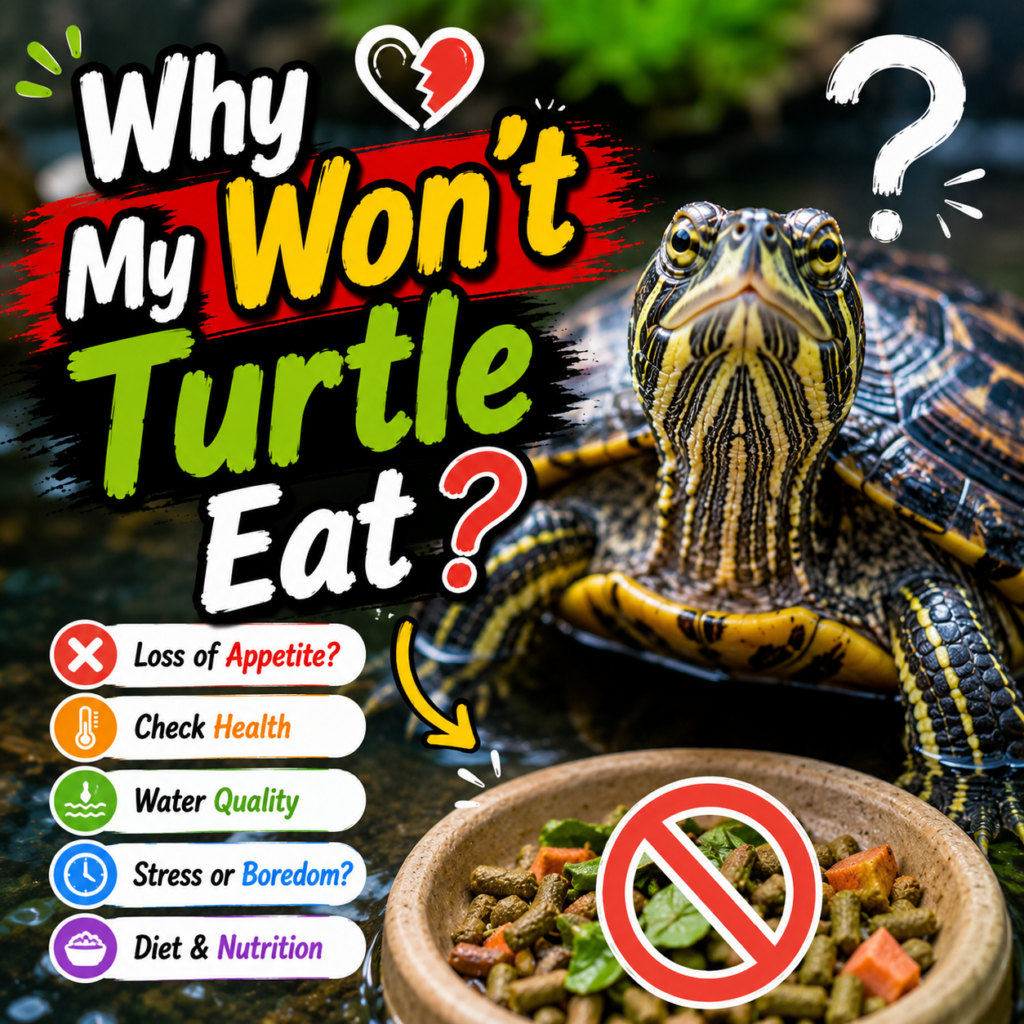
So, why won’t your turtle eat? Let’s explore the 6 most common reasons behind this behavior and how you can get your shelled companion back on a healthy diet.
1. The Water is Too Cold (Inadequate Temperatures)
Turtles are ectothermic (cold-blooded), meaning they rely entirely on their external environment to regulate their body temperature and metabolism.
If your pond or tank water drops below your turtle’s specific ideal range, their digestive system slows down drastically. They simply cannot process food efficiently, so their instinct tells them to stop eating.
- The Fix: Invest in a high-quality water thermometer. Most aquatic turtles (like Red-Eared Sliders) need water temperatures between 75°F to 78°F (24°C to 26°C) and a basking area temperature around 85°F to 90°F (29°C to 32°C). If your tank is too cold, add an adjustable aquarium heater immediately.
2. Lack of Essential UVB Lighting
Turtles don’t just need heat; they absolutely require UVB radiation to survive. UVB lighting allows your turtle to synthesize Vitamin D3, which is critical for absorbing calcium and maintaining a healthy metabolism. Without proper UVB lighting, a turtle will quickly become lethargic, weak, and lose its appetite.
- The Fix: Ensure your basking area has a dedicated reptile UVB bulb. Remember that UVB rays fade over time even if the bulb is still shining light; most UVB bulbs need to be replaced every 6 to 12 months.
3. Stress or Recent Environment Changes
Have you recently bought your turtle home? Did you move their tank to a noisier room, or change up their tank decorations?
Turtles are sensitive creatures that easily become stressed by sudden changes. A stressed turtle will go into hiding mode, and eating becomes a secondary priority.
- The Fix: Give a new or relocated turtle 3 to 5 days to acclimate to their new surroundings without handling them. Keep the room quiet and let them explore their habitat on their own terms.
4. Boredom and Diet Monotonous
Imagine eating the exact same dry cereal every single day for years. You’d probably lose your appetite too! Turtles are surprisingly intelligent and can get completely bored of standard commercial pellets if fed nothing else.
- The Fix: Spice up their menu! Introduce safe, high-value treats to jump-start their appetite. Try:
- Live feeder insects (crickets, dubia roaches, earthworms)
- Freeze-dried shrimp or krill
- Fresh leafy greens (romaine lettuce, dandelion greens)
- Small pieces of turtle-safe fruits (like strawberries or blueberries) as an occasional treat.
5. Seasonal Changes or Hibernation Instincts
As autumn and winter approach, you might notice your turtle eating less, even if your indoor tank temperatures remain stable. Turtles have strong ancestral biological clocks. The shortening of daylight hours outside can trigger their natural instinct to brumate (the reptile equivalent of hibernation), causing a natural drop in appetite.
- The Fix: Keep their light cycle consistent (12 hours of light, 12 hours of dark using automatic timers). If your turtle is an indoor pet, it is best to avoid letting them fully brumate, as it requires highly specialized management.
6. Vitamin Deficiencies or Underlying Illness
If you’ve checked the lighting, fixed the temperature, varied the food, and your turtle still won’t eat, an underlying medical issue may be at play.
- Respiratory Infections (RI): Look for wheezing, bubbles from the nose, or lopsided swimming.
- Vitamin A Deficiency: Often causes severely swollen or glued-shut eyes. If a turtle can’t see, it won’t eat.
- Impaction: If your turtle accidentally swallowed gravel or small stones from the tank substrate, its digestive tract could be blocked.
- The Fix: If the loss of appetite is accompanied by lethargy, swollen eyes, abnormal breathing, or lasts longer than a week, it is time to consult an exotic animal veterinarian immediately.
Quick Appetite Jumpstart Hacks
While you work on identifying the root cause, you can try these proven tricks to coax your turtle into taking a bite:
- Tempt Them with Motion: Earthworms or live ghost shrimp swimming in the tank trigger a turtle’s natural predatory hunting instincts, which can override a stubborn strike.
- The Scent Trick: Smelly foods work best. Dip their standard pellets in the juice of a can of tuna or salmon. The strong fishy scent is often irresistible to an aquatic turtle.
- Feed Them in a Separate Tub: If your tank water gets dirty quickly, your turtle might be uncomfortable. Try feeding them in a smaller, separate container filled with warm, clean water.
Conclusion: A Quick Environmental Check is Key
More than 80% of the time, a turtle that won’t eat is simply reacting to an issue with its habitat’s temperature or lighting. Before you panic, check your thermometers, swap out an old bulb, and offer a juicy earthworm. With a little environmental tweaking, your favorite reptile will likely be eagerly begging for snacks again in no time!