
If you have ever walked past a crow on your morning commute and felt like it was staring directly at you, you might not be imagining things. Or if you share a home with a pet parrot and notice they greet you with pure joy while screaming at a new houseguest, you’ve witnessed a remarkable phenomenon.
It leaves many nature lovers and pet owners wondering: Can birds recognize human faces? Or do they simply see us as blurry, identical figures moving through their territory?
As it turns out, neuroscientists and evolutionary biologists have studied this exact question, and the answer is mind-blowing. Some birds don’t just recognize human faces—they can remember them for years, categorize them as friends or foes, and even gossip about you to their friends.
Let’s dive into the incredible science behind avian facial recognition.
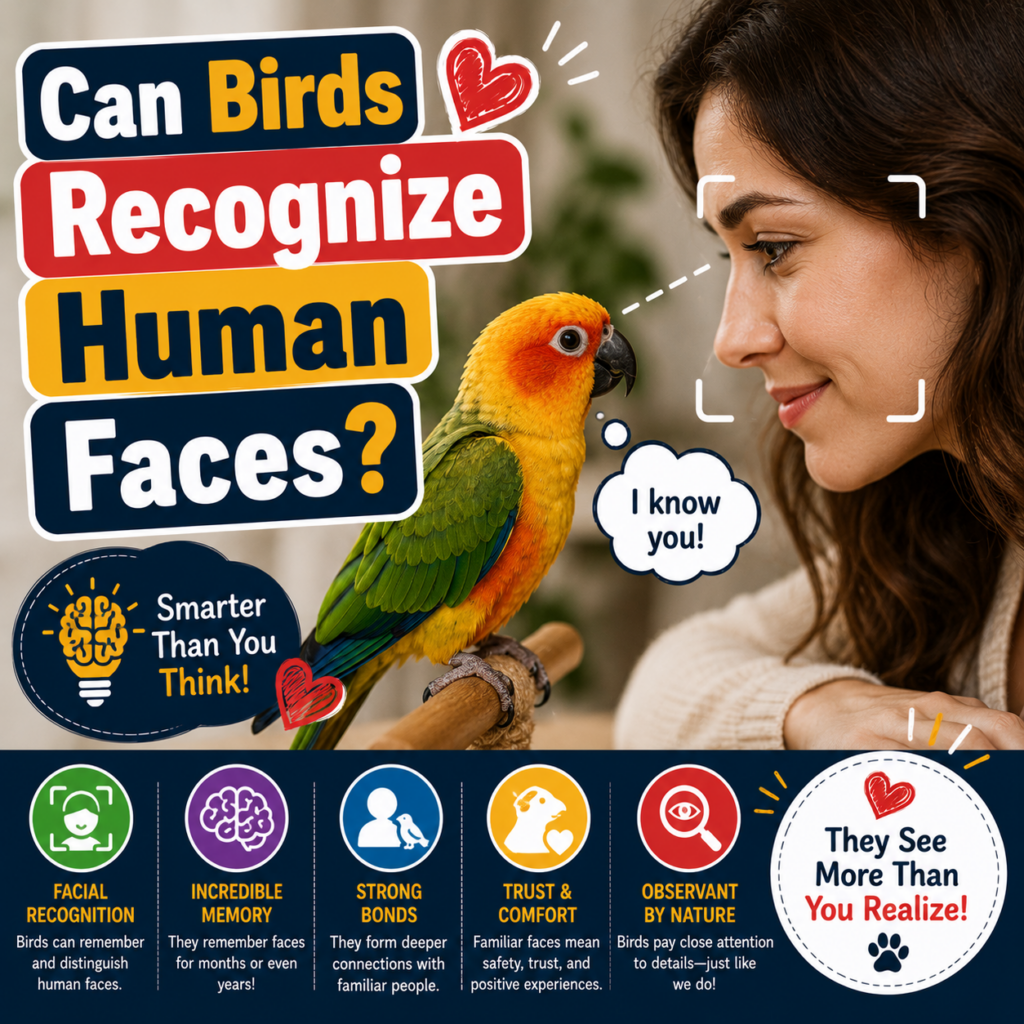
1. The Super-Intellect of the Corvid Family (Crows and Ravens)
When it comes to wild birds recognizing humans, the undisputed kings are the corvids—the bird family that includes crows, ravens, magpies, and jays.
A famous landmark study conducted at the University of Washington tested this exact ability. Researchers wore specific, realistic masks while trapping and banding wild crows (a stressful experience for the birds). Later, when researchers walked through the campus wearing different masks, the crows ignored them.
However, the moment a researcher walked out wearing the “dangerous” mask, the crows went wild. They began diving at the person, cawing aggressively, and flapping their wings.
The Crows Don’t Forget—And They Share Information
The study revealed two incredible facts about avian memory:
- Long-Term Memory: The crows remembered the specific facial features of the “dangerous” mask for over five years, associating that exact face with a negative experience.
- Social Learning (Bird Gossip): Even crows that had never been trapped joined in on the mobbing behavior. The original crows had actively taught their flock mates and children which human face was a threat!
2. Pet Birds (Parrots) and the Elite Bond
If you own an exotic pet bird like an African Grey, a Macaw, a Cockatoo, or a Cockatiel, you already know they can distinguish family members.
Parrots are highly social, flock-oriented animals. In the wild, their survival depends on their ability to instantly recognize individual birds in their flock. When kept as pets, they apply this powerful facial-recognition blueprint to their human family.
How Your Pet Bird Knows It’s You:
- Processing Micro-Features: Parrots have extraordinary vision that can process images much faster than human eyes. They memorize the distance between your eyes, the shape of your nose, and your hairline.
- The Haircut Test: Many bird owners report that if they get a dramatic haircut, dye their hair, or wear a large hat, their parrot may suddenly treat them like a total stranger or act afraid until they speak. This proves the bird is relying heavily on visual, facial geometry to identify their favorite human.
At a Glance: Facial Recognition Ability Across Bird Species
Not all birds possess the same level of facial recognition. Here is a quick breakdown of how different species view human faces:
| Bird Group | Facial Recognition Ability | Behavior Toward Familiar Humans |
| Crows & Ravens | Exceptional (Elite): Can remember a specific face for years and pass the information to their offspring. | Will bring “gifts” (shiny objects) to friendly humans; will mob and dive-bomb enemies. |
| Parrots | High (Deeply Emotional): Focuses heavily on their chosen family member. | Soft beak grinding, head bobbing, and gentle preening when near their favorite human. |
| Pigeons | Surprisingly Good: Can tell humans apart even if they change their clothes. | Will naturally flock toward humans who regularly drop breadcrumbs or seeds. |
| Chickens | Good: Can recognize up to 100 individual faces (both chicken and human). | Show clear signs of comfort around their daily caretakers and hide from strangers. |
3. Even Pigeons Can Tell Us Apart
You might think of city pigeons as simple creatures, but they possess surprising facial recognition software in their tiny brains.
A study in Paris had two researchers of similar build and skin color dress in different colored lab coats. One researcher consistently fed a group of wild pigeons, while the other chased them away.
Later, the researchers swapped coats. The pigeons were not fooled by the clothes. They completely ignored the coat color and fled from the specific face of the attacker, while eagerly crowding around the face of the feeder.
💡 The Visual Superpower of Birds
Why are birds so good at this? A bird’s eyes occupy a massive portion of its skull compared to humans. They have an extra type of cone receptor in their eyes that allows them to see ultraviolet (UV) light. This means a human face looks incredibly vibrant, detailed, and completely unique to a bird, making individual faces easy to catalog and remember.
How to Become a Bird’s Favorite Face
Whether you want to bond with a new pet parrot or make friends with the wild crows in your backyard, you can use their facial recognition to your advantage:
- Be the Provider of Premium Rewards: Always ensure your face is the one associated with high-value treats (like walnuts for parrots or unsalted peanuts for crows).
- Avoid Dramatic Visual Shifts Initially: When building trust with a sensitive bird, avoid wearing sunglasses, large masks, or bulky hats, as these accessories distort the facial geometry they are trying to memorize.
- Respect Their Boundaries: Never lunge at a bird or force physical contact. If a bird associates your face with fear, their advanced long-term memory means it will take a very long time to rewrite that negative impression.
The Bottom Line
The old insult “bird brain” couldn’t be further from the truth. Birds can absolutely recognize human faces. Whether through a crow’s legendary memory for a rival, a pigeon’s tracking of a friendly feeder, or a pet parrot’s deep, devoted love for their number-one human, birds live in a visually rich world where you are completely unique. So the next time you step outside or look into your bird’s cage, smile—because they know exactly who you are!