If you share your home with a highly intelligent companion bird like an African Grey, a Macaw, or a Cockatoo, you know how incredibly active their brains are during the day. They solve puzzles, mimic your footsteps, dance to music, and clearly call your name. But what happens when the sun sets, you cover their cage, and they drift off into a deep sleep?
You might occasionally hear a soft, midnight mumble of a word they learned that morning, notice their beak gently grinding in the dark, or see their feet twitch slightly on the perch.
These enchanting nighttime quirks leave many pet parents asking the ultimate cognitive question: Do parrots dream while sleeping?
For decades, scientists believed that complex dreaming was a luxury exclusive to humans and advanced mammals. However, breakthrough neuroscientific studies have completely shattered this theory. Let’s dive into the fascinating world of avian sleep biology to uncover what is playing inside your parrot’s mind at night.
1. The Neurobiological Proof: Shared Sleep Architecture
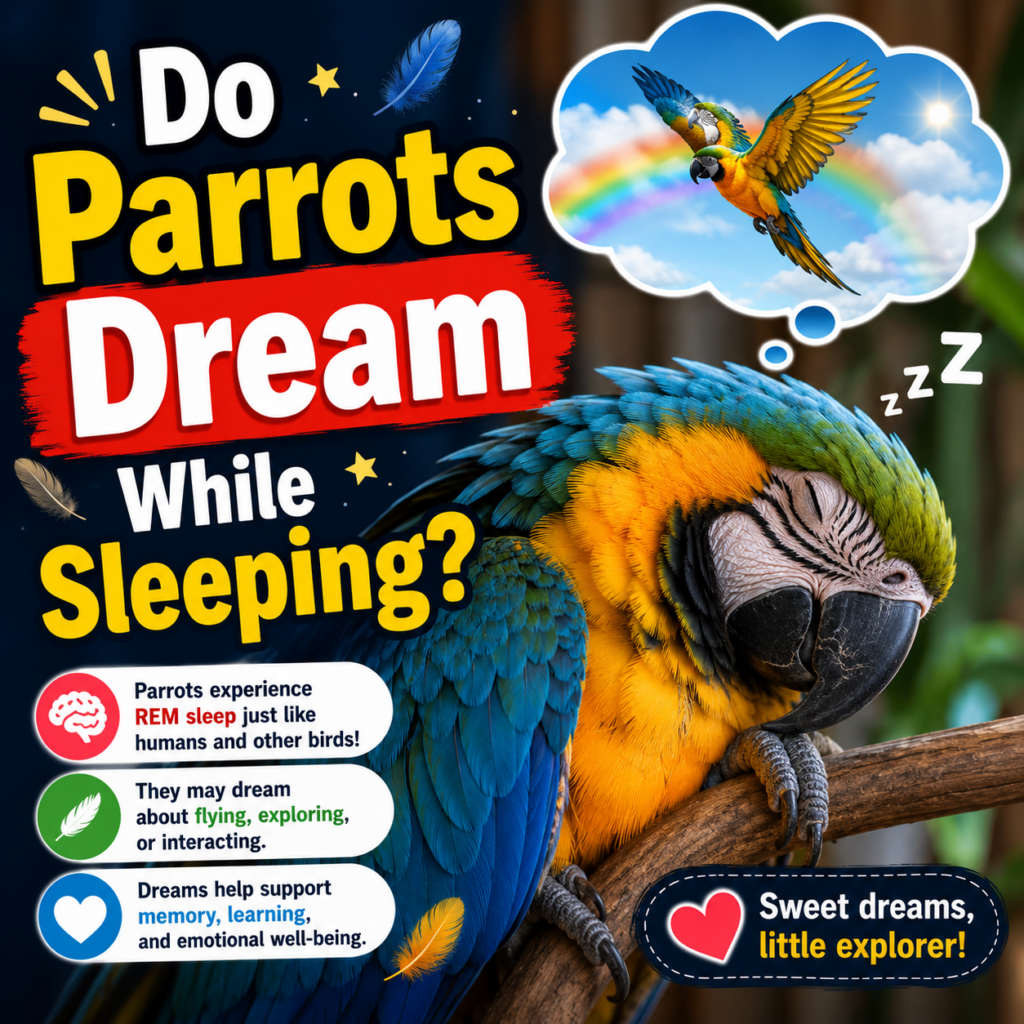
To determine if an animal can dream, neurobiologists look at the electrical patterns of the brain during sleep using an electroencephalogram (EEG). For a creature to experience true dreams, its brain must transition into a specific state known as REM (Rapid Eye Movement) sleep.
During human REM sleep, the brain is highly active—firing neurons at almost the exact same frequency as when we are wide awake—while the physical body remains temporarily paralyzed. This is the exact stage where vivid, story-driven dreaming occurs.
When scientists mapped the brainwaves of birds, they discovered a mind-blowing evolutionary parallel: birds are one of the only non-mammalian animal groups that experience distinct REM sleep.
2. What Do Parrots Dream About? The Melody Connection
While we cannot ask a parrot to write down their dreams in a morning journal, neuroscientists have found a genius way to decode what they are likely dreaming about.
A famous, groundbreaking study conducted at the University of Chicago looked closely at zebra finches (which share a similar vocal-learning brain pathway with parrots). Researchers monitored the specific neurons in the bird’s brain that fire when they practice and sing their songs during the day.
Replaying the Day’s Audio Track
The study revealed that when the birds fell into a deep REM sleep cycle, the exact same complex neural pathways fired in the identical, precise sequence as when they were singing wide awake.
To a parrot’s brain, learning human language, complex whistles, and environmental sounds requires a massive amount of cognitive processing. When your parrot sleeps, their brain isn’t shutting off; it is executing a nighttime rehearsal. They are actively replaying the audio data they gathered throughout the day—sorting, practicing, and hardwiring those new words and songs into their permanent memory banks.
At a Glance: Decoding Your Parrot’s Nighttime Behaviors
Just like humans, a sleeping parrot displays subtle physical cues that signal they have officially entered a vivid dreaming state.
| Nighttime Behavior / Cue | What Is Happening Biologically | The True Avian Meaning |
| Soft, Midnight Mumbling | Minor vocal cord activation during a rapid REM sleep burst. | They are actively dreaming about vocal practice or replaying a conversation they heard earlier. |
| Rhythmic Beak Grinding | A slow, sliding motion of the upper and lower mandible just before deep sleep. | Ultimate Comfort: Their internal stress levels are zero; they feel 100% safe in their territory. |
| Minor Toe Twitches or Tail Flips | Small motor neurons firing during an intense dream cycle. | They are experiencing a rapid dream sequence, likely mimicking physical flight, climbing, or playing. |
| Sudden, Frantic Thrashing | Night Thrashing / Night Terrors: Triggered by a sudden shadow or sound. | A panic response born from their wild prey instincts. They require immediate, quiet grounding. |
3. The Power of Unihemispheric Sleep: Dreaming with One Eye Open
While parrots have an incredible capacity for deep REM dreaming, their sleep is also beautifully regulated by an ancient survival mechanism called Unihemispheric Slow-Wave Sleep (USWS).
In the wild, a completely unconscious bird is an easy meal for a nocturnal predator. To survive, parrots have evolved the ability to shut down only half of their brain at a time while the other half remains alert.
- One half of the brain enters a restful, dreamless slow-wave sleep state, and the corresponding eye closes completely.
- The opposite brain hemisphere stays awake, and the corresponding eye cracked open to monitor the room for danger.
When your parrot feels completely safe, secure, and anchored inside your quiet home sanctuary, they will finally transition into full bihemispheric sleep—closing both eyes, dropping their evolutionary defenses, and plunging into the beautiful, vivid world of two-sided REM dreaming.
⚠️ The Golden Rule: Protecting Their Dream Cycle
Because parrot REM sleep bursts are incredibly brief and fragile, exotic birds require 10 to 12 hours of uninterrupted, predictable darkness every single night to preserve their neurobiology.
Chronic sleep deprivation prevents them from reaching the essential dreaming states needed to process memory. This lack of cognitive rest is the number one psychological trigger for severe behavioral issues, including chronic screaming, self-destructive feather plucking, and sudden hormonal aggression. Ensure their cozy corner can be darkened completely with a breathable cage cover or blackout curtains.
The Bottom Line
Yes, parrots absolutely dream while sleeping. Through the magic of evolutionary biology, their highly developed brains utilize REM cycles to rehearse beautiful songs, file away human vocabulary words, and decompress from the sensory stimulation of the day. When you hear your feathered companion let out a tiny, soft murmur in the middle of the night, smile—they are likely dreaming about a high-value walnut treat, a fun flight game, or a beautiful interaction with their favorite human flock leader!