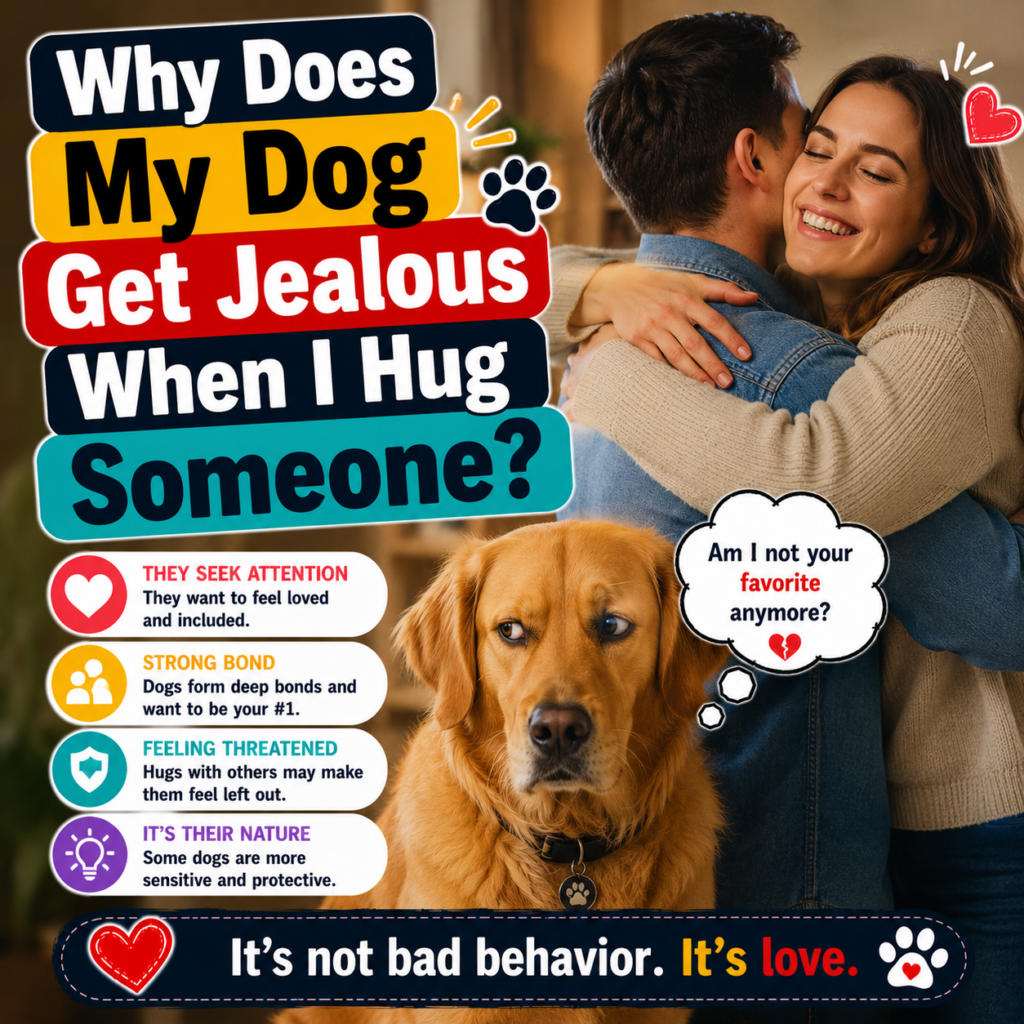
It is a scenario every devoted dog owner knows by heart: you step forward to give your partner, your child, or a visiting friend a warm, loving hug. Within seconds, a cold nose wedges itself directly between your knees. Your dog begins whining softly, pawing frantically at your legs, barking, or attempting to physically squeeze their entire body right into the middle of the embrace.
While it can look incredibly endearing—like your pup just wants to join the family group hug—it leaves many pet parents wondering: Why does my dog get jealous when I hug someone?
Do dogs truly possess the complex, human-like capacity for jealousy, are they being fiercely territorial, or is there an ancient evolutionary instinct firing inside their brain? Let’s look into the fascinating world of canine cognitive science and pack neurobiology to find out.
1. The Landmark Study: Yes, Canine Jealousy is Real
For a long time, the rigid scientific community believed that jealousy was a uniquely complex human emotion that required abstract thought, social comparison, and ego. Critics argued that pet owners were simply projecting human traits onto their animals—a concept known as anthropomorphism.
However, a groundbreaking study conducted at the University of California, San Diego (UCSD) completely shattered this theory.
The Experiment:
Psychologists adapted a test used to measure jealousy in human infants. They had dog owners ignore their own pets and instead shower affection on three different items:
- A realistic-looking, barking animatronic toy dog.
- A hollow plastic jack-o’-lantern bucket.
- A children’s storybook, which the owner read aloud with loving expressions.
The Brain-Opening Results:
The dogs’ behavior changed dramatically based on what the owner was interacting with. A staggering 78% of the dogs displayed aggressive or attention-seeking behaviors (snapping, pushing, whining, or pawing) when the owner hugged and talked to the fake toy dog. Only 42% reacted when the owner interacted with the pumpkin, and a mere 22% cared about the book.
This conclusively proved that dogs don’t just want random attention—they experience a primal form of jealousy when they perceive that a social rival is stealing love from their primary human anchor.
2. Guarding the Ultimate Resource: The Survival Instinct
To fully decode why your dog interrupts your hugs, we have to look past human social rules and step directly into their evolutionary biology.
In a canine pack dynamic, survival depends entirely on resources. To your domestic dog, you are the absolute epicenter of every high-value resource in their universe. You provide their premium kibble, fresh water, cozy shelter, exciting walks, and physical protection.
When you wrap your arms around someone else, your focus shifts 100% away from your pup. To their ancient programming, this sudden loss of your attention looks like a biological threat. Their behavior isn’t driven by malice; it is a defensive reflex designed to keep them close to their ultimate protector.
At a Glance: Decoding Your Dog’s “Jealous” Reactions
How your dog behaves when you hug someone can tell you exactly what emotional baseline or boundary line they are testing.
| Canine Behavior During a Hug | The True Meaning in Dog Language | What You Should Do |
| Pawing, whining, or wedgeing between you. | “I see you sharing love, and I need to reinforce my position as a vital pack member.” | Request a “Sit” command; reward them calmly only once the hug is finished. |
| Playfully barking or grabbing a toy to show you. | “The energy in the room just changed! Is this a new game? Look at me!” | Ignore the playful disruption until you finish your human greeting. |
| Growling, lip-curling, or snapping at the other person. | Resource Guarding / Aggression: “Back off, this human belongs exclusively to my territory.” | Correct immediately. Step away from the dog and consult a professional trainer to establish healthy boundaries. |
3. The Oxytocin Connection: Protecting Their Chemical High
Whenever you gaze into your dog’s eyes, pet their head, or speak to them in a soft, adoring tone, both of your brains experience a massive surge of oxytocin—the universal hormone responsible for love, trust, and deep emotional bonding. This chemical drop lowers your dog’s heart rate and wipes out their baseline cortisol (stress hormone).
When you hug another person, your dog reads your body language, changes in your vocal inflections, and your micro-expressions with extreme precision.
They recognize that a profound emotional exchange is happening, and they simply want to protect their access to that feel-good chemical loop. They interrupt the embrace because being included in your circle of affection is the most comforting, neurologically rewarding place in the entire house.
💡 How to Manage “Jealous” Interventions Safely
While having a dog that fiercely craves your proximity is flattering, you want to ensure it doesn’t cross the line into dangerous resource guarding:
- Do Not Reward the Disruption: If you immediately laugh, pet, or talk to your dog the second they push their way into your hug, you are using positive reinforcement to lock in that behavior. You are teaching their brain that interrupting human intimacy is highly profitable.
- Use the “Place” Command: Before stepping forward to hug your partner or guest, instruct your dog to go to their designated mat or bed. Reward them with a treat only when they remain calm, quiet, and securely anchored in their own space during the interaction.
- Turn the Rival into a Provider: If your dog displays mild jealousy toward a specific family member, have that person become the exclusive provider of high-value rewards (like feeding their favorite wet food or tossing a tennis ball). This rewrites their brain pathways to view that person as an asset rather than a rival.
The Bottom Line
When your canine shadow rushes to break up a warm hug, science shows they are experiencing a genuine, evolutionary form of jealousy. Driven by an ancestral need to protect their primary human protector, a desire to guard their survival resources, and a simple love for the feel-good rush of oxytocin, they just want to ensure they stay firmly rooted in your heart. By setting clear household boundaries and rewarding them for calm behavior, you can easily enjoy your human hugs while keeping your loyal, velvet shadow feeling completely secure and loved!