
Every parrot owner knows the comical frustration of trying to teach their bird a beautiful, multi-word phrase for months, only to have the bird completely ignore it. Meanwhile, the parrot hears the microwave beep, a high-pitched ringtone, or a smoke alarm battery warning once, and immediately copies it with ear-piercing, crystal-clear accuracy.
It leaves many bird parents asking a fascinating question: Why do parrots mimic some sounds more than others?
Are they just trying to be intentionally disruptive, or is there a specific biological, structural, and social filter inside an exotic bird’s brain that ranks human sounds? Let’s look into the cutting-edge neuroscience and evolutionary biology behind avian vocal choices.
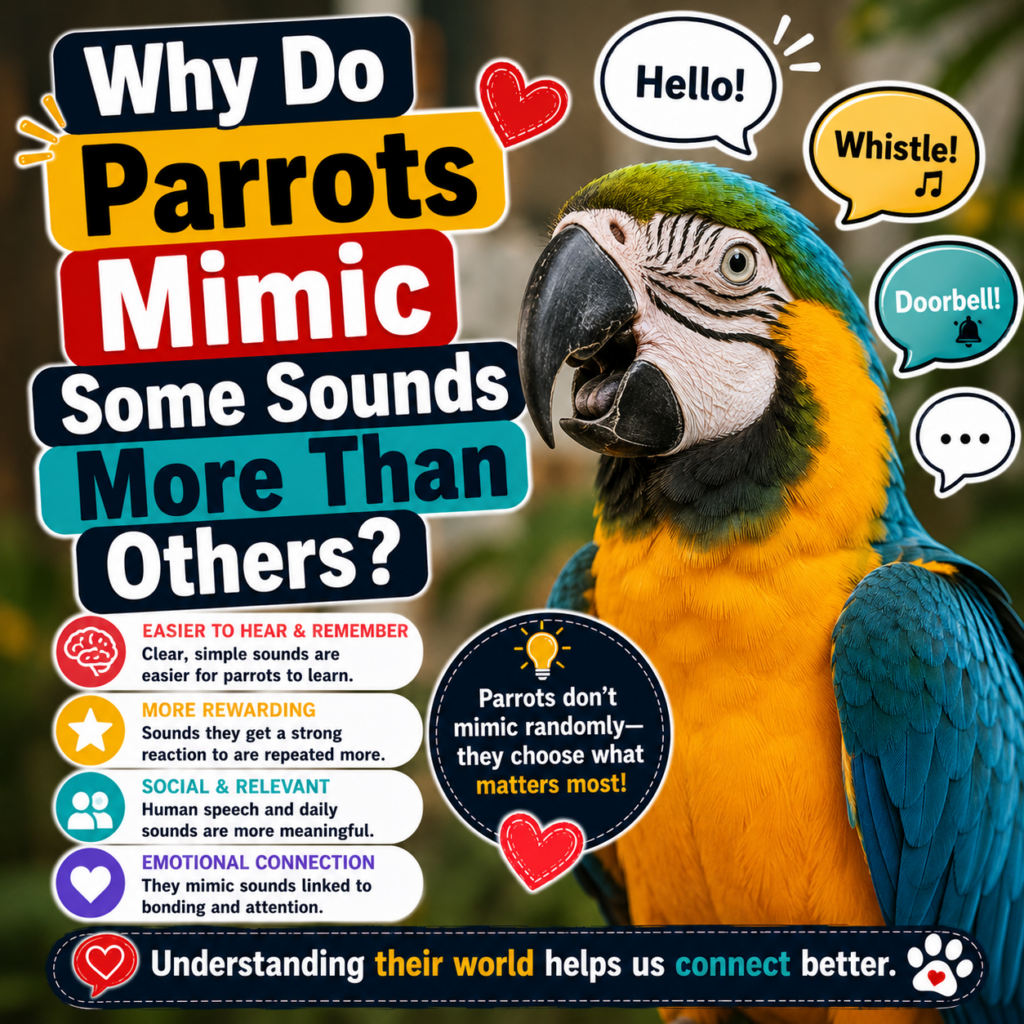
1. The “Drama Factor”: High-Energy and Emotional Resonance
To understand what makes a sound attractive to a parrot, we have to look at how they communicate in the wild. Parrots are hyper-alert prey animals that use vocalizations as a survival tool. In a wild jungle or savannah canopy, a flat, monotonous sound is background noise—but a sudden, sharp, high-energy exclamation means something vital is happening.
When humans speak, we naturally change our vocal tone based on our emotions.
Parrots are world-class decoders of human energy. If you say “Hello” in a flat, tired voice, your bird’s brain logs it as low-priority environmental static. But if you yell “Wow!”, laugh hysterically, or if an electronic appliance lets out a sharp, dramatic alert beep, your bird reads that sound as a high-value milestone.
They mimic the most dramatic, high-energy sounds because their instincts tell them that these specific noises carry the most social importance in the household range.
2. Anatomical Synergy: The Mechanics of the Syrinx
On a purely physical level, certain sounds are simply much easier or more satisfying for a parrot to produce than others.
Humans create vocal sounds using a larynx and flexible vocal cords located in the throat. Parrots do not have vocal cords. Instead, they possess a specialized, highly sophisticated vocal organ called a syrinx, located deep at the base of their trachea (windpipe).
The syrinx is surrounded by an intricate web of fast-twitch muscles that can vibrate independently, allowing some parrot species to produce two distinct frequencies simultaneously.
- The Match: High-pitched, clear, electronic frequencies (like phone pings, whistle tones, or doorbells) align perfectly with the natural resonant frequency of the avian syrinx.
- The Struggle: Low-pitched, guttural human consonants (like b, p, or m sounds) require complex coordination of the tongue and beak shape.
A parrot will naturally default to mimicking sounds that match their biological instrument effortlessly.
At a Glance: Feline, Canine, and Avian Sound Preferences
Parrots sort human household sounds into specific neurological categories based on energy, frequency, and social value.
| Sound Category | Common Examples | Why Parrots Are Obsessed With It | The Feline / Canine Reaction |
| Electronic Alerts | Microwave beeps, phone pings, text chimes, alarms. | Acoustical Perfection: Clear, high-frequency square waves that are incredibly easy for the syrinx to replicate. | Ignored, or treats it as a mild environmental cue. |
| High-Emotion Phrases | “Oh my god!”, laughter, sneezing, coughing. | The Drama Vector: Saturated with human energy, volume spikes, and emotional urgency. | May cause dogs to tilt their heads or look for reassurance. |
| Monotone Prose | Standard conversation, reading aloud, calm sentences. | Low-Value Static: Lacks the acoustic variation or energy to trigger memory retention. | Comforting background noise that encourages deep sleeping. |
3. Social Currency: The Need for Flock Reinforcement
Parrots are intensely social pack and flock animals. In the wild, young birds learn the distinct vocal signature of their parents and flock mates to stay connected during flight and identify who belongs to the family unit. This is known as acquiring a social dialect.
When kept as household companions, your human family becomes their default flock.
When a parrot mimics a specific sound, they are testing its social currency. If they whistle your text alert and you immediately turn your head, laugh, or look at your phone, you have just given that sound massive positive reinforcement. The parrot realizes that making this specific audio note successfully controls your movement and attention, driving them to repeat it endlessly to maintain their bond with you.
💡 The Scent and Sound of Surprise: The Sneezing Phenomenon
Have you ever wondered why almost every African Grey, Cockatoo, or Amazon parrot learns to mimic a human sneeze or cough perfectly? It is the ultimate combination of the Drama Factor and Anatomical Synergy. A sneeze is sudden, explosively loud, and usually followed by an emotional human reaction (“Bless you!”). To a parrot’s brain, a sneeze is a theatrical masterpiece that demands a permanent spot in their daily vocabulary list!
How to Shape Your Parrot’s Vocabulary Playbook
If you want to move your parrot away from mimicking annoying appliance beeps and toward beautiful words, use these behavioral conditioning adjustments:
- Infuse Your Words with Real Drama: Don’t just stand by the cage repeating a word in a dull tone. Step into the room, throw your hands up, use a high-pitched, enthusiastic voice, and treat the word like an absolute party.
- Starve the Unwanted Sounds of Attention: When your parrot makes an annoying sound (like mimicking a car alarm), execute a complete “blackout response.” Turn your back, refuse to make eye contact, do not speak, and walk out of the room for 60 seconds. This teaches their brain that the sound has zero social value and will not engage the flock.
- Pair Sound with a Visual Resource: Parrots understand context. Say the word “Apple” only when you are physically holding a bright slice of fruit. Connecting the audio cue to a vivid visual asset hardwires their associative learning pathways much faster.
The Bottom Line
Parrots don’t mimic sounds at random. Their vocal choices are a brilliant, evolutionary mixture of high-energy observation, structural acoustic synergy with their syrinx, and a deep, instinctual need to build a social connection with their human flock leaders. By understanding what makes a sound attractive to their unique sensory system, you can easily transform your daily training sessions into a fun, rewarding game that keeps your feathered companion mentally stimulated and beautifully connected to your world!