
We are constantly discovering that the animal kingdom is far smarter than we ever gave it credit for. We watch an African Grey parrot solve abstract logic puzzles and hold contextual conversations using human vocabulary. We see a Border Collie effortlessly sort over a thousand distinct toys by name, an octopus engineer a daring escape from a sealed aquarium tank, or a crow fashion a custom hook from a wire to pull food out of a deep tube.
These mind-blowing displays of brainpower leave many asking a fundamental cognitive question: What makes some animals so intelligent?
Why did a select group of species—ranging from marine mammals and exotic birds to domestic companions—evolve advanced problem-solving skills while others rely strictly on rigid, hardwired instincts? Let’s look into the cutting-edge neuroscience and evolutionary blueprints that drive animal genius.
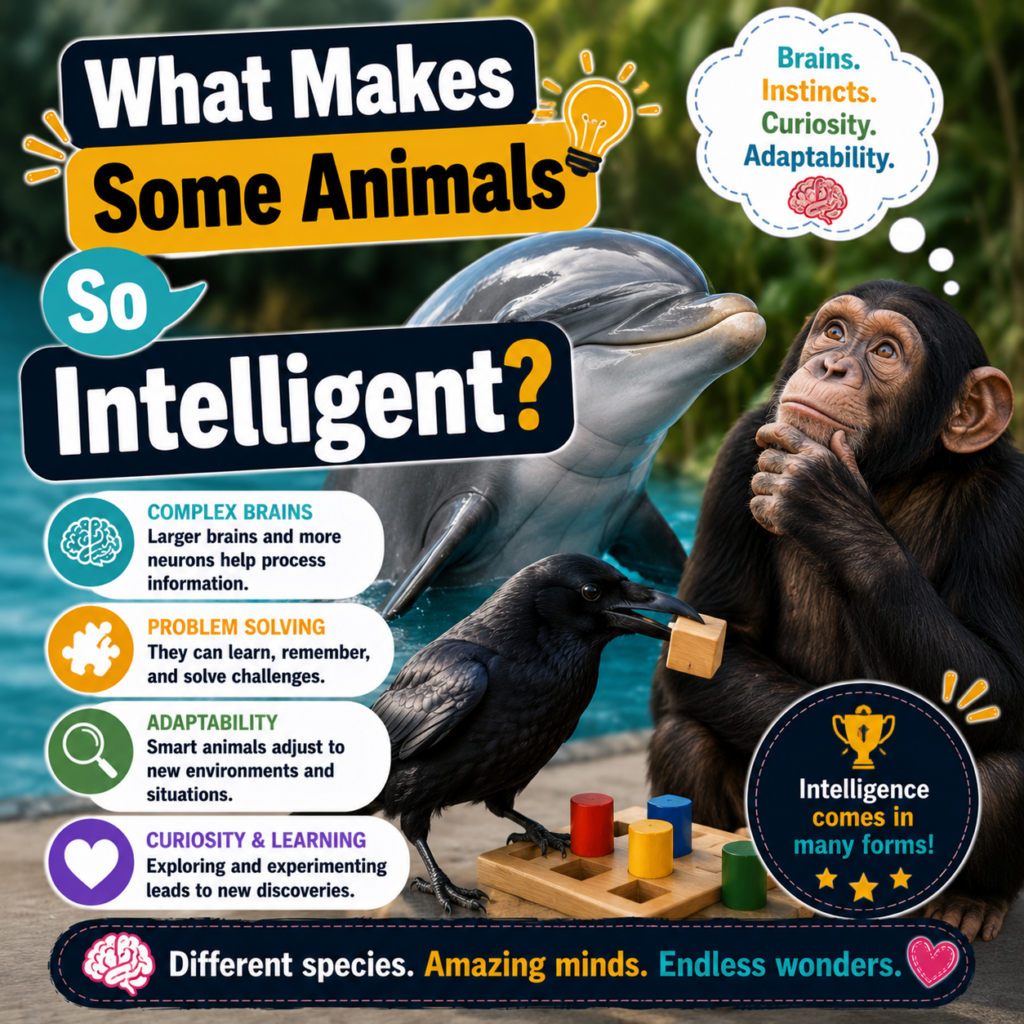
1. The Encephalization Quotient (EQ) and Brain Architecture
For a long time, scientists thought that a bigger brain simply meant a smarter animal. However, if sheer size were the only metric, blue whales and elephants would easily outsmart humanity.
To measure true potential for advanced intelligence, evolutionary biologists look at the Encephalization Quotient (EQ). This is a sophisticated mathematical ratio that compares the actual weight of an animal’s brain to the expected brain size for an animal of its specific body mass.
When an animal possesses a high EQ, it means their brain has a massive surplus of neural tissue that isn’t tied up managing basic biological functions like breathing, digesting, or moving muscles. This extra neural real estate is completely free to focus on cognitive expansion—allowing the animal to map environments, calculate risks, and process abstract logic.
2. The Social Intelligence Hypothesis: The Need for a Group Dialect
Why did these advanced brains develop in the first place? One of the most widely accepted frameworks in cognitive biology is the Social Intelligence Hypothesis.
The theory states that the most demanding cognitive challenge an animal can face isn’t navigating the physical environment—it is navigating a complex, rotating social hierarchy.
Consider wolves, dolphins, and parrots. In the wild, these animals live in highly structured, cooperative packs, pods, or flocks. To survive, an individual must remember hundreds of distinct faces, identify who is an ally or a rival, share information about food resources, and work together during a hunt or flight progression. This intense social landscape functions like an evolutionary gym, forcing the brain to expand its memory retention and communication pathways over generations.
At a Glance: Mapping the Dimensions of Animal Intelligence
Intelligence in nature manifests in completely distinct biological ways depending on the species’ survival needs.
| Animal Group | Evolutionary Driver | The Standout Cognitive Superpower | Real-World Example |
| Canines (Dogs) | Cooperative Pack Dynamics & Human Co-Evolution | Social & Linguistic Intelligence: Excels at decoding human micro-body language, words, and emotional inflections. | Border Collies learning syntax and fast-mapping vocabulary. |
| Avian Champions (Parrots & Corvids) | Complex Foraging Ranges & Lifelong Social Flocks | Abstract Logic & Tool Innovation: Highly developed nidopallium area allowing for cause-and-effect reasoning. | Crows crafting custom hook tools; African Greys understanding abstract concepts like shape and color. |
| Cephalopods (Octopuses) | Predatory Survival Without a Protective Shell | Tactile Autonomy & Spatial Engineering: Short-term and long-term memory distributed across eight independent arms. | Escaping secure tanks, navigating complex mazes, and using coconut shells as armor. |
3. The Nutritional Pipeline: Foraging and High-Value Diets
Brain tissue is incredibly expensive to maintain from a metabolic standpoint. The human brain, for instance, consumes roughly 20% of the body’s daily caloric energy, despite making up only 2% of our total weight.
Therefore, a species can only develop an intelligent, high-EQ brain if their regular diet can physically fuel it.
Animals that rely on low-nutrient, abundant food sources—like grazing herbivores eating grass or leaves—rarely evolve advanced problem-solving skills because their metabolic energy is entirely consumed by a massive, complex digestive process.
Conversely, apex predators, specialized hunters, and complex foragers (like fruit-eating monkeys or nut-cracking parrots) must actively outsmart their environment to secure high-protein, calorie-dense foods. This creates a powerful evolutionary loop: it takes a smart brain to find high-value food, and that high-value food directly feeds the growth of an even smarter brain.
💡 Avian Brains: Packing Dense Power into Tiny Spaces
For decades, humans dismissed birds as simple-minded, coining the phrase “bird brain.” This was because a parrot’s brain is physically tiny compared to a mammal’s. However, a groundbreaking neuroscientific study revealed a stunning evolutionary secret: birds pack double the number of neurons per square millimeter into their brains compared to primates. By packing their neurons into a tiny, ultra-dense structure called the nidopallium, parrots and crows achieve lightning-fast cognitive processing speeds without adding heavy physical weight that would ruin their ability to fly!
4. The Tool-Use Revolution and Mental Time Travel
The ultimate hallmark of an advanced animal mind is the capacity for mental time travel—the ability to look at a current situation, remember a past failure, and mentally simulate a future solution before physically executing it.
When an octopus stacks stones to block their den door, or when a chimpanzee strips leaves off a twig to create a perfect termite-fishing wand, they are stepping out of the present moment. They are demonstrating an abstract understanding of cause-and-effect, physics, and future planning. This level of cognitive agility proves that their minds aren’t just reacting to environmental triggers; they are actively rewriting the world around them to suit their needs.
The Bottom Line
Animal intelligence is not a linear ladder with humans sitting at the absolute top; it is a beautiful, radiating bush of specialized adaptations. What makes some animals so remarkably intelligent is a perfect evolutionary storm: a biological surplus of neural tissue (high EQ), the intense cognitive demands of navigating complex social flocks or packs, and a calorie-dense diet that provides the metabolic fuel required for deep processing. Whether it is a dog decoding human speech, a parrot analyzing abstract concepts, or an octopus engineering a puzzle, nature reminds us that brilliant minds come in all shapes, sizes, and coverings!