
Many parents remember the exact day their child came home, looked up with pleading eyes, and said the classic phrase: “Please can we get a puppy? I promise I’ll feed them, walk them, and clean up after them every single day!”
While it is easy to view this request with a bit of skepticism—knowing that parents often end up managing the bulk of household pet care—welcoming an animal companion into your home is one of the most powerful developmental investments you can make for your child.
To a young mind, a dog, a cat, or an exotic bird isn’t just a fun, interactive playmate. In child psychology and behavioral science, an animal operates as a living, breathing classroom.
What do children learn from caring for animals?
Beyond the simple chores of filling a food bowl or cleaning a birdcage tray, childhood interactions with pets wire a kid’s brain for advanced emotional, cognitive, and social success. Let’s look into the fascinating neuroscience and child development data behind growing up with an animal companion.
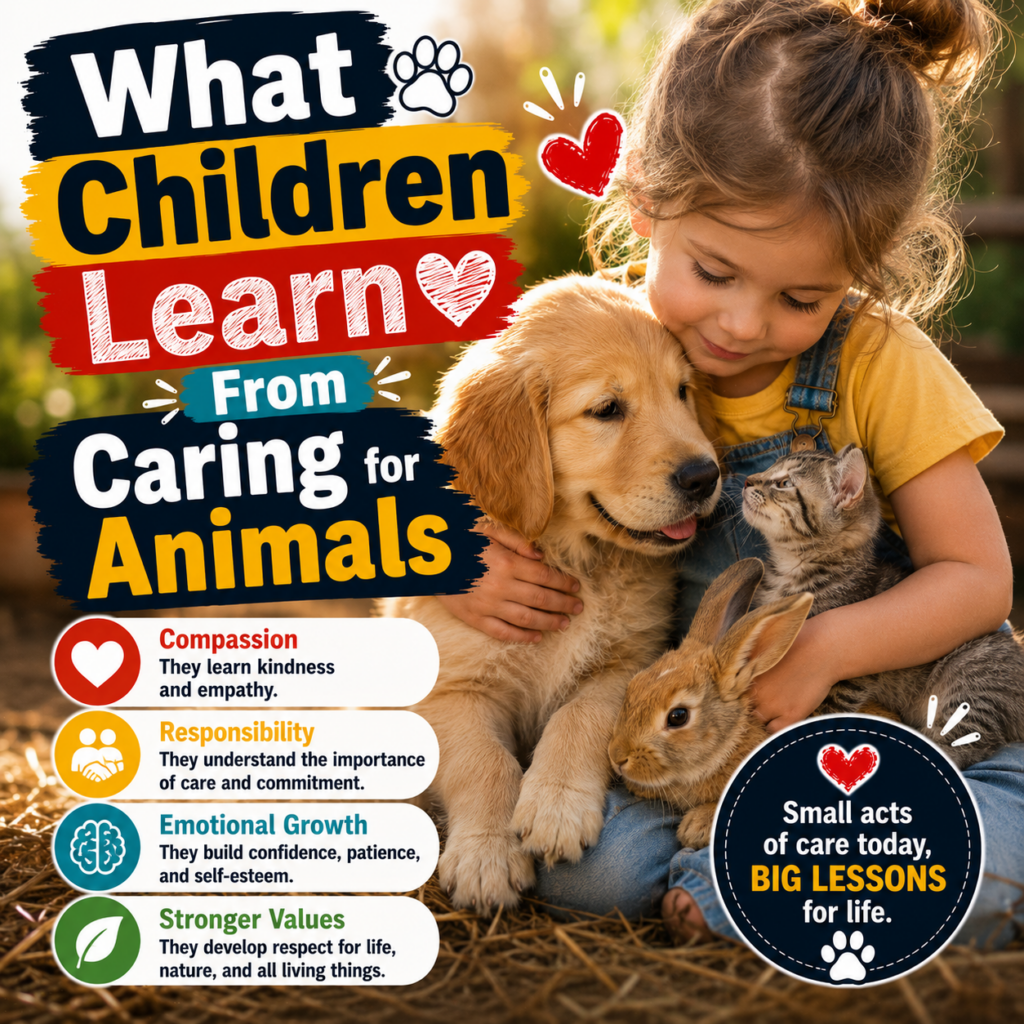
1. Advanced Emotional Intelligence: Mastering the Language of Empathy
The most profound milestone a child hits while caring for an animal is the development of cognitive empathy—the ability to step outside of their own perspective and decode another living being’s emotional reality.
Humans are verbal-first communicators, but animals broadcast their boundaries, fears, and desires through a subtle non-verbal grid. Children do not naturally enter the world knowing how to read these signs. However, when tasked with caring for a pet, their brains quickly transform into elite visual decoders.
When a child learns that a cat’s swishing tail means “I am overstimulated” rather than “I am happy,” or that a parrot’s wide, pinning eyes mean “I am startled,” they are practicing advanced emotional perspective-taking. Clinical studies confirm that children who grow up actively decoding animal body language display significantly higher levels of social empathy, sharing behaviors, and conflict-resolution skills with their human classmates later in life.
2. The Psychology of Accountability: Internalizing True Responsibility
It is one thing for a parent to lecture a child about cleaning their room or finishing their homework. In those scenarios, the consequence of a forgotten task is abstract—a lower grade or a temporary loss of digital screen privileges.
But when a child takes over an “act of care” routine for a family pet, the consequence becomes immediate, tangible, and deeply humanized.
If a child forgets to refresh their rabbit’s water crock or fails to feed their Golden Retriever at the scheduled evening time, they don’t just face parental disapproval. They look down and see a living creature they love looking back at them with sad, hungry eyes or a dry water bowl.
This direct feedback loop teaches children that their personal choices carry real-world weight. It shifts their mindset from a passive, self-centered worldview to an active, nurturing worldview, fostering a deep, internal sense of genuine accountability that no school textbook can teach.
At a Glance: Developmental Milestones Shared Through Pet Care
Every age bracket can absorb distinct psychological and behavioral assets by participating in daily pet care routines.
| Age Bracket | Age-Appropriate Pet Care Task | The Primary Cognitive / Social Skill Learned | The Biological Benefit |
| Toddlers (Ages 2-4) | Helping carry a lightweight plastic bowl, handing over a pet toy, or pointing out empty water dishes. | Cause-and-Effect Logic: Realizing that animals have basic physiological needs just like humans do. | Sensory stimulation and fine motor skill coordination. |
| Young Children (Ages 5-8) | Pouring pre-measured kibble, using a soft brush to groom a calm pet’s back fur, or hiding treats for a foraging game. | The Caretaking Routine: Navigating a predictable daily schedule and honoring boundaries. | Massive oxytocin release, which effectively wipes out school-day stress and cortisol. |
| Pre-Teens / Teens (9+) | Walking the dog safely, cleaning out a birdcage or litter box independently, or training commands. | Systematic Problem-Solving: Learning patience through positive reinforcement training and managing real assets. | Builds deep self-esteem, pride, and an unshakeable sense of capability. |
3. The Ultimate Emotional Buffer: Unconditional Positive Regard
Growing up in a modern, fast-paced world can be incredibly overwhelming for a child. Between navigating school tests, athletic expectations, and peer dynamics, children face constant evaluation and social anxiety.
This is where the family pet steps in as the ultimate psychological sanctuary. Animals offer unconditional positive regard without language barriers.
An animal companion does not care about a child’s school grades, their clothing choices, or their athletic performance. They welcome a child back to the bedroom nest with the exact same level of adoration every single day.
💡 The Power of the “Secret Keeper”
Developmental psychologists note that children frequently treat their pets as their primary “secret keepers.” When a child experiences confusing emotions like anger, grief, or frustration, they will often sit on the floor and whisper their thoughts directly into a cat or dog’s fur, or talk out loud to a bird perched on their shoulder. Because the pet listens intently without interrupting, judging, or repeating the secret, this interaction functions as a highly therapeutic form of cognitive self-soothing and healthy emotional processing!
4. Overcoming Fear with Science: The Lesson of Desensitization
When children help train a pet using positive reinforcement, they learn a beautiful life lesson in patience, consistency, and systematic problem-solving.
Imagine a child helping a nervous rescue pet overcome a fear of a loud appliance or a travel crate. Under a parent’s guidance, the child learns to break the challenge down into tiny, microscopic steps—offering a piece of boiled chicken or a lickable treat whenever the pet looks at the object calmly from a safe distance.
By watching the pet’s anxious walls melt away over weeks of patient repetition, the child learns a profound psychological truth: fear and anxiety can be completely rewired using patience, kindness, and structured steps. This realization builds a magnificent blueprint in the child’s mind that they can apply to their own personal challenges—whether overcoming an academic block, learning a complex musical instrument, or stepping into an unfamiliar social setting.
The Bottom Line
What children learn from caring for animals is nothing short of a complete life blueprint. By stepping up to feed, protect, and communicate with a companion animal, kids don’t just gain a fun household best friend—they absorb the sacred arts of unconditional love, non-verbal empathy, emotional grounding, and personal accountability. Encouraging these safe, respectful, and gentle child-to-pet connections under your roof transforms your living space into a beautiful sanctuary where both your human children and animal companions can live a deeply secure, happy, and balanced life together!