
It is one of the most frustrating, baffling plot twists in the entire domestic animal kingdom. You are sitting on the couch with your cat curled up peacefully on your lap. They are purring loudly, their fur feels incredibly soft, and you are gently stroking their back. Everything about their body language signals absolute bliss.
Then, out of nowhere, a switch flips.
Your cat’s body goes rigid. Within a millisecond, they turn around, clamp their teeth firmly onto your hand, strike with their claws, and dash across the room, leaving you looking at your hand in utter shock and disbelief.
You find yourself wondering: “What did I do wrong? Was that an act of random aggression, or is my cat secretly bipolar?”
In feline behavioral science, this startling behavior has an official technical name: Petting-Induced Overstimulation (or petting-induced aggression).
But why does my cat suddenly bite during petting? Let’s look past our human assumptions and step directly into the fascinating sensory neuroscience and evolutionary biology of the feline body to uncover the truth.
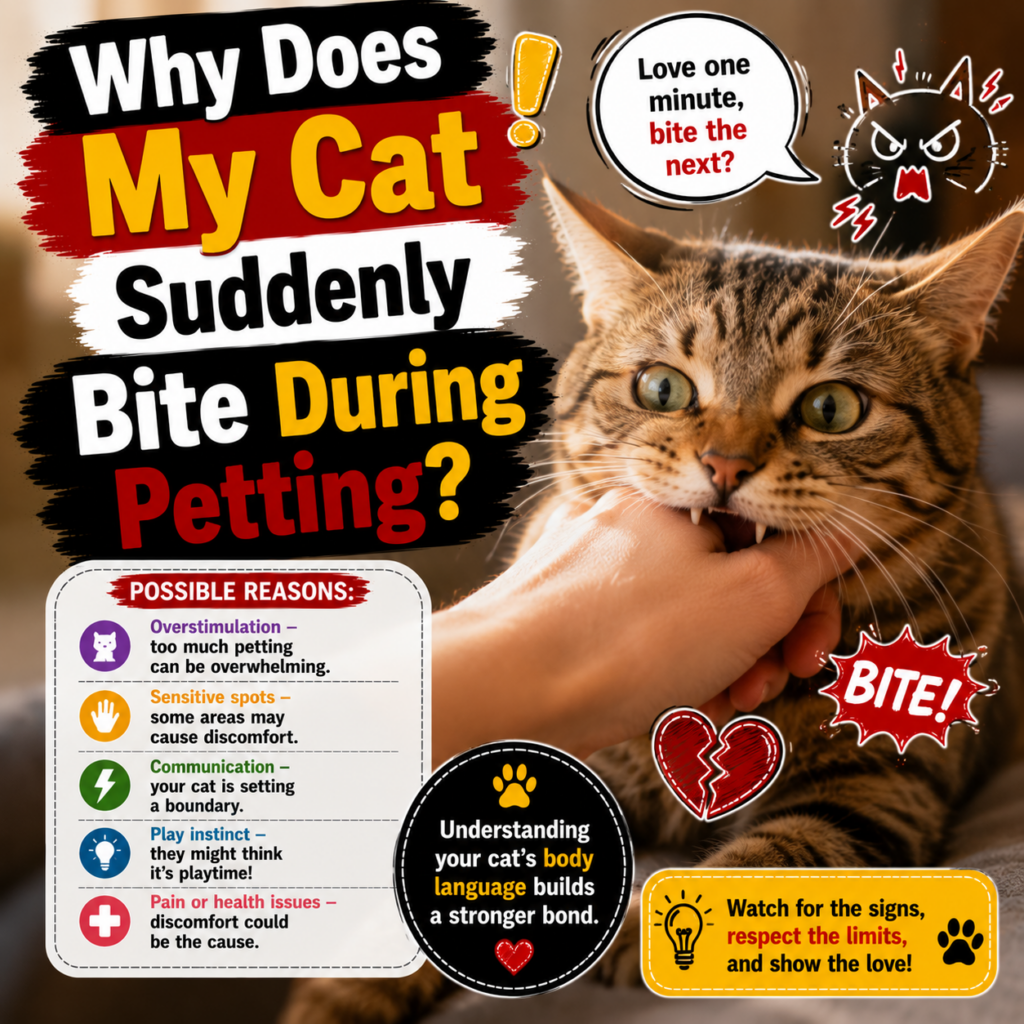
1. The Neural Circuit Overload: Static Shock vs. Sensory Pleasure
To understand why a sweet petting session turns into an accidental battlefield, we have to look closely at a cat’s skin mechanics and sensory processing networks.
A cat’s body is a hyper-tuned sensory antenna. Their skin is packed with highly specialized nerve endings, including hair follicle receptors and tactile corpuscles designed to track the microscopic movements of wind, prey movements, and environmental variables in the wild.
When you repeatedly pet your cat in the same localized zone—especially down their lower back or near the base of their tail—the tactile signals flooding their central nervous system can easily reach a tipping point.
What felt like a soothing, premium massage a moment ago suddenly crosses a neurological threshold and starts feeling like an irritating static shock, extreme heat friction, or an unpleasantly intense tickle. Your cat doesn’t bite you because they suddenly hate you; their primitive survival brain fires an involuntary reflex to stop the uncomfortable physical input immediately.
2. Master Decoders of Silent Warning Whispers
One of the greatest miscommunications between humans and felines is that humans assume a cat’s bite is a sudden reaction. Feline behaviorists note that cats almost never bite without warning.
Because cats live in a non-verbal sensory world, they continuously broadcast their rising baseline anxiety metrics through a series of micro-body movements. Humans miss these silent whispers because we are too focused on the sound of their purr.
Did you know that cats can continue purring even when they are intensely stressed, overstimulated, or in physical pain? Purring is a physiological self-soothing mechanism, meaning it isn’t a reliable green light for unlimited contact.
If you keep stroking their fur while completely ignoring their physical warnings, your cat reaches the absolute limit of their patience. The sudden bite isn’t an unprovoked assault; it is their desperate, final exclamation point to tell you that you missed every single boundary marker they tried to show you!
At a Glance: How to Read the Feline “Stop Sign” Grid
Before your cat resorts to a petting-induced bite, their body language will execute distinct, recognizable warning patterns across their eyes, ears, and tail.
| The Body Zone | The Safe “Green Light” Cues | The Hyper-Arousal “Red Light” Cues | What It Means in Feline Language |
| The Tail | Held high, looping gently at the tip, or resting completely limp and loose. | Thumping tightly against the floor, heavy twitching, or a rhythmic side-to-side swish. | “My internal energy is rising rapidly. Stop the movement right now!” |
| The Ears | Pointing forward naturally, loose, and dynamic. | Flattening horizontally (“airplane ears”) or turning backward toward your hand. | “I am shifting into high-alert defense mode. Back away from my space.” |
| The Eyes & Skin | Soft, squinty, sleepy eyes; loose, unviolated skin tracts. | Pupils dilating completely wild, staring fixedly at your fingers, skin along the spine rippling. | “My nervous system is completely fried. I am about to engage my claws.” |
3. The Evolutionary Blueprint: Low-Tolerance Defensive Filters
Why did cats evolve such a rapid, low-tolerance trigger point for physical touch compared to domestic dogs? The answer is written directly into their ancestral evolutionary history.
Domestic cats are the direct descendants of the African Wildcat, a small, solitary apex predator that simultaneously operates as a prey animal to larger carnivores (like eagles, jackals, and wild dogs). To survive in an unprotected wilderness, their brain architecture is engineered around high-speed hyper-vigilance.
When you continuously pet a cat’s belly, limbs, or lower flank tracts, you are invading high-risk structural areas that house their vital organs. If their internal arousal level gets too high, their ancient ancestral code interprets the continuous touch as a physical restraint or a hunting hold. Their survival reflex overrides their domestic formatting, causing them to bite to secure their freedom and protect the nest range!
💡 The Scent-Marker Rule: Where to Pet Your Cat Safely
If you want to eliminate petting-induced bites under your roof completely, stick to the facial gland architecture. Cats possess highly specialized sebaceous scent glands concentrated around their chin, the corners of their lips, their cheeks, and the base of their ears. Rubbing these specific zones releases calming facial fraction pheromones that lower their baseline cortisol. Keep your hands strictly focused on scratching their forehead, chin, and cheeks. Avoid the belly, the legs, and the lower back line—these regions hold high nerve density and heavy reproductive triggers that instantly invite overstimulation!
How to Handle an Overstimulated Interaction
If your favorite feline shadow locks their teeth onto your arm or displays a sharp warning sign during a lap session, apply these professional animal psychology guidelines to safely decompress the room energy:
- Freeze Immediately: The exact microsecond you see a tail twitch or feel their body go rigid, stop moving your hand. Do not pull your hand away violently, as a rapid fleeing motion will instantly fire your cat’s predatory tracking instincts, causing them to bite down harder or chase your fingers. Stay completely still and let your hand become a boring, lifeless object.
- Do Not Punish the Cat: Never yell at, scold, or physically smack a cat for an overstimulation bite. To their evolutionary script, they gave you multiple warnings, and their bite was a completely justified act of self-defense to stop physical pain. Punishing them will shatter their baseline trust metrics and cause their anxiety to spike.
- The Zero-Contact Reset: Calmly stand up and let your cat slide gently off your lap, or slowly walk out of their immediate visual range. Allow them 20 to 30 minutes of absolute solitude in a quiet, dark room corner to let their internal cortisol burn off and drop their heart rate back to a peaceful resting zone.
The Bottom Line
When your cat suddenly bites you during an intimate petting routine, science shows it is a beautiful, necessary manifestation of their wild, sensory biology. They aren’t trying to reject your love, display toxic behavioral malice, or sabotage your bonding moments. They are simply navigating a highly sensitive neural network that can easily cross over from pleasure into physical irritation. By learning to decode their silent tail thumps, respecting their facial scent-stamping preferences, and honoring their boundaries, you can transform your home into a beautiful, balanced sanctuary where you and your feline best friend feel completely secure, respected, and happy together!