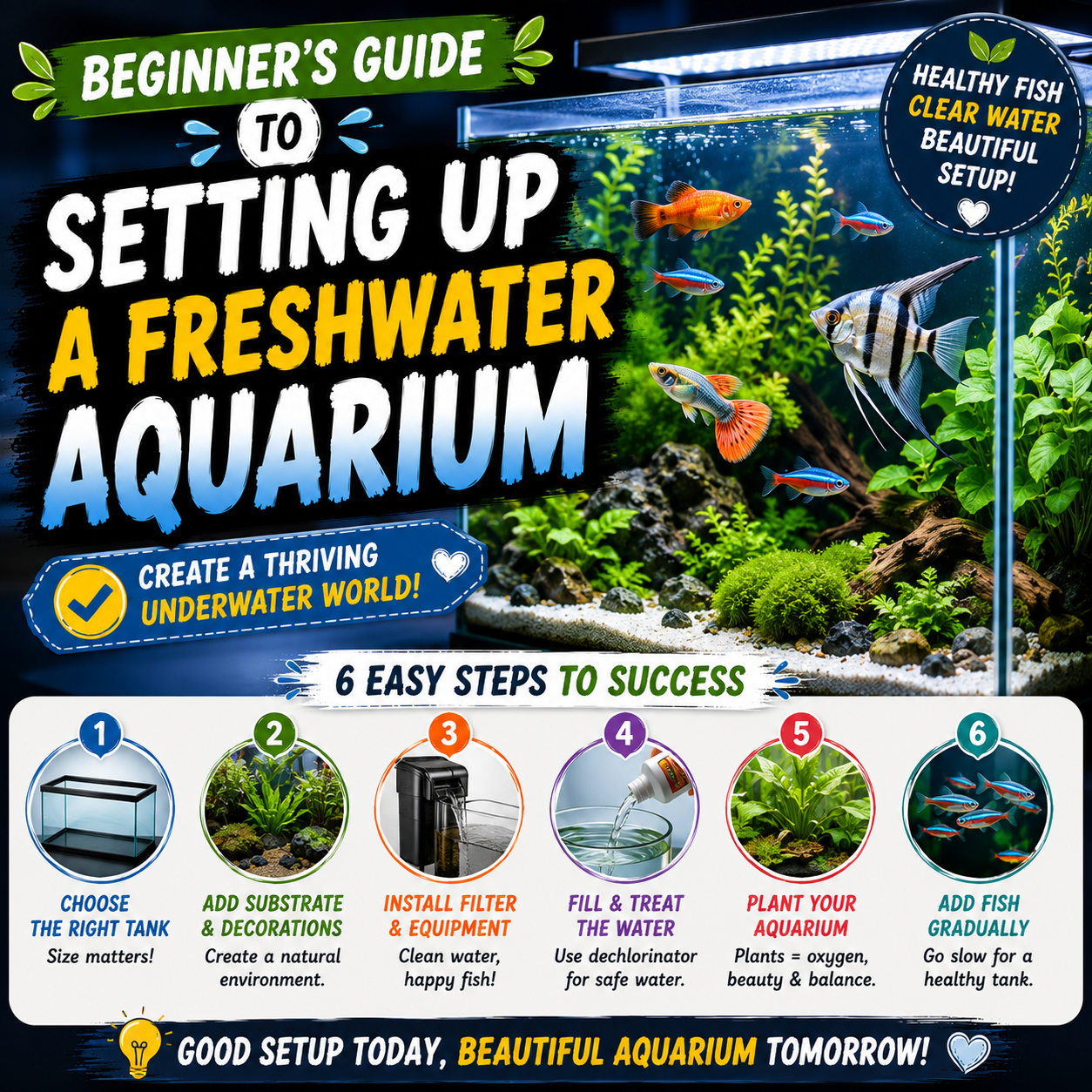
There is nothing quite like the serene beauty of a vibrant, crystal-clear freshwater aquarium. Watching colorful fish glide gracefully through a beautifully landscaped underwater world is incredibly relaxing and makes a stunning addition to any home.
However, many beginners dive into the fishkeeping hobby by buying a small gold-fish bowl, throwing in some tap water, adding fish the same day, and wondering why their pets don’t survive the week. In the aquarium hobby, skipping the setup science is a recipe for disaster.
Setting up a successful aquarium isn’t difficult—it just requires understanding basic aquatic biology and following a structured timeline. Let’s break down the ultimate beginner’s guide to setting up a freshwater aquarium from the ground up!
Step 1: Choosing the Right Tank Size (The Beginner’s Paradox)
When it comes to aquariums, smaller is actually harder, not easier. This is the biggest paradox for beginner fishkeepers.
In a tiny 5-gallon tank, even a minor mistake (like slight overfeeding) causes toxic waste levels to skyrocket rapidly. Conversely, a larger volume of water dilutes toxins naturally and acts as a biological buffer, making water parameters significantly more stable and forgiving.
- The Golden Entry Standard: Start with a 20-gallon (approx. 75 liters) long or breeder tank. It provides plenty of horizontal swimming space, opens up excellent fish stocking options, and is incredibly easy to balance chemically.
Step 2: Selecting and Preparing Your Substrate & Hardscape
Your substrate (the gravel or sand at the bottom) isn’t just for decoration; it acts as an anchoring ground for live plants and a breeding bed for beneficial, waste-eating bacteria.
1. Choose Your Base: Sand vs. Gravel
- Aquarium Gravel: Best for beginners keeping standard fish. It is easy to clean using an aquarium siphon vacuum.
- Aquarium Sand: Absolutely vital if you plan on keeping bottom-dwelling fish with sensitive whiskers, like Corydoras catfish, as rough gravel will scratch their faces.
2. Rinse Everything Thoroughly
Never pour substrate straight out of the commercial bag into your tank. It is covered in ultra-fine mineral dust. Place your substrate in a clean bucket and rinse it with running water 4 to 5 times until the water runs crystal clear.
Lay down a smooth 1.5 to 2-inch layer along the aquarium floor, sloping it slightly higher toward the back to create visual depth.
Step 3: Installing the Mechanical & Heating Matrix
Before adding a single drop of water, position your hardware inside the tank:
- The Filtration System: Invest in a high-quality Hang-On-Back (HOB) filter or an external canister filter rated for twice your actual tank volume. Your filter must run 24/7 to clear physical debris and cycle chemical toxins.
- The Heating System: Most colorful aquarium fish are tropical and require a stable water temperature between 75°F to 80°F (24°C to 27°C). Install an adjustable submersible aquarium heater alongside a separate glass thermometer positioned on the opposite side of the tank to verify uniform heat distribution.
Step 4: Filling the Tank and Conditioning the Water
Now it’s time to fill your aquatic canvas.
- The Pour Tactic: Place a clean ceramic dinner plate flat on top of your substrate. Pour your water slowly directly onto the plate. This breaks the water’s force and prevents your carefully laid sand or gravel from blowing around into a messy crater.
- The Chemical Mandate (Dechlorination): Standard tap water contains chlorine and chloramines. While safe for humans, these chemicals act like toxic acid on a fish’s delicate gills. You must add a heavy dose of liquid water conditioner (dechlorinator) to the tank instantly to neutralize these chemicals completely.
Step 5: The Critical Waiting Phase (The Nitrogen Cycle)
🚨 Stop! Do not buy fish yet. This is where 90% of beginners fail.
Before your tank can safely house fish, you must complete a biological process called The Nitrogen Cycle. This process takes anywhere from 4 to 6 weeks to naturally build a colony of beneficial bio-filtering bacteria inside your filter sponge. Without these bacteria, your fish’s waste will turn into toxic ammonia, causing lethal “New Tank Syndrome.”
[ Fish Waste / Decaying Food ] ──► Toxic Ammonia (0 ppm)
                                         │  (Nitrosomonas Bacteria)
                                         ▼
                                   Toxic Nitrite (0 ppm)
                                         │  (Nitrobacter Bacteria)
                                         ▼
                                   Safe Nitrate (< 20 ppm) ──► Removed via Water Changes!
How to Fishless Cycle Your Aquarium Safely:
- Turn on your filter and heater. Leave them running permanently.
- Drop a tiny pinch of fish food flakes into the empty tank every single day. As the food rots, it releases the initial ammonia needed to “feed” the incoming bacteria.
- Use a liquid aquarium testing kit weekly. You will watch Ammonia spike, then Nitrites spike, and finally, Nitrates will appear.
- The Safe Target: Your cycle is complete when a test shows 0 ppm Ammonia, 0 ppm Nitrite, and a low reading of Nitrates.
Step 6: Stocking Your First Fish (Slow and Steady)
Once your water test reads perfect zeros for Ammonia and Nitrite, you can finally head to your local fish store!
- Start Small: Only introduce 2 to 3 hardy fish during your first week (such as Zebra Danios, Neon Tetras, or Harlequin Rasboras). Adding too many fish at once will overwhelm your young bacterial colony and cause a toxic chemical spike.
- The Acclimation Protocol:
- Float the sealed plastic fish bag on the surface of your tank water for 15 to 20 minutes to match the temperatures exactly.
- Open the bag and add half a cup of your aquarium water inside. Wait 5 minutes. Repeat this twice.
- Use a soft fish net to scoop the fish out of the bag and gently drop them into your tank. Never pour the dirty store bag water into your pristine home aquarium!
Beginner Aquarium Maintenance Quick-Reference
To keep your aquarium crystal clear and healthy, adhere strictly to this basic routine:
| Frequency | Action Item | Biological Purpose |
| Every Day | Feed a small amount (what they can eat in 2 mins); check water temp. | Prevents food decay; ensures hardware is working perfectly. |
| Every Week | Perform a 20% partial water change using a gravel siphon. | Extracts bottom waste; dilutes safely accumulating Nitrates. |
| Every Month | Swish and clean your filter sponges inside dirty tank water. | Clears out physical sludge without killing beneficial bacteria. |
| ❌ NEVER | Rinse filter sponges or decorations under tap water. | Disaster: The chlorine in tap water will instantly kill your bio-filter. |
Conclusion: Patience Breeds Aquatic Perfection
Setting up a freshwater aquarium is a beautiful mix of art, design, and basic biology. By bypassing cramped bowls in favor of a spacious 20-gallon tank, giving your setup 4 to 6 weeks to complete the vital nitrogen cycle, and adding your colorful fish slowly, you will easily avoid the common traps that ruin the hobby for most beginners.
Be patient, check your water parameters consistently, and enjoy the breathtaking, peaceful experience of managing your very own thriving underwater paradise!