
We have all heard the incredible stories: a loyal family dog starts persistently sniffing, pawing, or licking a specific spot on their owner’s skin. Months later, that exact spot is diagnosed as a malignant melanoma.
While these accounts sound like something straight out of a movie script, they are far from mere urban legends. In fact, medical science has spent decades investigating this exact phenomenon.
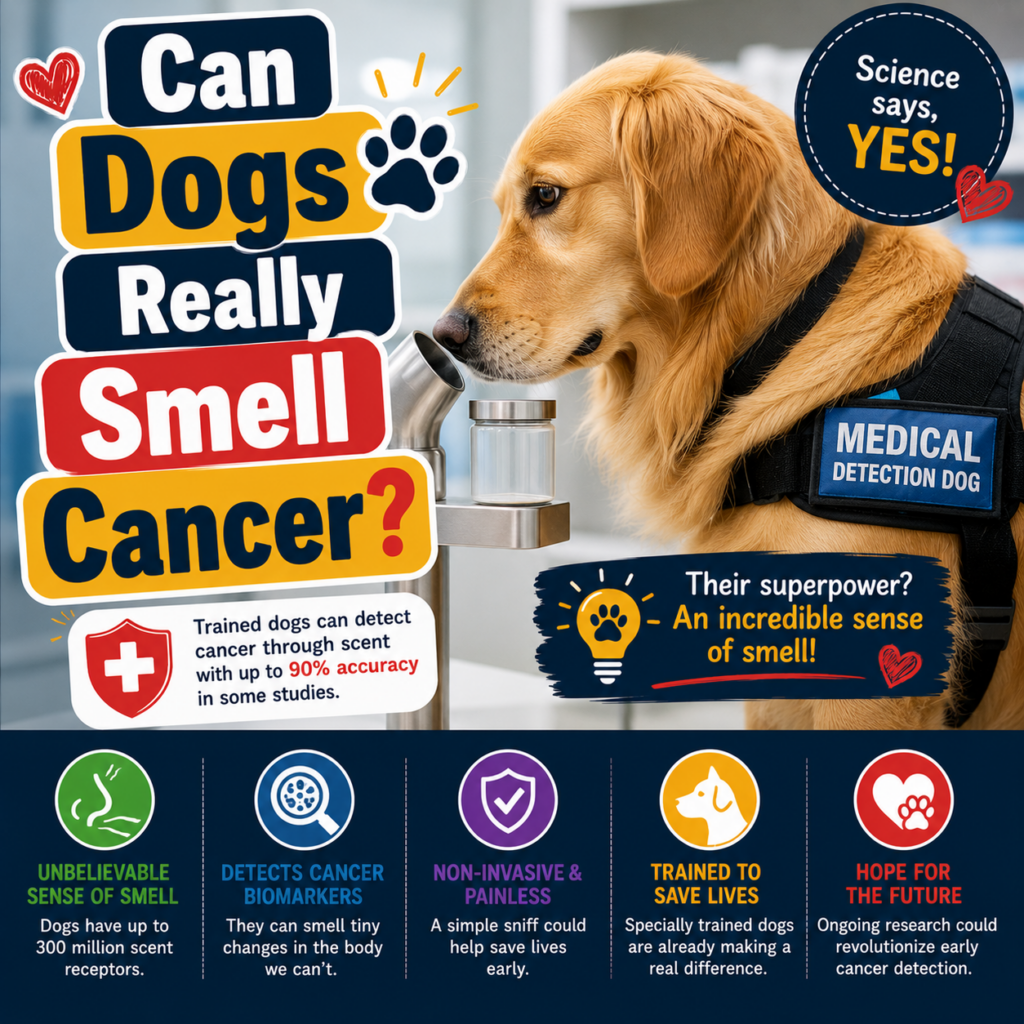
Can dogs really smell cancer? Is it biologically possible for a canine nose to out-diagnose advanced laboratory equipment?
Let’s look into the extraordinary neurobiology of the canine olfactory system and the scientific studies proving that our four-legged friends might just be the ultimate non-invasive diagnostic tools.
The Superpowered Canine Nose: How Tiny Can They Smell?
To understand how a dog can detect a complex disease like cancer, we first have to look at the anatomy of their snout.
While a human nose contains roughly 5 to 6 million olfactory (scent) receptors, a dog’s nose possesses between 125 million and 300 million scent receptors, depending on the breed. Furthermore, the part of the brain dedicated to analyzing smells—the olfactory bulb—is 40 times larger in dogs than in humans.
This gives dogs a sense of smell that is up to 100,000 times more sensitive than ours.
To put this extraordinary superpower into perspective, a human might notice if a cup of coffee has a teaspoon of sugar in it. A dog, however, can detect that same teaspoon of sugar diluted in two Olympic-sized swimming pools of water. They can isolate individual odor chemical components at concentrations as low as one part per trillion.
The Science: What Exactly Are They Smelling?
Dogs aren’t magically sensing “cancer” as an abstract concept. Instead, they are sniffing out specific chemical footprints known as Volatile Organic Compounds (VOCs).
When a person develops cancer, the normal metabolic processes of their cells become heavily altered. As cancer cells divide and mutate, they shed unique biochemical byproducts and cellular debris. These byproducts evaporate into the air as VOCs, entering the patient’s bloodstream and eventually diffusing into their breath, urine, sweat, blood, and stool samples.
Because every disease leaves a unique “odor signature” or “chemical fingerprint,” trained medical detection dogs can sort through thousands of everyday smells to pinpoint the exact compound linked to malignant tumors.
What the Clinical Studies Show
Over the last two decades, peer-reviewed medical studies have put trained sniffer dogs to the test, yielding mind-blowing results across various types of cancer:
| Cancer Type | Sample Type Sniffed | Clinical Study Results & Accuracy |
| Breast Cancer | Urine / Breath | A 2021 study showed a trained dog distinguished breast cancer urine samples from healthy ones with nearly 100% accuracy. |
| Lung Cancer | Exhaled Breath / Blood | Landmark trials show trained Beagles can accurately isolate lung cancer blood samples with a 97% accuracy rate. |
| Prostate Cancer | Urine Samples | Dogs can identify specific prostate cancer biomarkers in urine with accuracy rates ranging from 90% to 98%. |
| Colorectal Cancer | Breath / Stool | Studies prove dogs can easily detect early-stage colon cancer from watery stool, completely unaffected by surrounding gut inflammation. |
The Famous Anecdotes: Real-Life Medical Miracles
The formal scientific study of canine cancer detection actually began because of a real-life anecdote published in the prestigious medical journal The Lancet in 1989. A patient reported that her dog persistently sniffed a mole on her leg, even trying to bite it off through her clothes. When doctors biopsied the mole, it turned out to be a malignant melanoma.
In another widely publicized case, Dr. Claire Guest, co-founder of the UK organization Medical Detection Dogs, credits her Fox Red Labrador, Daisy, with saving her life. Daisy kept staring at Dr. Guest’s chest, pawing at her breast anxiously. Prompted by the dog’s erratic behavior, Dr. Guest went to the clinic and discovered a deep, malignant breast tumor long before it would have been visible on a routine mammogram.
💡 If They Are So Accurate, Why Aren’t They in Hospitals?
If dogs are hitting 95%+ accuracy rates, why aren’t they sitting in every doctor’s office screening patients? Animal behaviorists and epidemiologists cite a few practical limitations:
- Lack of Standardization: Dogs are living creatures. They can have “off days” due to fatigue, mood, or mild colds, making it hard to standardize them like a laboratory machine.
- The “Confounding” Problem: Non-cancer factors like an individual’s diet, medications, or unrelated minor infections can alter their overall VOC profile, occasionally confusing a dog.
- Scalability: Training a medical detection dog takes up to a year of intense positive reinforcement, making it highly expensive and difficult to scale for millions of global hospital visits.
The Future: From Bio-Noses to Electronic Technology
Instead of replacing laboratory tests with a pack of dogs, modern medical research is using canine noses to train Artificial Intelligence and electronic sensors.
Institutions like MIT and the University of Pennsylvania are pairing trained medical dogs with nanotechnology to develop the “Electronic Nose” (e-nose). By analyzing exactly which molecular combinations the dogs are reacting to, scientists are creating hyper-sensitive electronic chips capable of scanning a patient’s breath or blood sample for instant, early-stage cancer tracking.
The Bottom Line
Yes, dogs can absolutely smell cancer. Through their magnificent evolutionary hardwiring, their noses can pick up the microscopic chemical scent signatures left behind by cellular mutations long before conventional medical scans can detect a physical lump.
While your family pet might not be trained to run a clinical medical diagnosis, their intense sensitivity to your body chemistry is a powerful reminder of how deeply connected our furbabies are to our health and well-being.