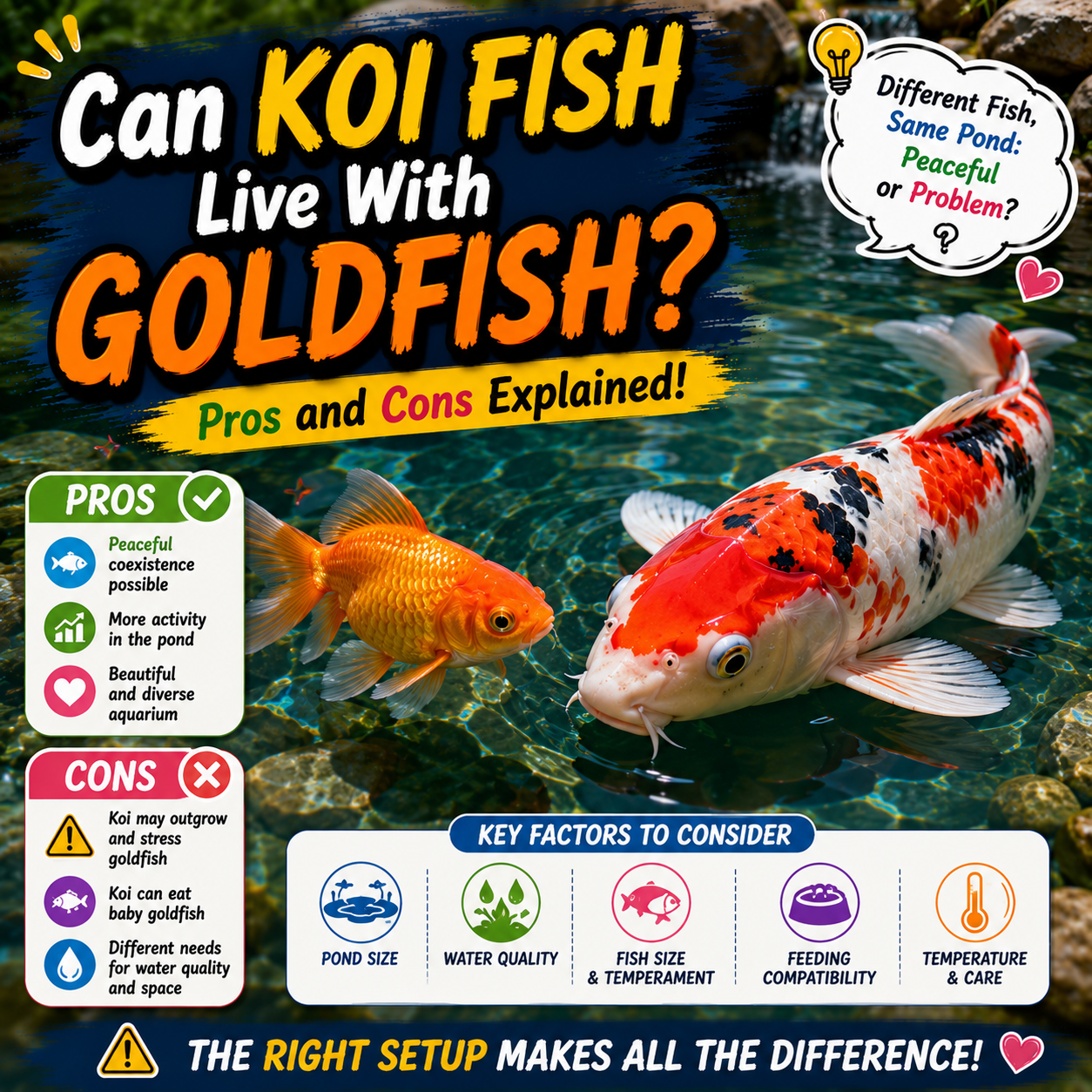
When designing a backyard garden pond, it is completely natural to envision a vibrant, swirling mix of different colors and patterns. Naturally, two of the most popular aquatic species in the world instantly come to mind: Koi and Goldfish.
Because they both belong to the Cyprinidae (carp) family, look somewhat similar as juveniles, and thrive in cold water, it seems like a match made in heaven. But can koi fish live with goldfish long-term?
The short answer is yes, they can safely coexist. However, managing a mixed pond isn’t without its challenges. Let’s dive into the detailed pros, cons, and essential rules of thumb to ensure your mixed community pond stays healthy and balanced.
The Biological Connection: Why It Works
Before looking at the management side, it helps to understand why these two species are fundamentally compatible.
Both koi (Cyprinus rubrofuscus) and goldfish (Carassius auratus) are cold-blooded, hardy omnivores. They share identical water parameter requirements:
- Water Temperature: Both prefer a stable range between 65°F to 75°F (18°C to 24°C) but can easily survive winter hibernation under frozen pond surfaces.
- Water Chemistry: They thrive in a pH of 7.2 to 7.8 and require a strict 0 ppm of Ammonia and Nitrites.
- Social Instincts: Neither species is naturally aggressive or territorial. They are both peaceful “shoaling” animals that enjoy the company of other fish.
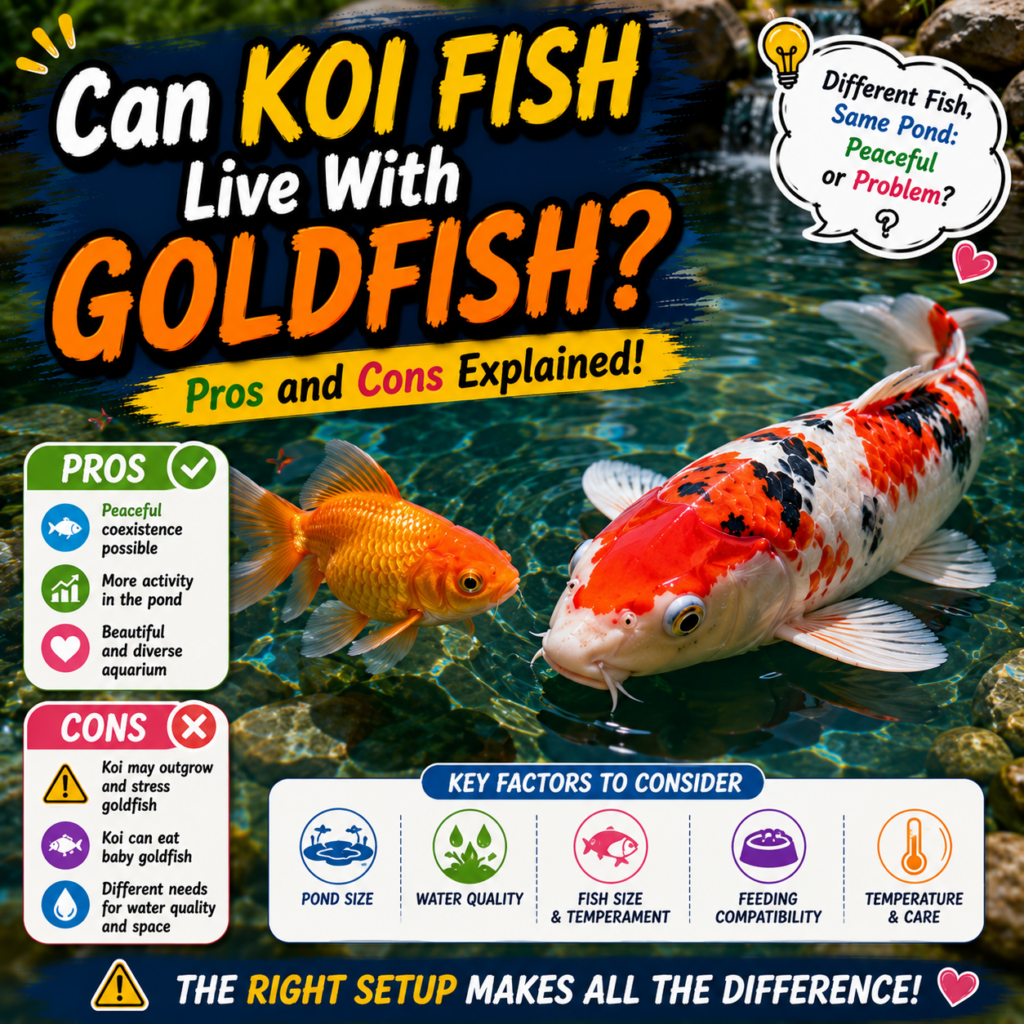
The Pros of Keeping Koi and Goldfish Together
Combining these two iconic species offers several fantastic benefits for pond owners:
1. Breathtaking Visual Diversity
Koi bring grand scale, complex Japanese patterns (like Kohaku or Showa), and a distinct whiskered majesty to the deep zones of your pond. Goldfish, on the other hand, offer intense, solid blocks of metallic red, bright orange, and pure white that pop beautifully against green lily pads in the shallow areas.
2. A Cost-Effective Setup
Finishing a massive pond exclusively with high-grade koi can cost thousands of dollars. Introducing hardy, affordable goldfish species allows you to fill out the pond beautifully without breaking your budget.
3. Shared Diet and Easy Feeding Routine
Because they are both carp variants, they eat the exact same food. You don’t need to buy separate products; a high-quality floating koi pellet can comfortably feed both species simultaneously.
The Cons of Keeping Koi and Goldfish Together
While a mixed community pond is beautiful, you must prepare for a few biological risks:
1. The Size Gap (The Accidental Snack Risk)
Adult koi can easily grow to 24 to 30 inches long, whereas standard goldfish max out around 10 to 14 inches.
While koi are not active predators, they are opportunistic vacuum-feeders. If you introduce a tiny, juvenile goldfish into a pond housing a giant adult koi, the koi might accidentally suck the small goldfish into its mouth during a feeding frenzy.
2. Cross-Breeding Conundrums (Hybrid Fish)
Because they are closely related genetically, koi and goldfish can cross-breed in the spring.
The resulting offspring are hybrid fish (often called “Koifish” or “Mule Koi”). These hybrids are completely sterile, meaning they cannot reproduce. Visually, they lack the beautiful coloration of true goldfish and don’t grow to the grand size of true koi—often turning out as dull, greenish-brown fish that take up valuable space in your pond.
3. Faster Water Quality Deterioration
Both koi and goldfish lack a traditional stomach, meaning they digest food continuously and produce heavy amounts of waste (ammonia). Packing a pond with both species multiplies the organic bioload exponentially, forcing you to work much harder to maintain water clarity.
🌟 The Compatibility Matrix: Choosing the Right Goldfish
You cannot toss just any goldfish into a koi pond. Fancy goldfish varieties (like Orandas, Black Moors, or Fantails) are slow, clumsy swimmers due to their egg-shaped bodies and double tail fins. Koi will easily out-swim them, steal all the food, and accidentally bump into them, causing injury.
❌ DO NOT PAIR: Koi  ──►  Fancy Goldfish (Orandas, Ryukins, Black Moors)
🌟 PERFECT PAIR: Koi ──►  Streamlined Goldfish (Comets, Commons, Shubunkins)
To guarantee peace in the pond, only select fast, single-tailed, streamlined goldfish breeds:
- Comet Goldfish: Fast, agile, and hardy with long, flowing fins.
- Shubunkin Goldfish: Features a beautiful calico pattern (blue, red, black, and white) that complements koi aesthetics perfectly.
- Common Goldfish: Incredibly tough, fast swimmers that can easily compete with koi at feeding time.
3 Essential Rules for a Successful Mixed Pond
If you want to move forward with a mixed koi and goldfish pond, adhere strictly to these three management rules:
- Rule 1: Enforce the “No Tiny Fish” Rule: Never introduce a goldfish into the pond unless it is at least 4 to 5 inches long. It must be physically too large to fit inside the mouth of your largest koi.
- Rule 2: Double Your Filtration Capacity: Because both species are heavy waste-producers, ensure your external canister filter or biological setup is rated for twice the actual volume of your pond.
- Rule 3: Keep the Space Spaciouos: Stick to a strict volume baseline. Provide at least 250 to 500 gallons of water per adult koi, and 30 to 50 gallons per adult goldfish.
Conclusion: A Vibrant, Harmonious Balance
At the end of the day, koi and goldfish make fantastic roommates as long as you respect the size difference. By pairing your majestic koi exclusively with fast, single-tailed goldfish like Comets or Shubunkins, keeping small babies out of the mix, and over-specifying your filtration system, you can easily maintain a healthy, peaceful, and visually stunning backyard ecosystem!