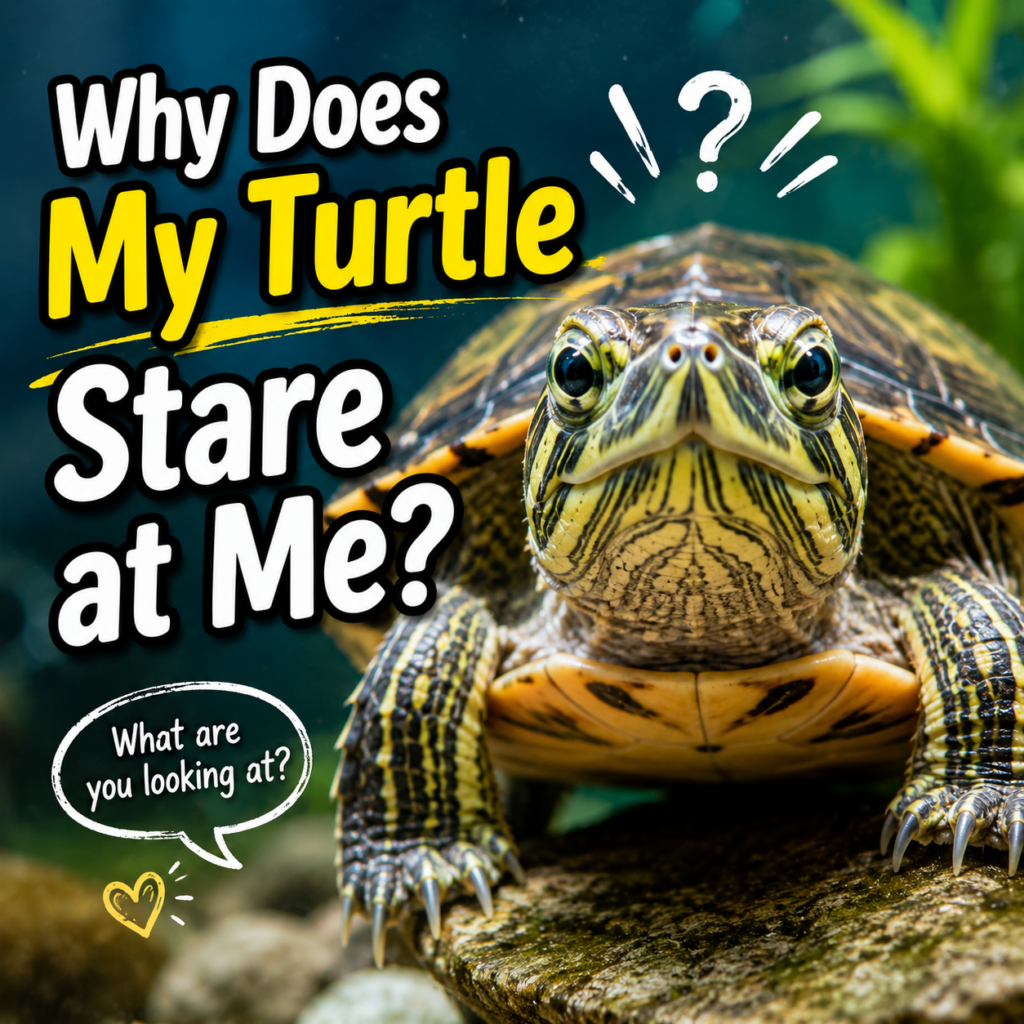
If you’ve ever looked over at your pet’s tank only to find two unblinking eyes locked onto you, you aren’t alone. Many turtle owners notice their shelled friends pulling off a serious, motionless stare down.
While it can feel a bit mysterious—or even a little creepy—there is actually a lot going on behind those tiny eyes. Turtles are much more observant than people give them credit for.
So, why does your turtle stare at you? Let’s crack the shell on this behavior and explore the 5 main reasons behind the gaze.
1. You Equal Food (The Ultimate Dinner Bell)
The most common reason for the turtle stare is simple: hunger and anticipation.
Turtles are highly opportunistic eaters. In captivity, they quickly figure out the exact sequence of events that leads to a meal. They learn to associate your human silhouette, the sound of your voice, or the rustle of a food container with delicious pellets, shrimp, or greens.
If your turtle is staring at you—especially while swimming frantically against the glass or bobbing its head—it’s essentially begging for a snack.
2. Curiosity and Environmental Awareness
Turtles may move slowly, but their brains are always processing their surroundings. They are naturally curious reptiles with surprisingly good eyesight, especially when it comes to detecting motion.
To a turtle sitting in a static tank, you are the most interesting, dynamic object in the room. Whether you are working at your desk, walking by, or watching TV, you represent movement and change. They stare simply because they are watching the “human show” outside their glass world.
3. They Recognize Their Keeper
Can turtles actually tell humans apart? Yes, they can! Research and owner experiences show that turtles learn to recognize the faces, voices, and general presence of the people who care for them regularly.
If your turtle stares at you warmly but retreats into its shell when a stranger walks into the room, it’s a clear sign of recognition. Your turtle knows who you are and is monitoring its favorite human.
4. Boredom or a Need for Stimulation
If your turtle is staring blankly into space or directly at you for hours without moving, it might be experiencing a bit of boredom.
In the wild, turtles spend their days foraging, exploring, and navigating complex environments. If their tank is too bare, they have nothing else to do but watch you. You can help spice up their life by adding:
- New tank decorations or safe rocks to climb.
- Floating toys (like a ping-pong ball) to push around.
- Live feeder fish or ghost shrimp to encourage their natural hunting instincts.
5. Boredom vs. Illness (When to Worry)
While a healthy turtle will stare out of curiosity or hunger, a completely listless, unblinking stare accompanied by lethargy can sometimes point to a health issue.
If your turtle is staring but refuses to eat, stays on its basking platform all day, or shows signs like swollen eyes, wheezing, or lopsided swimming, it could be suffering from a respiratory infection or vitamin deficiency. If the gaze is paired with these symptoms, a trip to an exotic vet is highly recommended.
How to Interact When Your Turtle Stares at You
Instead of just staring back, you can use these moments to build a stronger bond with your pet:
- Talk to Them: Turtles can hear low-frequency sounds and vibrations. Speaking softly helps them get used to your voice.
- Hand-Feed Safely: Offer a favorite treat, like a piece of romaine lettuce or a mealworm, using tweezers or your fingers (if they are gentle) to reinforce positive associations.
- Rearrange the Tank: Change up their environment during your weekly tank clean to give them something new to explore instead of just watching you.
Conclusion: Take it as a Compliment!
At the end of the day, a turtle staring at you is usually a wonderful sign. It means your pet is alert, engaged with its environment, healthy enough to look for food, and completely comfortable in your presence.
So next time you catch your shelled companion giving you the look, don’t worry—you’ve just got a very attentive, appreciative little fan!