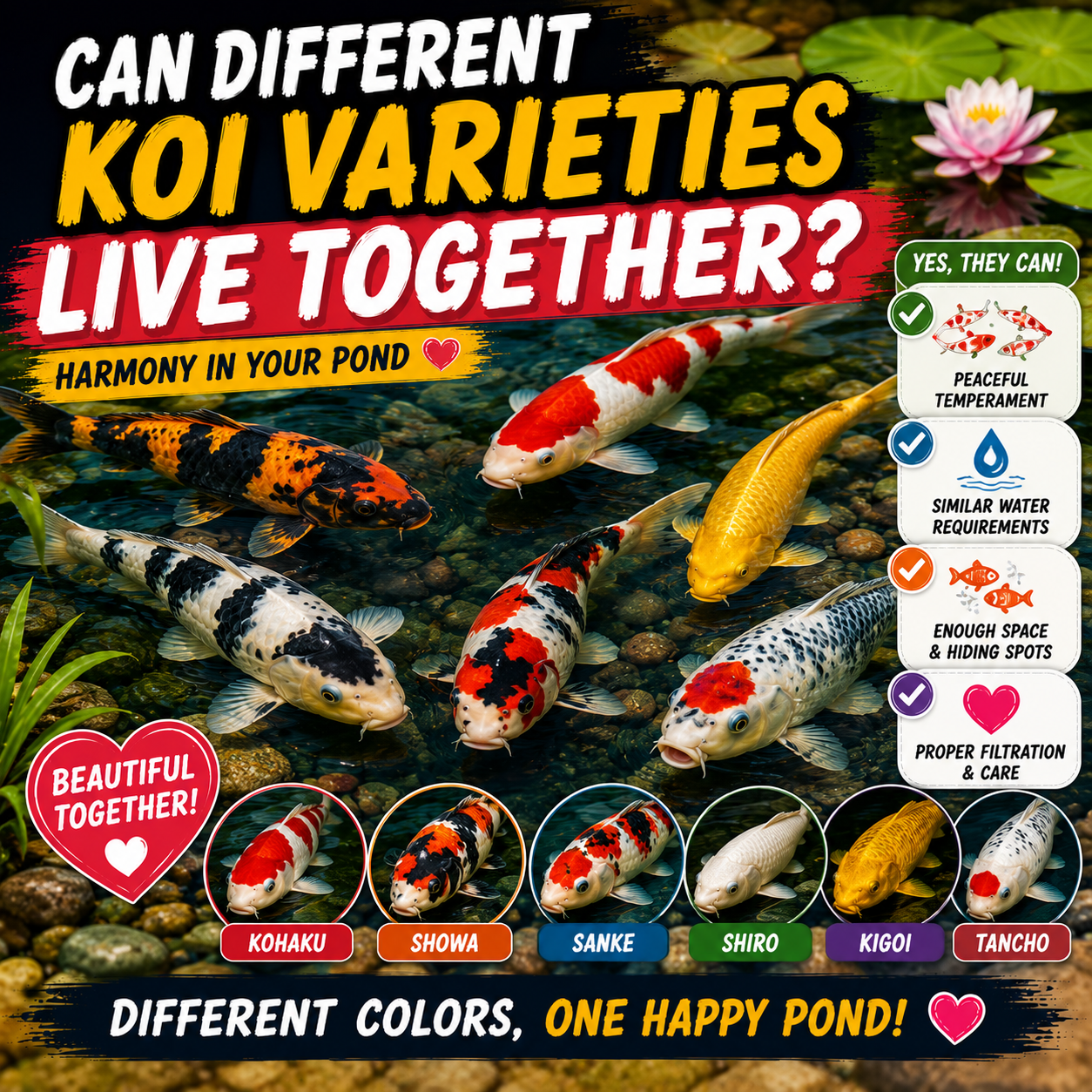
When you step into the world of koi keeping, you are immediately introduced to an astonishing spectrum of colors, scales, and patterns. From the iconic red-and-white Kohaku and the ink-black patterns of the Showa to the metallic, glittering armor of the Gin Rin varieties, it is completely natural to want to mix and match.
Naturally, every beginner pond designer faces a critical question: Can different koi varieties live together peacefully? Or will combining these distinct lineages trigger aggressive territory wars, behavioral clashes, or biological disasters?
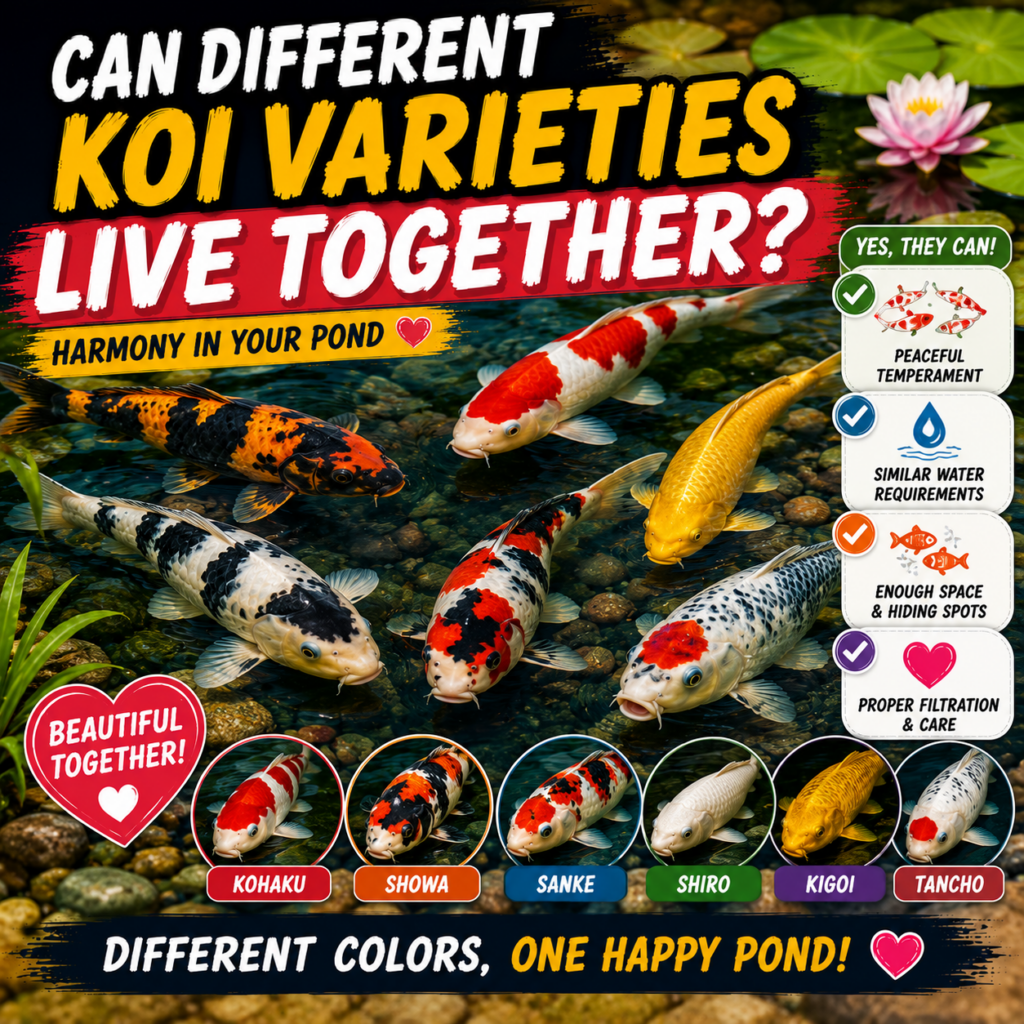
The fantastic answer is yes, they can absolutely live together happily! In fact, koi are among the most peaceful, socially cohesive fish in the world. However, creating a successful mixed-variety pond requires an understanding of a few subtle biological traits and structural rules.
Let’s dive into the fascinating genetics of these “living jewels” and explore how to build a thriving, diverse aquatic community.
The Biological Foundation: Why Mixed Koi Varieties Work
To understand why different koi types get along so seamlessly, you have to look at their genetic lineage. Every single ornamental koi variety in existence today—whether it is a standard Japanese Nishikigoi, a scaleless Doitsu, or a flowing Butterfly Koi—belongs to the exact same species: Cyprinus rubrofuscus (the domesticated common carp).
Because they are fundamentally the same animal under their skin, they share identical biological wiring:
- Social Shoaling Instincts: Koi are inherently non-territorial, peaceful “shoaling” fish. They do not establish rigid hierarchies, guard specific rocks, or bully other fish out of aggression. They derive comfort, safety, and reduced stress from swimming in tightly synchronized groups.
- Shared Environmental Parameters: Every variety thrives in the exact same water chemistry. They all prefer a stable pH between 7.2 and 7.8, require a strict 0 ppm of Ammonia and Nitrites, and love a temperature sweet spot of 65°F to 75°F (18°C to 24°C).
- Identical Nutrition Requirements: A standard high-protein floating koi pellet will perfectly satisfy the nutritional needs of every variety in your pond simultaneously.
The Rare Exceptions: Varieties with Special Care Considerations
While they will never fight out of malice, combining certain varieties requires caution due to physical or behavioral differences:
1. Standard Japanese Koi vs. Longfin Butterfly Koi
Butterfly Koi feature gorgeous, elongated, flowing fins and tails. While they are fully compatible with standard koi, their trailing fins are highly fragile and move at a slightly slower, more elegant pace.
- The Risk: During intense morning feeding frenzies, standard koi swim at lightning speeds. They can accidentally bump into, tear, or nip the delicate fins of Butterfly Koi.
- The Fix: Ensure your food pellets are scattered widely across the water surface so your slower Butterfly Koi can eat peacefully on the perimeter without getting trampled.
2. Scaled Koi vs. Doitsu (Scaleless/Leather) Koi
Doitsu koi were bred by crossing Japanese carp with German mirror carp, resulting in fish with either completely smooth skin (Leather Koi) or a single row of massive, mirror-like scales running along their spine (Mirror Koi).
- The Risk: Because Doitsu koi lack a thick, uniform protective layer of scales, their skin is significantly more vulnerable to physical scrapes against sharp rocks, rough pond walls, or predatory bird attacks.
- The Fix: Ensure your pond interior is completely free of jagged stonework and drop in smooth, subterranean koi caves or black PVC pipes where your scaleless beauties can hide safely.
The Visual Architecture: Designing the Perfect Palette
Mixing varieties isn’t just about compatibility; it’s about artistic contrast. If you toss twenty different darkly patterned fish into a pond, they will blend together into a muddy shadow when viewed from above.
To create a breathtaking visual experience, structure your school using the Three-Tier Contrast Matrix:
👉 Tier 1: The Bright Anchors (Gosanke Class)
   └── Kohaku (White/Red), Taisho Sanke (White/Red/Black), Showa (Black/Red/White)
👉 Tier 2: The Metallic Pop (Hikari Class)
   └── Ogon (Solid Metallic Gold/Platinum), Yamabuki (Bright Yellow)
👉 Tier 3: The Artistic Textures
   └── Asagi (Blue-gray scales), Shusui (Scaleless blue/red), Bekko (Tortoiseshell patterns)
By ensuring you have a strong balance of solid metallic fish (like a Platinum Ogon) alongside intricately patterned fish (like a Showa), the solid colors will act as natural spotlights, making the complex patterns of their roommates pop beautifully against the dark pond floor.
3 Rules for Managing a Mixed-Variety Pond Successfully
If you want your diverse koi community to thrive long-term, adhere strictly to these three management standards:
- Rule 1: Enforce the Size Match Rule: While varieties don’t care about patterns, they do care about size. Koi are opportunistic vacuum-feeders. Never introduce a tiny, 3-inch juvenile variety into a pond housing a giant, 24-inch adult. The adult won’t bite out of anger, but it can easily suck the juvenile into its mouth accidentally during feeding. Ensure all fish are at least 6 to 8 inches long before mixing.
- Rule 2: Prepare for Cross-Breeding Conundrums: When spring arrives, your different varieties will naturally breed with one another. Because they are the same species, they will produce viable offspring. However, mixed-variety breeding causes a genetic scramble. The resulting fry will almost always revert back to their wild carp roots—turning out as dull, greenish-brown mud fish rather than prize-winning show koi.
- Rule 3: Keep the Space Spacious: Don’t let your excitement for new varieties lead to overstocking. Every single adult koi requires a minimum of 250 to 500 gallons of actual water volume and a deep-water zone of at least 3 to 4 feet to stretch its fins and exercise healthily.
Conclusion: A Vibrant, Peaceful Living Canvas
At the end of the day, a koi fish does not judge its roommate by the color of its scales, the pattern on its back, or the length of its fins. To a koi, a friend is a friend. By keeping your fish matched in physical size, scattering food widely to accommodate slower swimmers, keeping your pond floor smooth for your scaleless varieties, and over-specifying your filtration system, you can safely design a magnificent, harmonious, and multi-colored living canvas right in your backyard!