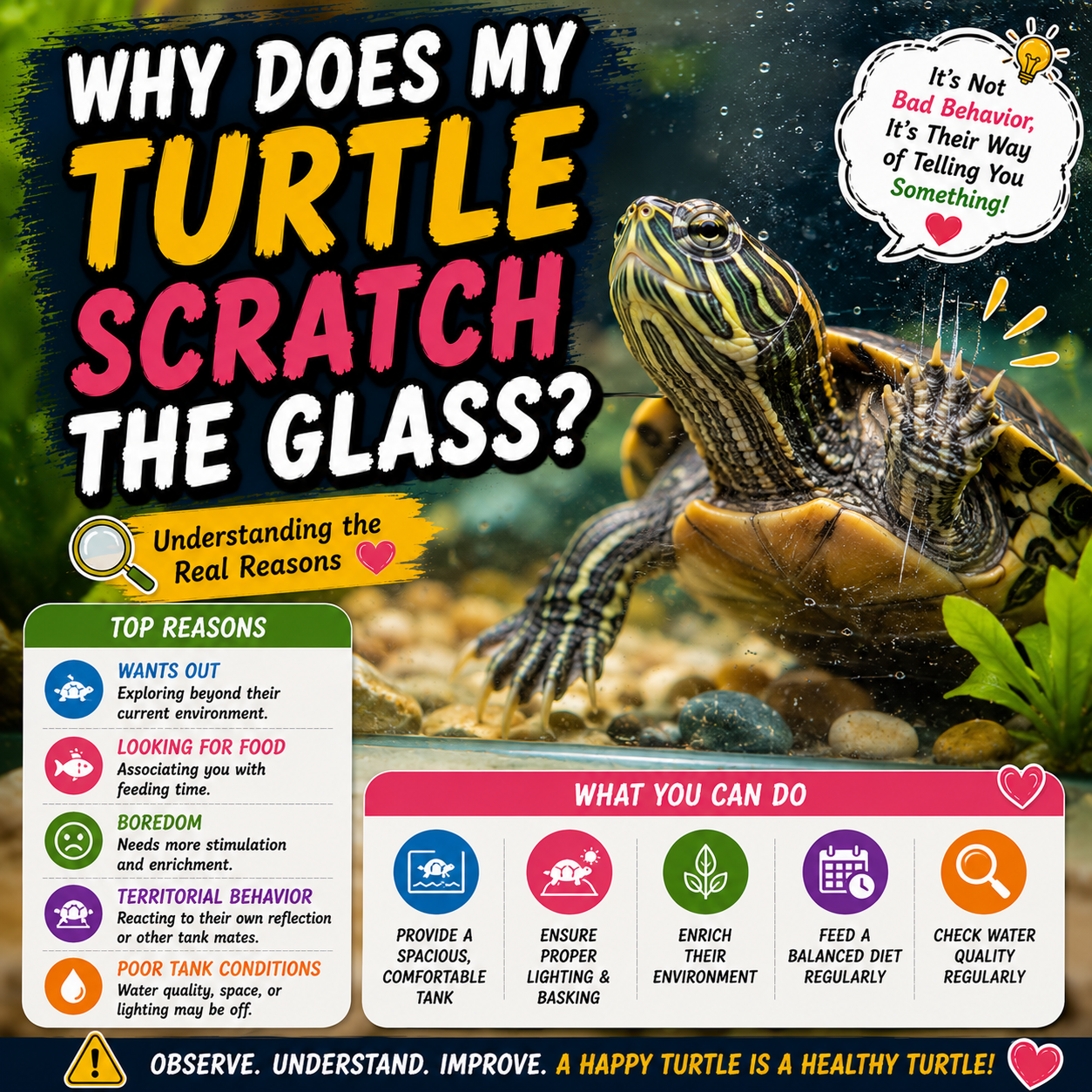
If you’ve spent any time relaxing near your aquatic turtle setup, you have likely witnessed a bizarre, repetitive behavior: your turtle swims directly into the glass wall, frantically scratching its front claws against the pane as if trying to run right through it.
In the reptile hobby, this frantic wall-scaling is commonly known as “glass dancing” or glass surfing. While it might look like a funny, energetic workout at first glance, the reality behind this habit is a major eye-opener. In most cases, a turtle that continuously scratches the glass is sending an urgent, visual distress signal.
So, why does your turtle keep scratching the glass? Let’s dive into the evolutionary biology of these prehistoric pets and uncover the 5 reasons behind this behavior, along with how you can fix it fast.
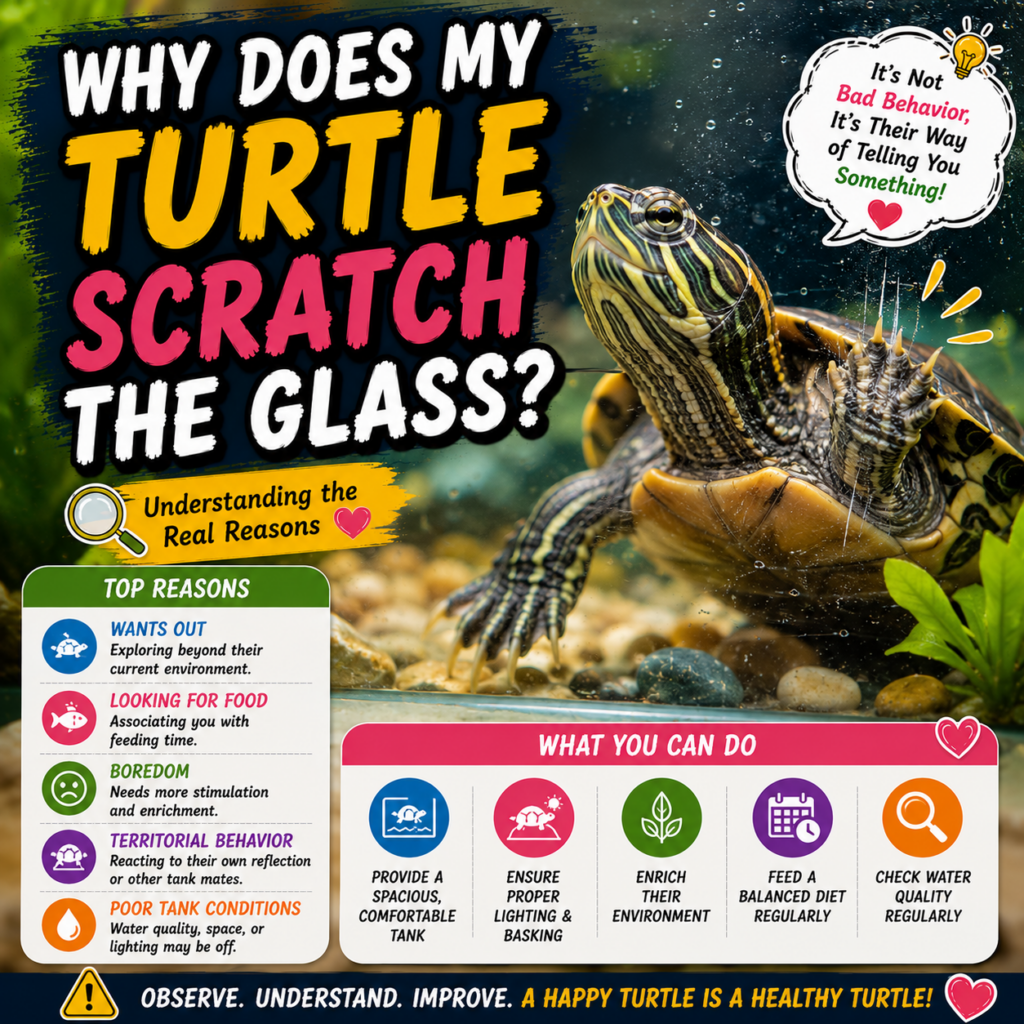
1. Confinement Anxiety (The Tank Is Too Small)
The absolute most common reason an aquatic turtle scratches the glass is simply that their enclosure is severely too small.
Turtles are active, migratory reptiles that swim miles across wild wetlands every single day. That cute, coin-sized hatchling you brought home from the pet store can easily balloon into a 10 to 12-inch adult within a few short years—especially female Red-Eared Sliders.
When a large, high-energy reptile is confined to a cramped tank, they develop severe cabin fever. Scratching the glass is a desperate, physical attempt to expand their boundaries and seek out more swimming room.
- The Industry Standard: Always enforce the 10-Gallon-Per-Inch Rule. For every single inch of your turtle’s shell length, they require a absolute minimum of 10 gallons of actual water volume.
- 8-inch Turtle –> Minimum 80-Gallon TanK
2. Inability to Understand the Concept of Glass
To understand a turtle’s frustration, you have to look through their evolutionary lens. Glass is a completely man-made invention that does not exist in nature.
A turtle’s brain operates on primitive, instinctual rules: “If I can see through it, I should be able to swim through it.”
When they look at clear aquarium glass, their brains do not register a physical wall; they see the room beyond it. They continuously push and scratch forward because they are genuinely confused as to why an invisible force-field is blocking their path forward.
3. Poor Water Chemistry or Intolerable Temperatures
If your aquarium size is perfectly scaled but your turtle suddenly starts glass surfing frantically, check your water parameters immediately. Turtles produce an exceptional amount of organic waste, and if your biological filter is overwhelmed, invisible toxins will spike rapidly.
High levels of toxic ammonia or nitrites act like chemical acid on a turtle’s sensitive skin and eyes. Similarly, if your water heater breaks and causes the water temperature to skyrocket past 82°F (28°C), your turtle will panic. They will scratch the glass frantically to escape what they biologically perceive to be a stagnant, toxic, evaporating wild pool.
- The Fix: Use a liquid test kit to verify that Ammonia and Nitrites are a strict 0 ppm, and calibrate your water temperature to a safe 75°F–78°F (24°C–26°C).
4. The Request for Food (Classical Conditioning)
Turtles are highly opportunistic foragers with massive appetites, and they are incredibly smart routine mappers.
If your turtle only starts scratching the glass and waving its claws when you walk into the room, congratulations—you have been successfully trained! Your turtle has experienced classical conditioning:
Your Silhouette Approaching –> Glass Scratching Storm –> Delicious Food Pellets
They are scratching the glass to grab your attention, begging for food, and associating your physical shape with their daily culinary rewards.
5. Lack of a Safe Basking Area or Gravid Behavior
If a turtle cannot find a way to express its core biological instincts, it will pace the perimeter in distress.
- Missing Heat Matrix: Turtles are cold-blooded ectotherms. They require a completely sturdy, dry basking dock equipped with a heat bulb and an unblocked UVB bulb hitting 85°F–90°F (29°C–32°C). If their dock is unstable, slippery, or too cold, they cannot dry their shells out to regulate their metabolism, leading to frantic glass scratching.
- The Gravid Factor (Female Turtles): If you own an adult female turtle and she is scratch-swimming aggressively, refusing to eat, and frantically trying to climb out of the tank corners, she might be gravid (carrying infertile eggs). She is searching desperately for a dry, sandy land plot to dig a nest and deposit her clutch.
The Glass Scratching Diagnostic: Fast Troubleshooting
| Observed Behavior | Potential Root Cause | The Immediate Fix |
| Scratches only when you approach. | Begging for Food / Treats | Maintain a strict feeding schedule; do not reward screaming/scratching instantly. |
| Scratches all day and night continuously. | Tank is Severely Too Small | Upgrade to a large aquarium or a massive indoor stock tank. |
| Frantic scratching + gasping / red eyes. | Ammonia Spike / Water Toxins | Perform an immediate 30% water change and upgrade your filter. |
| Female turtle scratching + refusing food. | Gravid (Carrying Eggs) | Provide a temporary nesting box filled with warm, loose topsoil/sand. |
How to Stop Glass Surfing and Calm Your Turtle
You cannot train a turtle to stop swimming forward, but you can alter their environment to lower their stress instantly:
- Add Visual Barriers: If your turtle is struggling with the transparency of the glass, apply a beautiful aquarium background sticker to three sides of the tank. You can also place large potted plants or opaque borders along the bottom edge of the glass to break up their line of sight.
- Upgrade to a Heavy-Duty Canister Filter: Ensure your external filter is rated for two to three times the actual volume of your aquarium to process heavy turtle waste loads and eliminate chemical stress.
- Introduce Cognitive Enrichment: Break up their boredom! Drop live, safe floating plants (like Anacharis or Duckweed) directly into the tank for them to hunt down, add large river stones to navigate around, or introduce a smooth piece of driftwood to break up the flat, repetitive tank floor.
Conclusion: Trade Boundaries for Space
At the end of the day, a turtle that keeps scratching the glass isn’t playing an underwater game—it is reacting to an environmental limitation. By expanding their water volume, securing their water chemistry through robust filtration, backing the aquarium with solid visual borders, and ensuring their basking area is perfectly heated, you will transform their stressful cage into a peaceful aquatic sanctuary.
Give your shelled pet the swimming space they biologically deserve, protect their water quality, and enjoy the breathtaking sight of a calm, healthy turtle thriving in its environment!